My mother saw me first.
Her smile disappeared.
“Mara, what are you doing here?”
“I came to bring Elliot his gift.”
My father moved toward me.
“This isn’t the time for a scene.”
“I agree.”
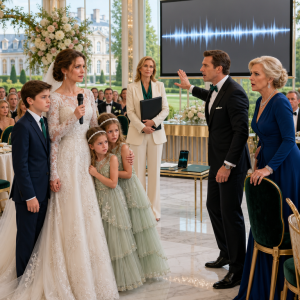
Behind me, four staff members from my company entered the garden carrying cream-colored envelopes. At my instruction, they handed one to every adult guest.
Camille looked around as people began opening them.
Each envelope contained a copy of the trust certificate identifying me as the controlling beneficiary, a notice suspending my parents’ distributions pending financial review, and a summary prepared by Marjorie documenting the unauthorized transfers associated with Reid’s companies.
The final page stated that formal civil filings had been submitted that morning.
The garden gradually became quiet.
Reid crossed the lawn toward me, his face rigid.
“What have you done?”
“I stopped paying for a life you were building behind my back.”
He lowered his voice.
“Those documents are private.”
“So were my signatures.”
Camille handed the baby to my mother and stepped forward.
“You’re humiliating us in front of everyone.”
“No, Camille. I’m correcting the story you planned to tell them.”
She glanced at the estate behind her.
“Mom and Dad own this house.”
Marjorie, who had been standing near the garden entrance, approached with the trust attorney.
“They do not,” she said. “Their right to occupy the property is currently under review.”
My father’s face lost its color.
“Mara, your grandmother would never have wanted this family divided.”
I looked at him for a long moment, remembering how he had stood beside the hospital door and refused to meet my eyes.
“Grandmother divided kindness from surrender. You were the ones who forgot the difference.”
Reid attempted to recover the confident tone that had carried him through years of excuses.
“You won’t maintain that company without me.”
Peter almost laughed.
Reid had never known that my business had been profitable long before he began introducing himself as its strategic adviser. He attended dinners, repeated ideas he heard from my employees and acted as though standing beside my work made it partly his.
“The company accounts are protected,” I told him. “Your access ended twelve days ago.”
For the first time, he seemed to understand that the future he and Camille had celebrated in my living room no longer existed.
I walked past them and placed the wooden star beside the baby’s white bassinet.
“This belongs to Elliot,” I said. “Nothing in these envelopes is his burden.”
Then I left the garden without raising my voice.
Behind me, the musicians had stopped playing, the guests were reading every page, and the people who had mistaken silence for weakness were finally learning how different those things could be.
The House I Chose to Keep

The months that followed were not easy, although they were far quieter than the sixteen days that changed my life.
The document examiner confirmed that several signatures had not been mine. The lenders reversed transactions that had not yet been completed, while state financial investigators reviewed the rest. Reid’s companies collapsed once they could no longer rely on my income or property as security.
Our marriage ended through attorneys rather than arguments.
My parents moved from the Caldwell estate into a smaller home after reaching an agreement to repay funds they had taken from the trust. Camille remained with them for a while, though her relationship with Reid did not survive the loss of the house, the company access or the comfortable future he had promised her.
That truth brought me no pleasure.
It simply confirmed that their partnership had been built around what they believed they could take from me.
I kept the house on Ashbourne Road, but I changed nearly every room. I removed the furniture Camille had selected, repainted the living room and turned Reid’s old office into a library filled with my grandmother’s ledgers, photographs and woodworking tools.
The antique cabinet remained in its corner.
Inside it, I kept both bracelets and Eleanor’s letter.
One morning the following spring, I woke before sunrise and walked through the quiet house with a cup of coffee in my hands. The first light entered through the eastern windows, touching the restored floors and the carved wooden staircase my grandmother and I had repaired together many years earlier.
For most of my life, I had believed strength meant carrying whatever the people I loved placed upon me.
My grandmother had understood something I had needed much longer to learn.
Real strength was knowing when to set the burden down.
I opened the cabinet, placed the Morning Star bracelet around my wrist and returned the Evening Star to its velvet box.
Then I closed the doors and turned the small brass key.
The house was still mine.
More importantly, so was the life inside it.