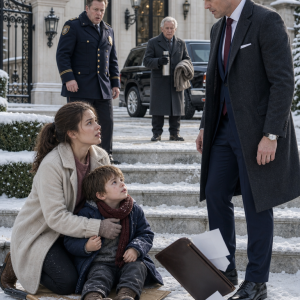
“I didn’t sign any of these.”
His expression tightened.
“Then we have a serious problem.”
He removed a small velvet box from the document case and placed it on my desk.
Inside was another gold bracelet.
It was almost identical to mine.
“Your grandmother’s estate attorney gave this to me three years ago,” Peter explained. “I was instructed to hold it until you discovered the hidden engraving in the first bracelet.”
My fingers felt cold as I opened the inner panel.
Evening Star.
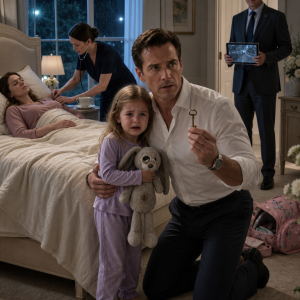
Beneath the velvet lining of the box lay a brass key no longer than my smallest finger.
“What does it open?” I asked.
Peter shook his head.
“The attorney said you would recognize it when the time came.”
My phone lit up on the desk.
Camille had sent me a photograph.
She was standing in my living room with Reid, the newborn resting in his arms while delivery workers carried a cream-colored sofa through the front door. My mother was visible near the fireplace, arranging flowers as though she were preparing the room for its rightful owners.
Beneath the image, Camille had written:
Thank you for taking care of our future until we were ready for it.
I enlarged the photograph.
In the far corner stood an antique walnut cabinet that had belonged to my grandmother. It was the only object she had ever forbidden me to alter, move or open by force. Two small brass circles were embedded in the carved stars on its doors.
I looked at the bracelets, then at the key.
For the first time since entering the hospital, I smiled.
Sixteen days no longer seemed like very little time.
It seemed generous.
What Eleanor Had Protected

Peter contacted a financial attorney before we left the office, and by the following morning I was sitting across from Marjorie Sloan, a former banking investigator who spoke in calm, precise sentences and never promised more than the law could provide.
She examined the documents for almost three hours.
“Do not confront your husband yet,” she advised. “Do not reveal what Peter found, and do not sign anything your family places in front of you. We’ll notify the lenders, secure the business accounts and request an immediate restriction on further transfers.”
That afternoon, while Reid believed I was staying at a hotel to recover from the family’s announcement, I returned to the house with Marjorie and a locksmith.
The antique cabinet stood exactly where it had appeared in Camille’s photograph.
I pressed the Morning Star bracelet into the brass circle on the left door and the Evening Star bracelet into the one on the right. Both fit as though they had been designed as parts of the lock.
The tiny key turned between them.
Inside the cabinet were six leather ledgers, a sealed letter, original trust documents and decades of property records organized in my grandmother’s careful handwriting.
The house on Ashbourne Road had never belonged to Reid and me jointly, despite what he had repeatedly claimed. It had been placed in the Eleanor Caldwell Heritage Trust before our marriage, with me as the sole beneficiary and my grandmother’s attorney as temporary trustee.
More importantly, my parents did not own the family estate where Camille planned to hold her son’s naming celebration and announce her engagement to my still-married husband. They had been permitted to live there and receive income from two rental properties, but the trust retained ownership.
Control of that trust was scheduled to pass to me once I opened the cabinet with both bracelets.
My grandmother’s letter explained why.
“Generosity is a virtue only when it is freely given,” she had written. “The moment others begin treating your kindness as an obligation, it becomes a chain. I protected these properties because I feared your family might one day confuse your patience with permission.”
She had also preserved records showing that my parents had repeatedly borrowed against future trust distributions without authorization. Reid had discovered those financial weaknesses and used them to gain their cooperation.
He had promised to hide their unauthorized loans if they supported his plan to remove me from the company, obtain control of my income and move Camille into my home.
The betrayal in the hospital had not been an impulsive family scandal.
It had been part of a financial arrangement.
During the next sixteen days, Marjorie and Peter worked with the lenders, a document examiner and the trust attorney. The questionable transfers were frozen. My company accounts were separated from every account Reid could reach. The locks at the house were changed legally under the trust’s authority, and Camille’s furniture was placed in secure storage with written instructions explaining how she could retrieve it.
Reid called me repeatedly.
At first, he sounded patient.
“Mara, we should sit down and discuss the transition like adults.”
Later, his patience thinned.
“You can’t pretend this marriage still exists.”
I answered only once.
“You’re right. I’m no longer pretending.”
He did not understand what I meant.
My parents sent messages about forgiveness, dignity and protecting the baby from unnecessary conflict. None of them mentioned protecting me.
I prepared one gift for the child: a small hand-carved wooden star made in my workshop, along with a savings bond that only he would be able to access as an adult. Whatever his parents had done, he had entered the world innocent.
The adults would receive something different.
The Celebration Beneath the Elm Trees

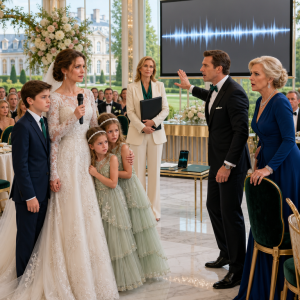
Camille’s event took place on a warm Sunday afternoon beneath the old elm trees at the Caldwell estate. White tables covered the lawn, musicians played near the fountain, and nearly a hundred guests gathered to celebrate Elliot’s naming ceremony and what Camille described on the invitations as the beginning of her new family.
She wore an ivory dress with pearl buttons. Reid stood beside her in a navy suit, carrying the baby as though he had already stepped into the life they had taken from me.