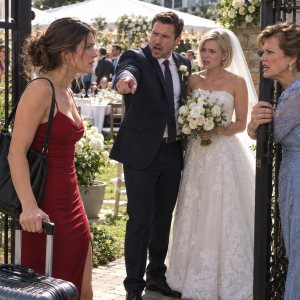
Patricia looked from him to me.
“Mrs. Whitaker,” Mills said, turning to her, “we’d like to ask about what you put inside your daughter-in-law’s suitcase last night.”
For a moment, no one spoke.
Andrew’s mouth opened, then closed. Patricia’s smile disappeared as if someone had simply turned off a light.
“I don’t know what you’re talking about.”
Mills opened the folder and showed her a still image from the bedroom recording. In it, Patricia stood beside my suitcase with the firearm in her hand, looking down at the open compartment.
Her eyes stayed on the photograph for a long second. Then she turned toward me.
“You recorded me?”
I had been quiet for years because quiet felt safer. That morning, I understood that silence had become a place they expected me to stay.
“You came into my bedroom after midnight and put a firearm in my suitcase. What did you expect?”
Her face tightened, and she moved forward as though she meant to grab the folder. An officer stepped between us.
“That camera was an invasion of privacy!”
“It was in my own bedroom,” I said. “And it recorded you entering without my permission.”
Andrew reached for my wrist.
“Lydia, we can settle this privately.”
I pulled away.
“That’s what you said about the missing money.”
For the first time that morning, the color drained from his face. Detective Mills told him to step back and keep his hands to himself. He did, but only after looking from the detective to his mother, trying to find a way to make the two of them tell the same story.
Mills explained that both Andrew and Patricia would be taken in for questioning about the firearm and the false report. Patricia began to cry, though she seemed more upset by the crowd gathering nearby than by what she had done.
Andrew changed direction at once.
“Lydia, listen. My mother came up with this. I told her it was a terrible idea.”
Patricia turned toward him.
“You told me she needed to be stopped before Seattle!”
“You said the plan would scare her into signing!” Andrew snapped.
People nearby had started to notice. A family with two suitcases paused near the check-in counter. A man in a business jacket lowered his phone. Patricia’s polished composure was gone.
“You promised she’d sign over her shares once she was desperate!” she said.
Andrew’s jaw tightened.
“Lower your voice.”
“You said she’d lose everything before anyone believed her!”
Detective Mills ordered them both to stop talking. The officers explained their rights, and the two of them were escorted away from the check-in area. They had spent years speaking as if consequences belonged to other people. Now they were walking through the terminal with officers on either side of them, while strangers watched quietly.
Patricia looked back at me.
“Lydia, please. We’re family.”
I took one step toward her, though I kept enough distance between us.
“Family doesn’t plant evidence or arrange a false report.”
She kept crying, but I felt no urge to comfort her. I did not feel triumphant, either. Mostly, I felt relief that I no longer had to pretend I hadn’t seen what I had seen.
The airport officers completed their questions and confirmed that I was free to continue my trip. Detective Mills stayed with me until everything was clear. My hands were still cold, and my coffee had gone untouched, but I boarded my flight on time.
As the plane rose above the clouds, I looked down at the city and thought about how many people spend years trying to keep a family together by making themselves smaller. I had done that, too. I had believed that if I stayed patient enough, polite enough, and reasonable enough, the people around me would eventually become reasonable in return.
They hadn’t.
The flight did not make the next part easy, but it gave me a few hours to sit with the truth without anyone trying to talk me out of it.
A Different Kind of Home
Three days later, Northstar Lodging held an emergency board meeting. I arrived with my attorney and a carefully organized set of records. I wasn’t interested in making a scene or delivering a speech about betrayal. I wanted the directors to understand what had happened, which payments were unsupported, and why the company needed independent oversight.
The board reviewed the findings and voted to remove Andrew as chief executive. My majority shares allowed me to cast the deciding vote. The directors authorized a civil recovery effort and agreed to cooperate with the financial investigators who were examining the company’s records.
For years, Andrew had spoken as though Northstar belonged to him because he occupied the largest office. He had forgotten that my father had built the company, and that the shares he wanted me to give away were mine to protect.
The legal process moved slowly. It did not resemble the neat ending people expect from a story. There were hearings, requests for records, long meetings with attorneys, and more paperwork than I thought one person could read in a lifetime. Financial accounts connected to the disputed payments were restricted while the court reviewed the evidence. Some money was recovered through settlements and court orders. Other amounts took longer to trace.
Andrew and I began divorce proceedings. The house he had treated as his private kingdom was eventually sold, and the proceeds were divided according to the settlement. Patricia later pleaded guilty to offenses connected to the firearm plot and received a custodial sentence. Andrew admitted his role in the financial misconduct and the airport scheme, and he received a prison sentence after the court considered the evidence.
I did not visit either of them.
That decision was not an act of punishment. It was a boundary, and I had spent enough years letting other people decide where mine should be.
I returned to Northstar and began repairing what I could. Employees who had been pushed aside for asking sensible questions were invited back into important conversations. We hired an outside accounting firm, added a second level of approval for large transfers, and made sure the board received regular, direct reports about the company’s finances.
The work was slow, but it was honest. I found that I preferred an honest problem to a polished explanation.
Almost a year after the night Patricia entered my room, I boarded another flight to Seattle. This time, my carry-on held only clothes, a book, and a folder of ordinary business papers. I placed it in the overhead compartment, settled into the window seat, and watched the morning light spread across the runway.
My phone buzzed with a message from my attorney. Another portion of the company’s money had been recovered.
I read the note, smiled, and turned off my phone.
For seven years, Andrew and Patricia had believed that fear would keep me under their control. They had overlooked the woman quietly gathering records while they congratulated themselves on being clever.
As the plane climbed into the morning sky, I felt something loosen inside me. Not every part of my life was settled, and I knew the road ahead would still ask more of me than I wanted to give. But the future no longer belonged to the people who had tried to frighten me into surrendering it.
They had expected to watch my life unravel at the airport.
Instead, I was traveling toward a life I could finally call my own.