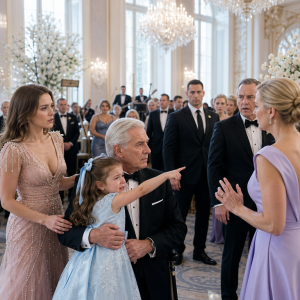
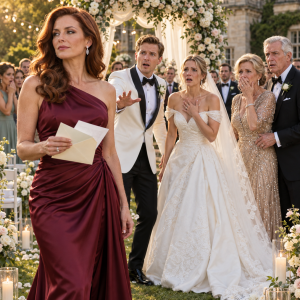
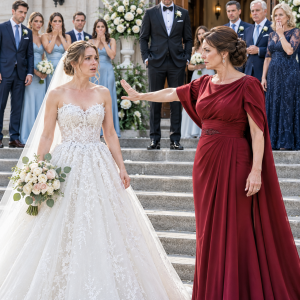
“You left me upstairs because my sleeves were worn.”
His eyes darted toward the watching directors. “That was a private disagreement. Paige came because she understands the firm.”
Paige released his arm. “Don’t put this on me.”
My father raised one hand, not in anger but to end the performance. “This family matter is Nora’s to handle. The company matter belongs to our board.”
At that, Lydia approached and gave Bennett a sealed envelope. He looked at it but did not open it.
“What is this?”
“Formal notice that Ashford & Rowe has withdrawn from investment discussions with Shaw Civic Design,” Lydia said. “Our review identified material inconsistencies in the records your office provided. Two affiliated companies are also suspending new assignments while an independent audit is completed.”
Bennett’s confidence finally gave way. “You can’t do this because of a marital argument.”
“We are not,” Lydia replied. “The supporting findings are listed on pages four through eleven. Your marital conduct did not create the accounting discrepancies.”
His phone began to vibrate. His chief financial officer called, followed by his bank. Because the anticipated investment appeared in a refinancing plan, its withdrawal would trigger questions Bennett had postponed. By morning, lenders and partners would know his empire rested on borrowed confidence.
“Nora,” he said, turning to me, “tell them this is a misunderstanding.”
“Is it?”
“We can go home and talk. I’ll explain everything.”
I opened Lydia’s second folder and handed him the separation notice.
“There is no ‘we’ going home.”
He scanned the first page, then looked up sharply. “You planned this?”
“I prepared for it last year. Tonight you gave me the courage to finish.”
Paige stared at him. “You told me the house was yours.”
“It is.”
Lydia corrected him calmly. “The property belongs to Mrs. Shaw’s premarital trust. Your occupancy ends according to the terms in that notice and the court’s schedule.”
Paige slowly removed the large ring Bennett had given her and placed it on a nearby tray.
“You said you were weeks away from being independent of every investor.”
“Paige, don’t.”
“You lied to me too.”
“Please leave,” the foundation chair said. “This evening is meant to help children.”
Paige left without looking at me. When status was removed, her affection went with it.
Part Six: The Door That Stayed Open
Bennett stood holding two envelopes while his polished life separated at the seams. For a moment I saw the earnest architect I had once loved, and wondered when ambition had ceased to be his tool and become his master.
He reached for my hand. Martin moved forward, but I shook my head. I did not need anyone to stand between us now.
“Nora, please,” Bennett said. “I made mistakes, but four years have to mean something.”
“They do mean something. They taught me what happens when love requires one person to become smaller every day.”
“I can change.”
“Maybe you can. But changing is work you must do without using me as proof.”
His voice broke. “Are you really going to take everything?”
I looked back at the man who had measured human value by clothing, access, and applause.
“I am taking only what was always mine: my name, my home, and the right to leave. Whatever happens to your firm will come from the records you signed.”
I felt no triumph. Humiliation never heals humiliation; it only passes the injury along. What I felt was the quiet certainty that his opinion no longer defined my life.
Before taking my father’s arm, I asked Lydia to protect Bennett’s innocent employees wherever the law allowed. Bennett seemed surprised; he had expected punishment because punishment was how he understood power.
As the music resumed, I realized I was too tired for introductions. I had spent years performing calmness and wanted to go somewhere I could simply be.
“Can we go home?” I asked my father.
His eyes warmed. “Which home?”
The Wellesley house held my books but too many lonely evenings. Westport belonged to my childhood, yet I was no longer the woman who had left it.
“Yours, for tonight,” I said. “Tomorrow, I’ll start deciding what mine looks like.”
Outside, the rain had softened to mist. While Martin brought the car, my father placed his coat around my shoulders as he had when I was little.
“I owe you an apology,” he said. “When you left, I let pride dress itself up as respect. I should have reminded you that my warning and my love were different things.”
“I made it hard to reach me.”
“We can both do better now.”
On the drive south, I found seventeen messages from Bennett and switched off the phone. Nothing important required my answer before morning.
The porch light was burning at my father’s house. Returning was not retreating; I had not come because Bennett rejected me, but because I had stopped rejecting myself.
In my old room, duplicates of every birthday card sat on the nightstand. The newest carried the familiar line: The door is still open.
From the hallway, my father called, “Tea or something stronger?”
“Tea. And toast, if there’s any.”
“There is now.”
We sat at the kitchen table until gray light appeared, talking not about Bennett or money but about the years between us. Lawyers, audits, and difficult conversations waited ahead. Freedom did not erase consequences; it gave me strength to meet them as myself.
Before sunrise, the investment was formally withdrawn; by noon, Bennett’s partners had called an emergency meeting. Months later, his smaller firm continued under new leadership, and he sent an apology that asked for nothing. I accepted it but did not return. Forgiveness can release the past without reopening its door.
Evelyn moved into the Westport cottage for a season and later opened a small baking business with her sister. I returned to art conservation, rented a sunny apartment near the river, and began rebuilding my relationship with my father one ordinary Sunday dinner at a time.
I had Celia repair the slate-blue gown and wore it the following spring to a modest museum fundraiser. When a volunteer complimented it, I said it was old, dependable, and worth mending.
Only after I said the words did I understand that I was speaking about more than a dress.