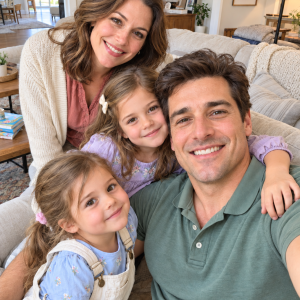
Both girls embraced him, and then Wren pulled me into the circle. Ethan’s hand brushed mine behind Ruby’s back. For an instant I felt the outline of the family we might once have been, but I refused to treat one tender moment as a promise. A future would have to be built with ordinary acts repeated long after the emotion of reunion had faded.
Months later, with my permission, Ethan told his parents. Vivian called several times before I answered. Her voice remained composed, but beneath it I heard something I had never heard at her table: uncertainty.
“I owe you an apology,” she said.
“You owe me more than words.”
“Yes.”
“The girls are not symbols of your family history. They are Ruby and Wren. If you ever measure their value—or mine—by money, connections, or the Hale name, you will not see them again.”
After a long pause, she answered, “That is fair.”
I did not forgive her that day; an apology did not purchase access. Eventually I allowed Vivian and Gregory to visit. Wren handed Vivian a toy lion and demanded a roar. The woman who had once controlled an entire dining room produced a whisper so weak that Ruby frowned.
“Louder.”
Vivian glanced helplessly at Ethan. He shrugged. “They have standards.”
Her second roar made both girls cheer. Later, Gregory sat on the floor building a block tower, far more human than he had seemed beneath the family portraits. Nothing erased the past, but the girls made everyone practice a better way of being present.
A Family Measured Differently

Ethan did not ask me to return to Boston or seek romance before trust existed. He rented a modest apartment in Portland, divided his work between coasts, and organized his schedule around the girls. He learned preschool pickup, appointments, bedtime songs, and the confusion created when one twin felt unwell and the other developed identical symptoms out of loyalty.
Trust returned quietly. Ethan arrived when promised, accepted no without punishment, and supported the girls without seeking influence. When his parents tested a boundary, he defended it before I had to. Gradually, I stopped expecting every promise to fail.
One rainy evening after the girls turned four, we sat on my narrow balcony with tea. Ethan looked older, with faint lines beside his eyes and two silver strands he blamed entirely on the twins.
“Do you still think about that dinner?” he asked.
“Sometimes.”
“So do I. For years I thought the worst part was telling you that you didn’t belong. But the worst part was making you understand that I valued their approval more than your dignity.”
“You did value it more that night.”
“I did.” He did not hide behind intention. “If I could return to that table, I would take your hand and leave before my father finished his threat. I cannot change that evening, so I am trying to make the right choice every time I am given one now.”
For years, I had mistaken forgiveness for declaring that a wound no longer mattered. Sitting beside him, I understood it differently. Forgiveness could acknowledge the full weight of what happened while refusing to let it govern every day that followed.
“I forgive you,” I said. “That does not erase anything, and it does not make us who we used to be.”
His eyes filled. “I know.”
“We are not those people anymore.”
“No,” he said. “I hope we’re better.”
I reached for his hand, and that was how our second life began—not with a dramatic promise, but with dinner, a walk, and eventually a first kiss beneath Portland rain. Another year passed before Ethan proposed after closing time at the arts center. Ruby and Wren were supposedly hiding behind a row of easels, although their whispers traveled through the entire room.
Ethan took my hands. “I spent much of my life believing my family name was something I had to protect. Then I lost you and learned that a name means very little if the people carrying it cannot respect themselves.” He lowered himself to one knee. “I don’t want you to belong to the Hale family. I want to belong to the family you built. Nora, will you marry me?”
Before I could answer, Ruby sprang from behind an easel. “Say yes, Mama!”
Wren appeared beside her. “He practiced a lot!”
I laughed through tears and looked at the man before me. His blue eyes were the same, but I no longer saw promises in them. I saw years of action.
“Yes,” I said.
When the girls were old enough to ask why Ethan had not been there at first, we told them the truth in language they could carry. He admitted choosing ambition over courage. I admitted that, while trying to keep them safe, I had kept their existence from him too long.
“So nobody was completely right?” Ruby asked.
“That’s true,” I said.
Wren leaned against Ethan. “But you know us now.”
He wrapped an arm around her. “I know you now, and I will keep showing up.”
That became our lasting truth. Love without courage is only a feeling, an apology without change is only words, and a family name is empty unless the people carrying it honor one another.
Sometimes I remember Vivian saying I did not belong at their table and realize she was right for reasons she never intended. I did not belong among people who believed worth could be inherited or approved by a board. My daughters cared whether Ethan remembered bedtime stories, whether Gregory built tall towers, whether Vivian could roar like a lion, and whether I was near when the dark felt too large.
One evening, years after that first dinner, I stood in our kitchen while Ruby and Wren argued over the last strawberry. Ethan slipped an arm around my waist and watched them present their competing cases with great seriousness.
“What?” I asked, catching his expression.
“I was thinking about how close I came to missing all of this.”
The girls raised their voices. I smiled. “You mean the strawberry trial?”
“All of it. You, them, the noise, even the arguments.”
He crouched between our daughters, listening as though no business meeting had ever mattered more. Their blue eyes, once a reminder of everything I had lost, now reminded me that people can become more than their weakest choice—but only if they face it without excuses and choose differently when no reward is guaranteed.
I had once believed I was not worthy of Ethan Hale’s family. In the end, that had never been the question. The question was whether he could become worthy of the life I had built without him. He answered it over years, not with money, influence, or another beautiful promise, but with presence, patience, humility, and love. And by the time I understood that, I also understood something I wished I had known while walking alone through Boston that cold November night: I had never been the one who was not good enough. Ethan had simply needed to become brave enough to deserve a place beside me.