“What do you want, Wesley?”
He lifted the box a little.
“I want us to get on the same page. I brought those almond pastries Sadie likes.”
He set the box on the coffee table and pulled a folded stack of money from his wallet.
“I’ll cover the ambulance bill. Take the rest for her winter clothes.”
There were several hundred-dollar bills in the stack. I looked at them, then back at him.
“Put it away.”
“It’s for Sadie.”
“You can pay your share of the medical bill through the proper channels.”
He sighed and walked into the kitchen before I could stop him. From beneath his coat, he brought out a glossy gift bag and called Sadie’s name.
She appeared in the hallway wearing flannel pajamas and thick socks. The instant she saw him, her shoulders rose toward her ears. She looked at me, and I nodded once.
Wesley slid the bag across the counter.
“I brought you a new tablet.”
Sadie lifted out a thin cardboard box. It held a cheap replacement device, not the one she had before. She held it against her chest.
“Thank you.”
Wesley patted her hair.
“You’re welcome, Chloe.”
Sadie went still. Chloe was the name of Dana’s niece. Wesley quickly glanced at his watch.
“Go set it up in your room.”
Sadie walked away without looking at him.
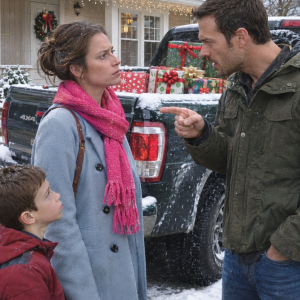
When she had gone, Wesley pulled a document from his coat and asked me to come outside. He flattened it on the hood of his SUV and pointed to a signature line.
“This is a standard waiver for the custody review next week,” he said. “If we sign it, we can keep the schedule exactly as it is. I’ll pay the hospital bill, and we can all move on.”
I read the first paragraph. The document asked me to waive future claims about the hospital visit and state that the current custody arrangement was in Sadie’s best interests.
“You want me to sign that the night she was outside in the rain was an isolated incident?”
“It was.”
“Why are you in such a hurry to cancel the review?”
He looked past me at the house.
“Because if you bring this up, there’ll be a file opened. Dana works in healthcare. That could cause problems for her.”
I folded my arms against the cold.
“I’m not signing anything.”
“You’re making a mistake.”
“Then we’ll let the mediator decide.”
His face changed. The careful apology was gone.
“Don’t be stupid, Elise.”
“Please leave.”
He drove away without taking the money or the bakery box. Inside, the cheap tablet sat on the kitchen counter. I did not throw it away; I put it in a cabinet with the other things that might matter later.
That afternoon, I sat beside Sadie on the living room rug while a cartoon played quietly on the television. She was winding a thread around her finger.
“Did I do something wrong?”
“No.”
“Dad says I’m making trouble.”
“You told the truth about what happened. It’s the adults’ job to figure out what comes next.”
She stared at the screen.
“Do I have to pack my bag for Friday?”
“No. You’re staying here this weekend.”
She looked up, checking my face as if she needed to be sure I meant it.
“I don’t have to go?”
“You don’t have to go.”
Her shoulders relaxed. She leaned into me and wrapped her arms around my neck.
“Can we make macaroni and cheese?”
“Absolutely.”
The Dispatch Records
On Tuesday afternoon, Marjorie and I sat at her conference table with a thick envelope from the county dispatch office between us. She had obtained the records through a court order. The pages listed dates, addresses, caller names, and incident codes.
“We’re looking for calls connected to Wesley’s address,” she said. “Start with the dates Sadie wrote down.”
I read through the first pages, checking each column. The print was dense, and the names blurred together after a while. Marjorie worked through a second stack beside me.
At first, I found nothing. Then, on a Sunday in October, I saw the street name and the house number. The caller was listed as Dana. The incident code described a medical concern involving a child, but the call had been canceled before an ambulance arrived.
I looked at the next page. Another dispatch entry from September listed the same address. This time the caller was Wesley. The note said a child had been outside and was now inside with an adult. A unit had been sent, then redirected before reaching the house.
The details did not prove every line on Sadie’s paper, but they showed that the address had appeared in the dispatch system before the night of the rainstorm. I continued down the page.
“Marjorie,” I said.
She turned toward me.
There was another call. Then another. Each one fell close to a date Sadie had written down. The descriptions were brief, limited by the records, but the repeated address was unmistakable.
Frank had not been mistaken when he asked how many times the ambulance service had been sent there.
Marjorie placed her glasses on the table.
“This is why he gave you his badge number.”
The next morning, she filed for an emergency hearing and requested the testimony of the paramedic, the school counselor, and the hospital staff. Wesley’s attorney argued that the dispatch entries were incomplete and did not establish what had happened inside the home. Marjorie agreed that the records did not tell the whole story. She said they did establish a pattern that deserved a closer look.
The judge ordered that Sadie remain with me while the court reviewed the evidence. Wesley’s visits would be supervised until a family specialist could speak with Sadie and make recommendations. It was not a final ruling, and Marjorie reminded me that the next steps would take time.
But Sadie would not have to return to that house while the adults sorted through the records.
When I told her, she sat quietly at the kitchen table, her hands wrapped around a mug of warm milk.
“Does the judge know about the paper in my backpack?”
“Yes. Marjorie showed it to the judge.”
“Does Dad know I wrote it?”
“He knows the court has seen it.”
She looked down at the mug.
“Will he be mad?”
I sat beside her.
“That’s for him to manage. You don’t have to take care of his feelings.”
She watched the steam rise and fade.
“Can I still go to school tomorrow?”
“Of course.”
For a while, the house returned to ordinary things: spelling words on the refrigerator, laundry folded on the couch, macaroni cooling in a bowl between us. Sadie still woke some nights and asked me to check that the front door was locked, so I did, then sat beside her until her breathing slowed. Healing did not arrive all at once, and I learned not to measure it by whether she had stopped pulling at her sleeves.
The folded notebook page stayed in Marjorie’s file, protected in a clear sleeve. I kept the photographs on my phone. The page was small and plain, written in a child’s careful hand, but it had carried Sadie’s memory from a wet backpack to a courtroom where adults finally had to listen.
Months later, after the court had heard from the paramedic and the school counselor, the custody arrangement changed. Sadie remained with me, and any contact with her father had to follow the court’s conditions and her counselor’s recommendations. It was not the sort of ending that erased what had happened. It was a beginning built around steadier mornings, warmer rooms, and the certainty that when Sadie told the truth, someone would believe her.
Sometimes she still asks whether she did the right thing by writing down those dates.
I tell her the same thing every time.
“You were brave to keep track of what happened, sweetheart. The responsibility was never yours to fix it.”
She has kept the blue backpack. The front pocket is dry now, the zipper still a little stiff from the rain. Inside, she carries library books, colored pencils, and whatever small treasures she finds on the walk home.
The paper is no longer in there. It did what she needed it to do.