It lasted perhaps one second.
Mom looked at him.
Dad looked at me.
That was enough.
“Who told you that?” Jake asked.
I didn’t answer.
“Were you there?”
Jake pushed himself away from the refrigerator.
“I went with him, okay? He asked me to come.”
“Did you know he was selling my Corolla?”
“Obviously I knew what car we were in.”
Mom whispered, “Jake.”
He threw up his hands.
“What? She already knows.”
I watched him.
“Did you see Dad sign my name?”
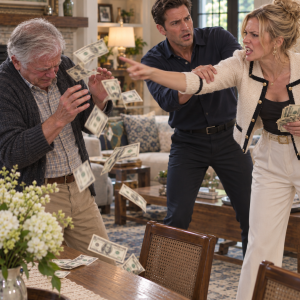
The kitchen went completely still.
Jake looked at Dad.
Dad’s face changed.
There it was.
Not an answer.
Something better.
Fear of the question.
“Don’t answer that,” Dad said.
Jake stared at him.
Melissa had come down the stairs behind us.
“Why can’t he answer?” she asked.
Dad turned sharply.
“Stay out of this.”
Jake rubbed both hands over his face.
“I didn’t think it was going to turn into all this.”
“That isn’t what I asked.”
“Haley, come on.”
“Did you see him sign my name?”
Jake looked toward the counter.
Then he said, “Yeah.”
Mom sat down.
Melissa covered her mouth.
My father stared at Jake with an expression I’d seen directed at me many times but never at him.
“You idiot.”
Jake’s head snapped up.
“What? You told me it was fine.”
Dad stepped toward him.
“Shut your mouth.”
The officer moved closer to the kitchen.
Nobody shouted after that.
They didn’t need to.
For years, Dad had told us that family came first.
Now I finally understood what he’d meant.
It didn’t mean we protected one another.
It meant his decisions came first, and the rest of us were expected to call obedience love.
Jake looked at me.
“So what happens to my tuition?”
The question was so perfectly Jake that under different circumstances I might have laughed.
“I don’t know.”
“The money’s already gone.”
“Then you’ll have to work it out with the people who decided to use my property.”
“I could lose my classes.”
For years, that sentence would have worked on me.
I would have pictured Jake falling behind, Dad disappointed, Mom crying, and somehow concluded that preventing all of it was my responsibility.
This time I picked up my box.
“Then talk to the financial-aid office.”
Dad’s face hardened.
“Selfish.”
Before I could answer, Melissa spoke from the stairs.
“Dad, the car was hers.”
Everyone looked at her.
She immediately shrank beneath the attention, but she didn’t take it back.
“It was hers,” she repeated.
Dad pointed toward the hallway.
“Go upstairs.”
Melissa did.
But the words stayed behind.
The car was hers.
It was such a small sentence.
It was also the first time someone inside my family had said the truth without attaching an obligation to it.
I left.
The legal process was slower and less dramatic than people imagine these things to be. Nobody was handcuffed in our kitchen. The Corolla did not magically reappear outside my apartment. The person who eventually bought it had done so believing the sale was legitimate, and nobody wanted to turn an innocent buyer into another victim.
What mattered was documentation.
Carson Auto cooperated after the signature was formally disputed. My hospital records established where I had been. Dad’s own messages established that he had arranged the sale and intended the money for Jake. Jake’s presence at the dealership supported what the paperwork already suggested.
Eventually, the dispute was resolved through an agreement that reimbursed the value I’d lost along with related expenses.
My parents had to bear the consequence.
Not me.
Jake didn’t lose his entire future. He got a part-time job, worked with the college on a payment arrangement, and took a slightly lighter course load the following semester.
When Melissa told me that, I waited for guilt.
Instead, I felt something I wasn’t accustomed to feeling when my family had a problem.
Nothing urgent.
Jake had a problem.
Jake was solving it.
The world continued.
I spent my first few weeks away from home sleeping in Amy’s spare room. Through an employee assistance program at the hospital, I also started therapy.
During my second session, the therapist asked what I wanted.
I spent ten minutes talking about my family.
She listened patiently.
Then she said, “Haley, I asked what you want.”
I stared at her.
I genuinely didn’t know.
That embarrassed me more than crying would have.
I’d spent so many years anticipating what other people needed that wanting something without first justifying it felt almost irresponsible.
Eventually I found a small one-bedroom apartment fifteen minutes from the hospital. The walls were beige, the kitchen was narrow, and the bedroom window faced a parking lot.
Amy gave me a coffee maker.
Tyler found a used kitchen table with two mismatched chairs.
My first night there, I slept on a mattress on the floor because the bed frame hadn’t arrived.
At six the next morning, I woke before my alarm.
For several seconds I lay still, waiting.
I expected Dad’s footsteps in the hallway. Mom calling my name. Jake asking whether I could send money. Some emergency already forming before I’d had coffee.
Nothing happened.
The refrigerator hummed in the kitchen.
A truck passed outside.
That was all.
I made coffee and sat on the floor beside the window.
I’d never felt so peaceful in such an empty room.
Mom continued texting.
At first the messages were accusations.
“Your father hasn’t been sleeping.”
“Jake is struggling.”
“Melissa doesn’t understand why you’re doing this.”
Later they became softer.
“We should talk.”
“We miss you.”
“We want our family back.”
I didn’t block her.
I also didn’t answer immediately anymore.
One afternoon Melissa texted me.
“Did Dad really sign your name?”
I looked at the message for a long time.
Part of me wanted to send her everything—the paperwork, screenshots, dates, dealership records—so she could never doubt me.
Then I remembered what it felt like to have someone tell me what I was required to believe because we were family.
So I sent only the truth.
“Yes. I didn’t authorize the sale, and I didn’t sign those documents.”
Three minutes later, she replied.
“Okay. Thanks for telling me.”
That was enough.
Several months later, I bought another car.
It wasn’t expensive. Another used sedan, reliable and plain, with fewer miles than the Corolla but no features worth bragging about.
When the salesman handed me the keys, I stood beside the driver’s door and held them for a moment.
I thought about myself at nineteen, studying after midnight because I had an exam the next morning.
I thought about myself at twenty-two, picking up overtime because I wanted enough money to buy a dependable car without asking anyone for help.
Then I remembered myself at twenty-four, standing beneath fluorescent hospital lights while a dealership manager told me there was a signature in my name on paperwork I’d never seen.
I drove home.
Before getting out, I opened the glove compartment.
Inside, I placed my old nursing badge from the year I bought the Corolla and a printed copy of Dad’s first message.
We sold your car.
For months, I’d thought those four words marked the moment my family took something from me.
Sitting alone in my own parking space, with my own apartment key beside the new car key in my palm, they meant something different.
I closed the glove compartment, carried my groceries upstairs, and didn’t call anyone to explain what I’d bought or how much I’d paid.
For the first time in my life, nobody needed to approve it.