The Pin on My Jacket
“What’s that pin? You get it in a cereal box?”
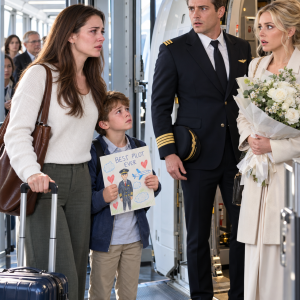
First Officer Mark Jensen pointed at the silver wings on my red jacket while warning lights flashed behind him.
I was seventy-six years old, standing in the forward galley of Global Flight 451, and the captain was unconscious behind the cockpit door.
Nobody laughed.
Mark seemed to notice that.
He lowered his hand.
“Ma’am, return to your seat.”
I looked past him into the cockpit.
The left engine display was fluctuating.
Hydraulic pressure was falling.
And underneath the alarms, I could hear something I hadn’t heard in more than thirty years.
A compressor surge.
“Your left engine is failing.”
His face tightened.
“I know what my airplane is doing.”
“Then shut down the left side before the failure reaches the hydraulic system.”
That was when Chloe, the senior flight attendant, stepped between us.
She was maybe thirty-five. Her hands were shaking, but her voice wasn’t.
“Mark.”
He looked at her.
“What?”
She nodded toward me.
“Let her try.”
Mark stared at her as if she’d lost her mind.
Then another alarm sounded.
He stepped aside.
I took off my red jacket, folded it over the jump seat, and entered the cockpit.
The silver pin remained attached to the lapel.
I hadn’t worn it in years.
I still don’t know why I’d put it on that morning.
Maybe because it had been sitting in my dresser too long.
Maybe because at seventy-six, you stop waiting for special occasions.
I sat in Captain Evans’s seat while Chloe helped move him back.
Mark stayed in the right seat.
“You touch nothing unless I tell you.”
I put on the headset.
“Fair enough.”
Then a voice came through.
“Global Four-Five-One, Falcon Two-One. We have visual contact.”
I looked through the windshield.
An F-35 was flying off our left wing.
Another appeared on the right.
Mark swallowed.
“Military escort.”
“I can see that.”
I keyed the radio.
“Falcon Two-One, Global Four-Five-One.”
Silence.
Then:
“Global Four-Five-One, identify speaker.”
I looked at the engine instruments.
The numbers told me we had minutes, not hours.
“Pauline Mercer.”
Another pause.
“Are you flight crew?”
“Not anymore.”
Mark turned toward me.
I continued.
“Former Air Force test pilot. T-38. YF-23 program.”
The radio went quiet.
I hadn’t said the next words aloud in thirty-two years.
“Call sign Widow Six.”
The silence lasted perhaps three seconds.
It felt much longer.
Then the F-35 pilot came back.
His voice had changed.
“Widow Six, Falcon Two-One. Copy.”
Mark stared at me.
“Widow Six?”
I pointed toward his panel.
“Fuel cutoff.”
He didn’t move.
“Mark.”
He reached for it.
“Cutting fuel.”
The left engine wound down.
The vibration eased.
Not completely.
Enough.
“Hydraulics?”
He checked.
“Still dropping.”
“Alternate pump.”
He engaged it.
The pressure stabilized just above the minimum.
Mark stared at the gauge.
Then at me.
He didn’t apologize.
I didn’t need him to.
We had 214 people behind us.
Calder Field
The next problem appeared six minutes later.
Our navigation display showed a new destination.
CALDER.
I leaned closer.
“Did you enter that?”
Mark shook his head.
“No.”
“Did Evans?”
“Not while I’ve been here.”
I checked the coordinates.
My hands stopped moving.
Calder Field had been a test facility in Nevada.
Officially, it had closed in 1994.
Unofficially, I’d spent eleven months there.
“Falcon Two-One, confirm destination.”
The answer came immediately.
“Global Four-Five-One, proceed Calder Field.”
I looked at Mark.
“Who gave that order?”
“Widow Six, maintain present heading.”
That wasn’t an answer.
“Who gave the order?”
Static cracked through the headset.
Then another voice appeared.
Older.
Rougher.
Not military radio procedure.
“Pauline, don’t go to Calder.”
I stopped breathing for a second.
Mark leaned forward.
“Who is that?”
I didn’t answer him.
The voice continued.
“Ask them what happened to Widow Seven.”
My fingers tightened around the yoke.
There had been only one Widow Seven.
Daniel Cross.
Daniel had flown with me during the last phase of a classified test program.
Thirty-two years earlier, I had been told his aircraft went down during a night test.
No wreckage was recovered.
No body either.
I attended his memorial anyway.
“Daniel?”
Static.
Then:
“Took you long enough, Six.”
I looked through the windshield at the F-35 beside us.
“You died.”
“That’s what they told you.”
“Where are you?”
“Not Calder.”
Mark touched my arm.
“Pauline, we’re losing pressure again.”
He was right.
The aircraft had made the decision for us.
We needed a runway.
Daniel gave me coordinates.
They led toward a narrow valley almost eighty miles from Calder.
Falcon Two-One ordered us to ignore him.
Daniel told me that if we followed the military escort, we might never leave Calder.
I had two contradictory voices, one damaged airliner, one unconscious captain and no way to know who was telling the truth.
So I did what test pilots are trained to do.
I stopped listening to people.
I looked at the evidence.
The coordinates Daniel transmitted matched an old emergency strip I remembered from the test program.
Calder’s coordinates didn’t.
They had been altered by several miles.
Someone had changed the navigation database.
I turned toward Mark.
“We’re taking Daniel’s runway.”
“You don’t know who he is.”
“I do.”
“You knew him thirty years ago.”
I looked at him.
“Thirty-two.”
Mark exhaled.
Then he nodded.
That was the first time he stopped treating me like a passenger.
We descended into the valley with one engine, limited hydraulics and a landing gear warning that appeared at 4,000 feet.
The nose gear wasn’t locking.
Mark tried the alternate extension.
Nothing.
“Again.”
He did.
Nothing.
I could see the runway now.
Short.
Narrow.
Surrounded by rock.