Evelyn stiffened.
Sloane continued.
“Because she told me Adelaide had been selfish, irresponsible, and determined to hold you back. She said the divorce saved your future.”
I looked at Evelyn.
That part did not surprise me.
Graham sat down heavily.
“Sloane, I swear I did not know.”
She nodded slowly.
“I believe you.”
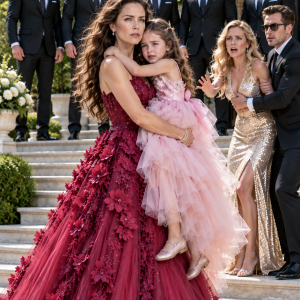
Then she looked through the window toward the lawn where nearly two hundred guests were waiting.
“But I can’t walk out there and pretend this morning never happened.”
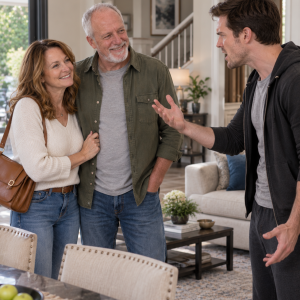
Graham stood.
“What are you saying?”
Sloane’s eyes filled with tears, but her voice remained steady.
“I’m saying you just learned you have three seven-year-old children. Whatever happens between us, you need to understand what that means before you make promises to anyone today.”
He did not argue.
And that told me she was right.
The Wedding That Never Began
The ceremony was postponed.
Then, quietly, it was canceled.
Guests were told there had been a serious family matter.
Most never knew the full story.
I took the children back to the hotel.
Graham asked if he could come later.
I agreed, but only after I had spoken to the children first.
That conversation was the hardest part of the day.
We sat together on one large hotel bed.
I held their hands.
“There’s something important I should have explained sooner.”
Wren studied my face.
“Is this about the man at the wedding?”
I nodded.
“His name is Graham. And he is your father.”
Callum blinked.
“Our dad?”
“Yes.”
Hayes asked the question that broke my heart.
“Did he not want us?”
I pulled him closer.
“He didn’t know about you.”
Then I explained what I could in words children could understand.
I did not blame Evelyn.
I did not defend Graham.
I simply told them the truth.
Someone had hidden important information, and because of that, their father had not known they existed.
The First Conversation Between a Father and Three Children
Graham arrived just after seven.
He had changed out of his tuxedo.
For the first time in years, he did not look polished or confident.
He looked nervous.
Callum opened the door.
The two stared at each other.
Then Callum said, “Mom says you’re our dad.”
Graham swallowed.
“Yeah. I guess I’m still trying to understand that too.”
Wren stepped closer.
“Did you really not know?”
He crouched so he was at eye level with them.
“I really didn’t.”
Hayes remained behind me.
Graham noticed but did not pressure him.
Instead, he said, “I know being related to you doesn’t automatically make me someone you trust. I think I have to earn that.”
That was the first thing he said all day that gave me hope.
The children asked simple questions.
Where did he live?
What was his favorite pizza?
Did he like baseball?
Could he tell them why Callum had the same strange cowlick in his hair?
For nearly two hours, Graham answered everything.
When he finally left, Wren whispered to me,
“He looks sad.”
“He has a lot to think about.”
She nodded thoughtfully.
“So do we.”
She was right.
What Happened After the Wedding
Nothing became perfect overnight.
That is not how real families work.
Graham moved slowly.
At my request, we met with a family counselor before introducing any legal arrangements.
He began visiting Savannah twice a month.
Then every other weekend.
He attended school performances and soccer games.
He learned that Hayes hated bananas, Wren loved astronomy, and Callum could talk for twenty minutes without taking a breath.
Sometimes he made mistakes.
Sometimes I became angry.
Sometimes the children became frustrated because seven missing years could not be repaired with gifts or weekend trips.
But Graham kept showing up.
That mattered.
As for Evelyn, rebuilding anything with her took much longer.
She wrote letters to each child.
I kept them until I believed they were old enough to decide whether they wanted to read them.
She never asked me to excuse what she had done.
Perhaps she understood that some decisions cannot be undone simply because regret arrives later.
Sloane and Graham did not marry.
Six months afterward, I heard she had taken a position in Seattle.
I respected her more than she would probably ever know.
She had refused to build a marriage on top of a truth that had just shattered everything around it.
And Graham and I?
We did not fall back in love.
That was not the point of our story.
We became something more useful.
Parents.
Eventually, even friends.
The Invitation I Keep in a Drawer
I still have the wedding invitation.
It sits in the same box as my old letters.
Sometimes I think about how close I came to throwing it away.
If I had, Graham might still believe I had disappeared from his life without looking back.
My children might still believe their father had never cared enough to find them.
And Evelyn’s secret might have remained hidden forever.
Life does not always correct itself.
Sometimes truth appears quietly inside an envelope you almost never open.
Sometimes the person you thought had abandoned you was living inside a completely different version of the past.
And sometimes closure is not about returning to what once existed.
It is about finally understanding what happened, choosing what deserves another chance, and walking forward without carrying the weight of questions that no longer need to remain unanswered.
Sometimes the most painful misunderstandings are not created because two people refuse to care, but because someone else decides they have the right to control information that could have changed both of their lives.
No parent, friend, relative, or authority figure should make life-changing decisions on another adult’s behalf simply because they believe they know what future would be best for that person.
Silence can look exactly like rejection from the outside, which is why discovering the reason behind someone’s absence can completely change the meaning of years filled with disappointment.
Children deserve truth delivered with kindness, because protecting them does not mean inventing a perfect version of the past but giving them enough honesty to understand that adult mistakes were never their responsibility.
A biological connection may create a relationship on paper, but genuine parenthood is built slowly through consistency, patience, ordinary conversations, missed opportunities repaired where possible, and the decision to keep showing up.
Forgiveness does not require pretending that nothing happened, and sometimes the healthiest form of forgiveness is simply releasing bitterness while still maintaining clear boundaries around the person who caused the harm.
A relationship that ends does not automatically mean every part of it was meaningless, because even painful chapters can eventually lead to responsibilities, relationships, lessons, and unexpected forms of family that did not exist before.
There is courage in demanding the truth, but there is also courage in hearing an uncomfortable truth without immediately turning it into another battle, especially when children and their future are involved.
Some second chances are not meant to restore old romances or recreate former lives; they exist so people can finally become the parents, friends, or human beings they should have had the opportunity to become years earlier.
The invitation Adelaide nearly discarded ultimately reminded her that one unexpected choice can reopen a door to the past, not so we can live there again, but so we can finally understand it clearly enough to move forward in peace.