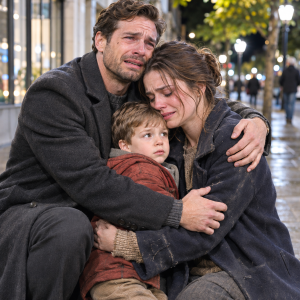
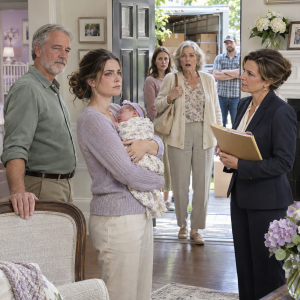
Patrick brought a folding chair into the empty living room, and Molly climbed into my lap. She showed me her knitted rabbit, Mr. Buttons, and said Patrick had told her I made wonderful pancakes. Luke smiled like the boy I remembered.
“Why didn’t you come sooner?” I asked him.
He looked at the floor. “I thought you would hate me.”
I held his face between my hands. “I spent eleven years praying you were still out there. There is nothing you could have done that would make me stop loving you.”
He wept then, and I held him while Molly leaned against my side, listening to the grown-ups speak in the gentle, uncertain way people do when they are trying to find a path back to one another.
Luke told me how, after his father’s sudden heart condition had taken him from us, he carried a guilt that did not belong to him. They had argued the night before, and Luke could not believe my reassurance that angry words had not caused what happened. He fell in with older boys, began drinking and using substances, and eventually left town at twenty, ashamed of how difficult it had become to keep his life steady.
Years later, he met Molly’s mother, Hannah. For a while, he held a job at an auto shop, stayed with a recovery program, and learned the bedtime stories by heart. Hannah passed away after a sudden illness two years ago, and his grief unsettled the progress he had made; he lost his job and struggled to keep the routines that made Molly feel secure.
Then Patrick found him.
The Photograph in the Pocket

Patrick sat across from me and unfolded the old jacket across his knees. He reached carefully into the inside pocket and brought out a small photograph, its corners worn soft from years of being carried.
I knew the picture at once: Luke at sixteen, standing beside the kitchen window with a grin that made the whole room brighter. On the back, in my handwriting, were the words, “Luke Bennett, age sixteen. My whole heart.”
“I thought this was gone,” I whispered.
Patrick nodded. “I found it the first night I wore the jacket.”
Six years earlier, I had given him that coat after a freezing shift at the QuickWay. Patrick had been shivering so badly that the cocoa cup rattled in his hands, and I had taken Luke’s old jacket from the closet because I could not bear to watch another child stand outside in the cold. It was too large for Patrick, but it was warm, and at the time that seemed reason enough.
He spotted Luke’s name, remembered my stories, and promised himself he would look for him once his own life was steady. After Walter fired me, Patrick kept the jacket and picture close. A youth counselor helped him finish school and train as an EMT; later, he became a firefighter.
“Every winter, I thought about you,” he said. “I remembered the cocoa you left out and the way you talked to me like I was worth waiting for.”
I smiled through tears. “You always hated coffee.”
He laughed softly. “Still do.”
Once his life was stable, Patrick searched old notices and asked people from Luke’s repair shop about him. A former coworker said Luke had a daughter and was struggling. Patrick found them across the state line, showed Luke the photograph and jacket, then helped with appointments and watched Molly during job interviews.
“He’s been steady for fourteen months,” Patrick told me. “He’s back at an auto shop, and Molly’s doing well in kindergarten.”
Luke lowered his eyes. “I wanted to come back when I could give you something good.”
I squeezed his hand. “You are something good, sweetheart. You always were.”
Patrick passed me an envelope. Inside was a cashier’s check for twenty-five thousand dollars, and my first instinct was to refuse it, even with my boxes on the lawn and no place to sleep.
“I can’t take this.”
“It isn’t charity,” he said. “It’s a way of honoring what you did for me.”
“You don’t owe me a thing.”
“I know,” Patrick said, taking my hand. “That’s why I want to give it.”
He had saved because he hoped to find me and wanted me to have a safe place to stay. I hugged him, and he held me with the same careful strength as on the porch.
“You told me I’d grow into that jacket,” he said.
I laughed through my tears. “I did.”
“I think I grew into something else, too—the kind of person you believed I could be.”
A Name Cleared, a Door Opened
When we carried the last box outside, Walter still waited beside the deputy. Patrick loaded the truck while Luke buckled Molly in, and I paused on the porch, remembering the ordinary evenings that had made the duplex home.
Walter glanced at his watch. “Let’s move it along, Sylvia.”
Patrick stepped toward him. “Do you remember the food Mrs. B supposedly gave away?”
Walter frowned. “What about it?”
Patrick unfolded a sheet of paper he had kept for years, listing every hot dog, cup of cocoa, and sandwich I had offered him. He had wanted to repay me someday.
“Forty-three hot dogs, thirty-one cups of cocoa, and a few sandwiches,” he said. “Even at full store price, that doesn’t come close to the work and stability she lost after you called her dishonest.”
Walter’s cheeks colored. “She broke the rules.”
“Maybe she did,” Patrick said evenly. “But she didn’t deserve to have an accusation follow her without proof.”
A dark sedan pulled in behind the truck, and a white American attorney named Rebecca Shaw stepped out. Patrick had asked her to review Walter’s statements to prospective employers, and she told him to preserve relevant records.
Rebecca turned toward me. “We can talk through your options in private. You don’t have to decide anything today.”
I thanked her, then looked at Walter. I had imagined telling him how much his accusation cost me, but with Luke beside me and Molly waiting, I no longer needed him to understand before I could leave it behind.
“The saddest part is that you thought feeding a hungry kid made me a bad person,” I said. “I never regretted it. If another child came into that station cold and hungry, I would do the same thing again.”
Walter looked away. I climbed into the truck, and Molly took my hand.
“Grandma, are you coming home with us?”
I looked at Luke. He was waiting with hope and worry mixed across his face.
“If you want to, Mom.”
I nodded. “More than anything.”
Patrick drove us through familiar streets to a small yellow house with a white porch.
“Whose house is this?” I asked.
Patrick shut off the engine. “It’s a place for you to stay, if you want it. I bought it last year, and you can live here without rent while we decide what feels right. An independent attorney can explain the options.”