He did not answer.
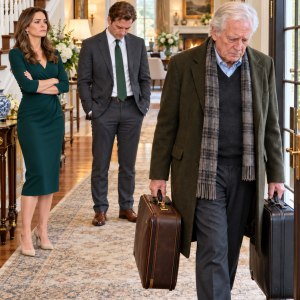
When I returned to the ballroom, Vanessa was already collecting her belongings, and by the time the final guests departed, she had left without speaking to him.
The Years That Changed Everything
The months that followed were difficult in ways that had nothing to do with the public attention surrounding our separation.
Nathaniel’s company entered a lengthy restructuring process, and subsequent investigations uncovered improper financial reporting and the misuse of company resources.
Eventually, he faced federal charges related to those activities, and after legal proceedings that attracted considerable local attention, he received a five-year sentence.
Vanessa resigned from her position shortly after the investigations became public, later publishing a memoir about her experience inside the company, although I never read it.
Our divorce was finalized separately, with the court applying the valid provisions of our agreement and dividing the remaining marital property according to state law.
I moved out of the house Nathaniel and I had shared and purchased a modest home near the coast, where the mornings were quiet enough that I could hear gulls from my kitchen window.
For the first time in years, I began living without constantly anticipating someone else’s disappointment.
I returned to preservation work, expanded the foundation’s scholarship programs, and spent more time with friends who had known me long before I became anyone’s wife.
Occasionally, people asked whether I felt satisfied by Nathaniel’s downfall, and I always struggled to answer because satisfaction was not the emotion I associated with those years.
I had loved him once, and although I no longer wished to share my life with him, watching someone lose everything he had valued was not a pleasant memory.
What I felt instead was relief that I no longer had to surrender pieces of myself to preserve a marriage that had stopped offering either kindness or respect.
Over time, even the anger faded.
A Familiar Face In The Library

Five years after the gala, I attended a fundraising reception at the newly restored Franklin Memorial Library, a beautiful old building in Cambridge whose reading rooms had been reopened through a grant from our foundation.
It was a cool November evening, and the library glowed with soft light as guests wandered between exhibitions of historic manuscripts and photographs documenting generations of neighborhood life.
I wore a simple emerald-green dress and spent much of the evening speaking with teachers, librarians, and scholarship recipients, whose enthusiasm reminded me why my family’s work had always mattered more than the wealth behind it.
Near the end of the reception, I stepped into a quieter hallway leading toward the administrative offices.
A maintenance employee was cleaning the marble floor near a tall window, moving his mop carefully around the legs of an antique wooden bench.
I might have walked past without noticing him if he had not paused when he heard my footsteps.
He looked up.
It was Nathaniel.
His hair had turned gray around the temples, and his face carried the weariness of someone who had lived through years he would rather forget, but I recognized him immediately.
For a moment, neither of us spoke.
Then he lowered his eyes and shifted the mop aside so I could pass.
“Eleanor,” he said quietly.
“Hello, Nathaniel.”
He looked toward the reception room, where laughter drifted faintly through the open doorway.
“I didn’t realize you’d be here tonight.”
“The foundation helped restore the building.”
He nodded slowly.
“I should have guessed.”
There was no bitterness in his voice, only a tired acceptance that made him seem older than the years that had passed.
After a moment, he looked at me again.
“I’m sorry for how I treated you. I know that doesn’t change anything.”
I studied his face, remembering how desperately I had once wanted to hear those words, and how strange it felt to receive them now that I no longer needed them.
“Thank you for saying that,” I replied.
He glanced down at his work.
“I have a steady job now. It’s not much, but it’s honest work, and I’m trying to do things differently.”
“I’m glad you’ve found a way forward.”
His eyes filled with an emotion he did not attempt to explain.
“You deserved better than the way I treated you.”
For a moment, I considered telling him how much those years had hurt, how many evenings I had spent questioning my own worth, and how long it had taken me to stop hearing his dismissive remarks whenever I entered a room full of accomplished people.
But I realized that none of those words were necessary anymore.
“I hope you’re doing well, Nathaniel,” I said gently. “And I hope you keep moving forward.”
He nodded, and I continued down the hallway.
When I reached the doorway, I glanced back once and saw him return to his work, carefully guiding the mop across the marble beneath the same tall windows that had stood there for more than a century.
There was nothing triumphant about the sight, and I felt no pleasure in the difference between our circumstances.
I simply saw a man trying to rebuild an ordinary life after making choices that had cost him dearly.
As I returned to the reception, a young scholarship recipient approached me with her mother, eager to explain that she had been accepted into a university program she had once considered beyond her reach.
The girl’s excitement was contagious, and as I listened to her describe her plans, I felt something settle quietly inside me.
For so many years, I had believed that the most important moment of my life would be the evening Nathaniel finally discovered who I really was.
But standing in that library, surrounded by people whose futures were opening in ways they had scarcely imagined, I understood that my identity had never depended on his recognition.
I had been Eleanor Whitmore before I met him, and I had remained Eleanor Whitmore through every year in which he treated me as though I were someone less.
My grandmother had been right all along.
Dignity was not something another person could give you, and it was not something they could take away simply by refusing to see it.
It lived in the choices you made when nobody was applauding, in the kindness you offered when resentment would have been easier, and in the courage to leave a place where you were no longer treated with respect.
That night, as I stepped outside beneath the clear autumn sky, I thought about the rain outside the Ashbourne Grand five years earlier, when I had stood alone while my husband celebrated the life he intended to build without me.
I had believed then that walking through those ballroom doors would be the moment I reclaimed my power.
Now I understood that the real turning point had come much earlier, when I finally decided that I would no longer make myself smaller to remain in someone else’s life.
And with that thought, I walked toward home, grateful not for everything I possessed, but for the quiet, ordinary freedom of knowing that I had never needed anyone’s permission to be myself.