The Christmas Invitation I Never Received
When my only son told me I was not welcome at his Christmas dinner, I was standing in the narrow kitchen of my rented apartment outside Charleston, South Carolina.
In one hand, I held a chipped blue coffee mug.
In the other, I held the silver key to a fourteen-million-dollar oceanfront estate on Kiawah Island.
The irony was almost enough to make me laugh.
Almost.
“Mom, please don’t come this year,” Grant said over the phone.
His voice carried the careful calm of someone who had practiced an unpleasant conversation several times before making the call.
I looked through the window at the gray parking lot below. A cold December rain had darkened the pavement, and an abandoned shopping cart leaned against the curb.
“What do you mean, don’t come?” I asked.
There was a pause.
“Vivienne’s parents are flying in from Connecticut,” he explained. “They’re expecting something private and elegant. Vivienne planned a formal dinner, and she thinks it would be easier if we kept the guest list small.”
I closed my fingers around the silver key.
For forty-one years, I had rearranged my life around Grant.
I had worked extra hours when he needed braces. I had sold my wedding jewelry to help cover his college tuition. Years later, when he and Vivienne wanted to buy a house in an expensive neighborhood, I quietly provided most of their down payment.
They believed the money had come from a small insurance policy.
They had never asked enough questions to learn the truth.
“Am I not part of the family?” I asked.
Grant sighed.
“Of course you are. But Vivienne’s family has certain traditions. The dinner will be very refined. Seven courses, formal seating, imported wine. She’s worried you might feel uncomfortable.”
Uncomfortable.
That was the polite word people used when they wanted to make you feel inferior without admitting it.
“Did Vivienne tell you to say this?”
Another pause gave me the answer.
“Mom, please don’t make it difficult. We just want everything to go smoothly.”
I imagined him standing in his bright designer kitchen, looking toward his wife for approval while speaking to the woman who had once stayed awake beside him through every childhood fever.
He expected tears.
He expected an argument.
Perhaps he even expected me to ask whether I could stop by briefly to give my grandson his presents.
Instead, I placed the silver key on the counter and answered quietly.
“All right, Grant. I hope you have the Christmas you planned.”
His relief was immediate.
“Thank you for understanding.”
“Merry Christmas, sweetheart.”
I ended the call before he could say anything else.
For several minutes, I stood alone in the kitchen.
The pain was real. Money could provide comfort, privacy, and freedom, but it could not protect a mother from the moment her own child decided she was an embarrassment.
Still, beneath the sadness, something stronger began to rise.
Grant and Vivienne believed they had removed an inconvenient older woman from their celebration.
They had no idea they had just given me permission to create a Christmas of my own.
The Truth Behind My Modest Life

My late husband, Russell Carroway, had never been a man who displayed his success.
He wore inexpensive watches, drove the same truck for twelve years, and preferred quiet dinners at home to public attention.
What most people never knew was that Russell had invested early in several technology companies and purchased coastal land before prices rose dramatically.
When he passed away fourteen years earlier, he left me far more than grief.
He left me a financial empire.
At first, I barely touched it. I was too heartbroken to make large decisions.
Later, I studied every account, property, and investment. I hired reliable advisers, learned how markets worked, sold weak assets, and expanded the strongest ones.
By the time Grant called to exclude me from Christmas, my net worth was close to seventy-six million dollars.
Yet I continued living simply.
Part of that decision came from habit. I did not need a large home or designer clothing to feel secure.
But another part came from curiosity.
I wanted to know how people would treat me if they believed I had nothing to offer them.
Unfortunately, my son and his wife had provided a very clear answer.
That afternoon, I drove to their house.
Their gated neighborhood was filled with stone homes, perfectly trimmed hedges, and Christmas decorations selected to match each property’s exterior paint.
Grant’s house looked especially impressive.
I knew every detail because I had helped pay for it.
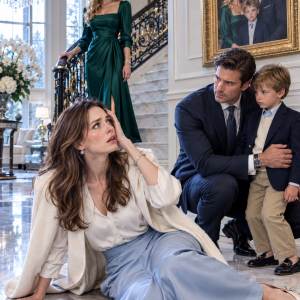
When Vivienne opened the door, she wore a cream cashmere dress and held a crystal glass of sparkling water.
Her polished smile disappeared for half a second when she saw me.
“Evelyn. We weren’t expecting you.”
“I gathered that,” I replied. “I came to see Theo and to understand why I have been removed from Christmas.”
She hesitated before stepping aside.
The entryway smelled of pine candles and expensive coffee. A tall Christmas tree stood in the living room, decorated entirely in white and silver. It was beautiful, but it felt more like a hotel display than a family tree.
Grant appeared from his office.
“Mom, you didn’t need to drive over.”
Before I could answer, seven-year-old Theo ran around the corner.
“Grandma!”
His face lit up as he rushed toward me.
My heart softened instantly.
But before he reached me, Vivienne placed a hand on his shoulder.
“Theo, you haven’t finished your piano practice.”
“But Grandma’s here.”
“You can see her another time. Go upstairs, please.”
Theo looked at me with confusion.
“It’s all right, darling,” I said gently. “We’ll have our own special day soon.”
He walked away slowly.
Vivienne led me into the living room and sat on an ivory sofa I had quietly paid to replace after their old one was damaged.
Grant remained near the fireplace.
“Evelyn, I hope you understand this is not meant to hurt you,” Vivienne began.
“Then explain how it is meant.”
She crossed her legs.
“My parents appreciate a certain atmosphere. They are accustomed to formal gatherings, fine dining, and thoughtful conversation. We simply felt you might not enjoy the evening.”
“What kind of conversation do you believe I am incapable of having?”
Her smile tightened.
“You prefer simple things. Grocery coupons, church events, neighborhood news. My parents discuss art foundations, international travel, and charitable boards. We didn’t want anyone to feel out of place.”
The insult was wrapped in such smooth language that she probably believed it sounded kind.
I turned to my son.
“Do you agree with her?”
Grant stared at the floor.
“Mom, we just want one perfect evening.”
There it was.
To him, perfection required my absence.
I stood and adjusted my coat.
“Thank you both for being honest. I hope your evening is exactly what you deserve.”
Grant followed me toward the door.
“Mom, don’t take it personally.”
I looked at him over my shoulder.
“You asked your mother not to attend Christmas. There is no way to take that except personally.”
Then I left.
A New Kind of Christmas
Back at my apartment, I opened the small safe hidden behind my winter coats.
Inside were property deeds, investment statements, legal documents, and the keys to several homes.
The Kiawah Island estate had been purchased only two weeks earlier.
It stood directly beside the Atlantic Ocean, with nine bedrooms, twelve bathrooms, a private stretch of beach, a heated pool, a library, and a dining room large enough to seat forty guests.
I had planned to move there quietly after the holidays.
Now I had a better idea.
I called my younger sister, Margo.
Grant and Vivienne had not invited her to a family holiday in four years because Vivienne considered her too outspoken.
“Evelyn?” Margo answered. “Is everything all right?”
“Do you own a formal dress?”
“I own something that looked formal in 2018. Why?”
“Because you are spending Christmas Eve at my new home on Kiawah Island.”
She laughed.
“Your new home? You live above a dentist’s office.”
“Not anymore. I’ll text you the address. Bring dessert if you like, but do not bring that dry fruitcake.”
There was a long silence.
“Evelyn, have you joined a mysterious coastal society?”
For the first time that day, I genuinely laughed.
“Just be there at six.”
Next, I called my cousin Roscoe, a retired auto mechanic whom Vivienne disliked because he spoke loudly and told long stories.
Then I invited former neighbors, distant relatives, widowed friends, Russell’s old business partner, and several people who had spent previous holidays alone.
Within two hours, thirty-eight guests had accepted.
Their enthusiasm revealed something painful.
Vivienne had not only pushed me aside. Over the years, she had slowly separated Grant from nearly everyone who did not fit the image she wanted to present.
I decided to bring them back together.
I hired a young event designer named Blair Winslow to decorate the estate.
When she asked what style I wanted, I gave her one instruction.
“Make it beautiful, but make it feel alive. I want children to laugh without anyone worrying about fingerprints.”
Blair filled the house with deep green garlands, warm gold lights, red velvet ribbons, fresh flowers, and a Christmas tree tall enough to reach the second-floor balcony.
I hired Chef Adrian Cole, who had recently left a celebrated Savannah restaurant.
Together, we created a menu that included roasted vegetables, butter-poached lobster, handmade pasta, herb-crusted beef, fresh bread, and a dessert table large enough to delight every child in the room.
I did not choose those things to compete with Vivienne.
I chose them because generosity should feel joyful, not intimidating.
The Woman They Had Never Seen
On Christmas Eve, a stylist helped arrange my silver hair into a soft, elegant shape.
I wore a deep ruby gown, a diamond necklace Russell had given me on our twentieth anniversary, and the antique watch he had worn on our wedding day.
When I looked into the mirror, I did not see a lonely widow from a small apartment.
I saw the woman I had become while everyone else was too distracted by appearances to notice.
Margo was the first guest to arrive.
When I opened the front door, her suitcase slipped from her hand.
She stared past me at the curved staircase, the crystal chandelier, and the ocean visible through the wall of windows.
“Evelyn, whose house is this?”
“Mine.”
“Did you secretly win the lottery?”
“No. I secretly paid attention to my investments.”
Her eyes filled with tears.
“Why didn’t you tell me?”
I took her hand.
“Because I wanted one place where no one loved me for the wrong reason.”
She hugged me so tightly I nearly lost my balance.
By seven o’clock, the estate was filled with voices, music, and movement.
Children ran through the hallways. Roscoe told stories beside the fireplace. Old friends embraced after years apart.
No one worried about using the wrong fork.
No one examined clothing labels.
No one was asked to speak more quietly.
At the center of it all, I felt something I had not felt in years.
I felt at home.
Blair arranged a group photograph on the terrace just after sunset. The sky glowed purple and gold above the ocean.
I stood in the middle of thirty-eight people who had accepted my invitation without knowing anything about my money.
Afterward, I posted three photographs online.
The first showed the illuminated estate.
The second showed our long dinner table filled with smiling guests.
The third showed me standing on the balcony in my ruby gown.
My caption was simple:
“Christmas with the people who made room for me before they knew how much room I owned. May we never shrink ourselves to fit inside someone else’s idea of worth.”
Then I placed my phone facedown and returned to dinner.
The Call That Changed the Evening
The first call came forty minutes later.
I ignored it.
Then came another.
And another.
Messages began appearing from Grant.
Mom, where are you?
Is that your house?
Why did you never tell us?
Vivienne’s parents are asking questions.
Please call me immediately.
I waited until dessert before stepping onto the terrace and answering his ninth call.
“Merry Christmas, Grant.”
“Mom, what is happening?” he demanded. “Everyone has seen those photographs. Vivienne’s friends are calling. Her parents are furious because they thought you were spending the evening alone.”
“You told them I was alone?”
He hesitated.
“Vivienne said it would be easier than explaining everything.”
I looked through the window at my guests laughing around the table.
“I am at my home with my family.”
“Your home? You bought that place?”
“Yes.”
“How?”
“That is a long conversation you never cared enough to have.”
His voice became sharper.
“You need to remove those photographs. People think we excluded you.”
“You did exclude me.”
“You’re embarrassing us.”
“No, Grant. Your own choices are embarrassing you. I simply stopped hiding the truth.”
Suddenly, Vivienne took the phone.
“Evelyn, I don’t know what kind of performance this is, but you are damaging our reputation.”
“Your reputation should be able to survive one honest photograph.”
“You made us look cruel.”
“I did not make you look like anything. I showed where I spent Christmas after you told me not to enter your home.”
Before she could respond, I heard a small voice in the background.
“Grandma?”
My anger disappeared.
“Theo? I’m here, sweetheart.”
“Did you leave because I didn’t finish piano practice?”
My chest tightened.
“No, darling. Never. None of this is your fault.”
“I miss you.”
“I miss you too. You are loved more than you can imagine, and I promise we will see each other soon.”
The call ended.
I stood alone beneath the balcony lights, listening to the waves.
I had exposed Grant and Vivienne’s behavior, but Theo had been caught in the middle.
That was the one thing I would not allow to continue.
The Morning After
At nine the next morning, Grant’s SUV stopped outside my gates.
I let them drive the full length of the palm-lined entrance before meeting them at the door.
Grant looked exhausted. Vivienne wore large sunglasses, but they could not hide her swollen eyes.
I led them into the library.
They remained standing while I sat behind Russell’s restored mahogany desk.
Grant looked around the room.
“Is all of this truly yours?”
“Yes.”
“How much do you have?”
It was the wrong first question, and he knew it as soon as he asked.
“Enough to understand that money does not improve character. It only reveals it.”
Vivienne lowered her glasses.
“Please explain.”
I folded my hands.
“Russell left me several investments and properties. I expanded them. My current assets are worth approximately seventy-six million dollars.”
Grant’s face went pale.
Vivienne sat down without being invited.
“Why did you live like that?” she whispered.
“Because a modest life never harmed me. It also allowed me to see how people treated someone they believed had no influence.”
I looked directly at her.
“You mocked my clothing, my apartment, my interests, and my relatives. You limited my time with Theo because you believed I lowered the image you wanted to create.”
Tears appeared in her eyes.
“I was insecure,” she said. “I thought if everything looked perfect, people would respect me.”
“Respect built on exclusion is not respect. It is fear dressed in expensive fabric.”
Then I turned to Grant.
“Your behavior hurt more because you knew better. You watched your wife dismiss me, and you remained silent because silence was convenient.”
He covered his face.
“I’m sorry, Mom.”
“You are sorry because you understand what I own. I need to know whether you will still be sorry after the surprise fades.”
He looked at me.
“What can I do?”
“You can begin by expecting nothing from me. No inheritance promises. No financial rescue. No access to my advisers. If you want a relationship with me, rebuild it through your actions.”
Vivienne nodded slowly.
“And Theo?”
“Theo will always be welcome here. Neither of you will use him to reward or punish me. He deserves a family that does not make affection conditional.”
For once, neither of them argued.
What We Built After the Truth
Repair did not happen quickly.
Vivienne began counseling and gradually admitted how much of her behavior had come from fear of being judged by her own parents.
Grant started visiting every Saturday.
Sometimes we talked on the terrace. Sometimes he helped Roscoe restore an old convertible in the estate garage.
He stopped speaking to me as if I were fragile or confused.
He began asking about Russell, about the investments, and about the years of my life he had never bothered to understand.
Theo spent weekends and school vacations with me.
We collected seashells, baked bread, read stories in the library, and used jars of buttons to teach him how saving and giving worked.
I wanted him to understand that wealth was not a private staircase built to place yourself above others.
It was a bridge.
The following year, I created the Open Table Foundation, an organization offering financial education, companionship programs, and legal support to older adults who had been isolated or underestimated by their families.
Margo joined the board.
Grant volunteered at community events.
Even Vivienne eventually helped organize a holiday dinner for families who had nowhere else to go.
I did not forget what happened.
Forgiveness did not require pretending the wound had never existed.
But I refused to let bitterness become the final chapter.
The next Christmas, our dinner table held forty-six people.
Grant sat beside me.
Vivienne carried dishes from the kitchen without worrying about whether the plates matched.
Theo placed a handmade paper star at the top of the tree.
Before dinner, he raised his glass of apple cider and smiled.
“This year, nobody gets left out.”
The room became quiet.
I looked at my family, at the people who had returned, and at the new people we had welcomed.
Then I lifted my glass.
“That is the only tradition worth keeping.”
A person’s modest clothing, quiet lifestyle, or simple home can never reveal the full measure of their wisdom, sacrifice, strength, or success, so never mistake humility for weakness or assume that someone’s value can be calculated by what they display.
When a family begins caring more about appearances than affection, even the most beautiful table can become cold, because true elegance is not found in expensive food or perfect decorations but in making every loved one feel welcome.
Silence may prevent an argument for one evening, but when you remain silent while someone you love is being treated unfairly, that silence can become a deeper betrayal than the unkind words themselves.
Money can provide comfort and freedom, but its greatest purpose is not to impress others; its greatest purpose is to protect dignity, create opportunities, and build places where people feel safe, respected, and included.
Growing older does not mean becoming smaller, quieter, or less deserving of attention, because every stage of life carries its own authority, experience, and right to occupy space without asking permission.
Forgiveness is not the same as forgetting, excusing, or immediately restoring trust, because healthy forgiveness can include firm boundaries, honest consequences, and the expectation that changed behavior must follow every apology.
Children should never be placed between adults during family conflict, because their hearts often accept blame for situations they did not create, and they deserve reassurance that love will never depend on adult disagreements.
People who truly care about you will make room for you before they know what you own, what you can offer, or how useful your presence may become, while those who value status will often reveal themselves when they believe you have nothing.
A painful rejection can sometimes become the doorway to a stronger life, because the moment you stop begging for a seat at someone else’s table may be the moment you finally begin building one large enough for everyone who deserves to be there.
The most powerful response to being underestimated is not always revenge; sometimes it is creating a life so honest, generous, and self-respecting that the people who dismissed you must confront the truth without you ever lowering yourself to their level.