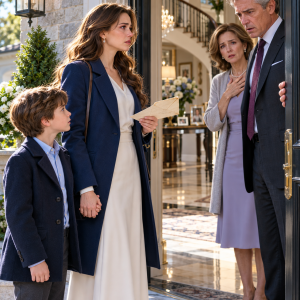
“She is my daughter!”
“Then tell me why your daughter hides under a table when a glass breaks.”
Laurel stared at me.
“You don’t understand her.”
“Then explain why she believed losing her home depended on stealing documents from me.”
Bryce raised both hands.
“This is being blown completely out of proportion.”
I picked up my phone and played part of the saved conversation.
Laurel’s own voice filled the room.
“We need the documents from the office drawer.”
Then Bryce’s voice followed.
“Friday. That’s the deadline.”
I stopped the recording.
Nobody spoke.
Finally, Bryce said:
“You’re taking that out of context.”
I nodded.
“Then you can explain the context to the professionals who already have a copy.”
For the first time, both of them looked genuinely worried.
The Smallest Word in the Room Changed Everything
The situation moved quickly after that.
The appropriate professionals arrived to address what had been reported and make sure Paige was safe.
Laurel immediately began insisting that I was trying to turn her daughter against her.
One of the professionals knelt near Paige.
“Would you like to go stand with your mom?”
Paige moved closer to me instead.
Laurel stared at her.
“Paige, come here.”
My niece gripped the back of my sweater.
Then she said one word.
“No.”
It was quiet.
But the entire room seemed to change.
Laurel blinked.
“What did you say?”
Paige looked around me.
“I don’t want to go with you.”
She was crying now, but she did not take the words back.
For perhaps the first time in her life, Paige had discovered that saying no did not automatically mean she would lose everything.
A House Became a Home
The following months were complicated.
There were interviews, evaluations, financial reviews and many conversations with professionals.
The recorded call was not the whole story. It simply opened the door to information that could then be examined properly.
Paige remained with me under protective arrangements while everything moved forward.
Eventually, when she was asked where she wanted to live, I sat beside her.
She wore the pink jacket she had chosen months earlier.
She looked at the person asking the question.
Then she looked at me.
“I want to live with Aunt Meredith.”
Later, when her living arrangement with me became stable, we did not throw a huge celebration.
We ordered pizza.
That was all.
Halfway through dinner, I noticed two slices still sitting on Paige’s plate.
I had never seen her willingly leave food before.
“Are you okay? You don’t like it?”
For a moment, she looked worried.
Then she remembered where she was.
She smiled.
“I’m just full.”
Those three words meant more to me than she could possibly understand.
Two Years Later
Our kitchen is a mess most mornings now.
There are pencils on the table, sneakers beside the stairs, forgotten cups on the counter and a houseplant Paige insists she can keep alive despite considerable evidence to the contrary.
And there is noise.
Wonderful, ordinary noise.
One morning, I accidentally knocked a coffee mug onto the kitchen floor.
It shattered.
For a moment, I froze.
I remembered that first dinner.
The broken glass.
The frightened little girl hiding beneath my table with her arms over her head.
I looked toward the kitchen island.
Paige, now twelve, glanced at the broken mug.
Then she looked at me.
“Nice shot, Mom.”
I laughed.
She grabbed the broom.
“Don’t move. You’re barefoot.”
She walked toward the broken pieces without fear.
She did not apologize.
She did not flinch.
She did not protect her head.
She simply helped me clean up a broken mug.
I had spent years designing houses and believing a home was made from walls, windows, light and carefully chosen materials.
Paige taught me something different.
A beautiful house can still be nothing more than property.
A home is the place where a child can accidentally break a glass and know the world will not collapse around her.
It is where she can leave food on her plate because she is full.
It is where she can choose the pink jacket simply because she likes pink.
It is where she can say no and still know she will have a bed that night.
My sister once tried to use Paige to take something valuable from me.
Instead, I discovered something I had never planned to find.
A daughter.
And the first night Paige finally slept without placing a chair against her bedroom door, I understood something else.
Protecting her had not destroyed the peaceful life I once had.
It had simply taught me what peace was supposed to feel like.
A child who appears unusually quiet or obedient may sometimes be carrying fears adults cannot see, so creating a safe place for them to speak can matter more than demanding immediate answers.
Real safety is not created by expensive houses or comfortable surroundings, but by knowing that ordinary mistakes will be met with patience rather than fear.
Children should never be placed in the middle of adult conflicts or made responsible for solving financial problems that they did not create and cannot possibly understand.
Sometimes the most important thing an adult can do is listen carefully to what a child says, notice what the child cannot yet say, and seek appropriate help instead of dismissing the warning signs.
Protecting someone you love does not always require a dramatic confrontation; sometimes it means staying calm, preserving the truth and allowing the right people to see the facts clearly.
Family ties can be meaningful, but being related to someone does not erase the responsibility to establish boundaries when a vulnerable person needs protection.
A child should never have to earn food, affection, shelter or a sense of belonging by proving that they are useful enough to the adults around them.
Healing often reveals itself through ordinary moments—a meal left unfinished, a freely chosen jacket, a bedroom door left unblocked or a broken cup that no longer causes fear.
One of the greatest gifts we can give a child is the certainty that saying “no,” making a mistake or telling the truth will not automatically cost them the people and home they depend on.
Sometimes the family we never expected to build becomes the family that teaches us the deepest meaning of home, because love is ultimately measured not by what we own but by how safe another person feels beside us.