Not physically.
Just smaller than the boy I remembered.
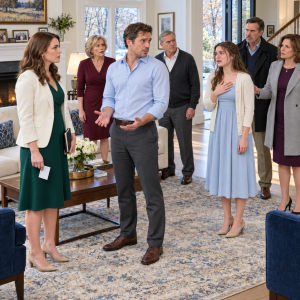
He tried to approach me.
“Dad, please.”
I stopped.
“Don’t.”
“You don’t understand everything.”
“Then explain the part I’m missing.”
He looked around.
“I was desperate.”
“Desperate people ask for help.”
He said nothing.
“They don’t manufacture a story about their father’s health. They don’t use a child as a shortcut to money.”
Corbin’s eyes dropped.
“I never wanted Hallie hurt.”
I looked at him for a long moment.
“You don’t have to hurt a child directly to damage her life.”
That was the last conversation we had for a long time.
Hallie Asked One Question
Children notice more than adults think.
One evening, Hallie climbed beside me on the porch swing.
“Grandpa?”
“Yeah, bug?”
“Why doesn’t Uncle Corbin come over anymore?”
I had rehearsed answers for this moment.
None of them felt right.
So I chose the simplest truth an eight-year-old could carry.
“Your uncle made some choices that weren’t good for our family.”
She thought about that.
“Is he mad at me?”
My heart nearly broke.
“No. None of this is because of you.”
She leaned against my arm.
“Are you going anywhere?”
I wrapped my arm around her.
“Not if I have anything to say about it.”
She smiled.
Then she asked whether we could make pancakes for dinner.
We did.
The House Felt Different Afterward
I changed every lock.
I upgraded the cameras.
I moved the trust documents to a secure location and added independent professional oversight so no single family member could ever gain easy control.
But the biggest change wasn’t financial.
It was emotional.
For years, I had confused forgiveness with access.
I thought loving someone meant repeatedly opening the door.
Corbin taught me that those are not the same thing.
You can love someone and still protect your home from them.
You can remember who they used to be without pretending not to see who they have become.
And you can choose a child’s safety over an adult’s feelings.
Russell remained across the street.
Every morning at seven, he walked his old Labrador past my house.
Sometimes he waved.
Sometimes I joined him.
One morning, I finally asked him something.
“What would’ve happened if you hadn’t warned me?”
Russell stopped walking.
“Don’t spend too much time living inside that question.”
I nodded.
He was right.
Then he smiled.
“Besides, neighbors are supposed to notice when something doesn’t look right.”
I laughed.
“You could’ve started with that instead of scaring ten years off my life.”
He laughed too.
“Would you have listened?”
I thought about it.
“Probably not.”
“Exactly.”
What Meredith Really Left Behind
Months later, Hallie and I planted a dogwood tree in the backyard for Meredith.
Hallie chose the spot.
She insisted her mother would have wanted it where we could see it from the kitchen.
While we covered the roots with soil, Hallie asked me what her mother had left her.
She knew there was money somewhere.
Children hear things.
I put down the shovel.
“Your mom left you something much bigger than money.”
Hallie frowned.
“What?”
“She left you proof that she thought about your future even when you weren’t in the room.”
Hallie smiled.
“That’s not something you can buy.”
I stared at her.
Eight years old.
And somehow wiser than many adults I had known.
“No,” I said. “It isn’t.”
That night, after Hallie went to sleep, I stood at the kitchen window looking toward Russell’s house.
The same window where I had once watched rain pour down while wondering whether I was becoming too old to protect my granddaughter.
I understood something differently now.
Protection isn’t always about being stronger than the person on the other side of the door.
Sometimes it’s about recognizing danger before you invite it inside.
Sometimes it’s about listening when someone trustworthy tells you something you don’t want to hear.
And sometimes the greatest inheritance we can leave a child isn’t property, money, or a carefully written trust.
It’s teaching them that love should never require them to surrender their safety, dignity, or peace.
Family ties can be precious, but sharing blood with someone should never require you to ignore repeated behavior that threatens the stability, dignity, or future of the people you are responsible for protecting.
Trust should be built through consistent actions rather than demanded through titles like parent, child, sibling, or relative, because genuine loyalty reveals itself most clearly when money and personal advantage enter the picture.
A person who quietly warns you about something uncomfortable may sometimes be offering a greater act of friendship than someone who constantly tells you only what you want to hear.
Protecting a child means thinking beyond today’s comfort and making decisions that safeguard their emotional security, financial future, and ability to grow up without carrying problems created by adults.
Forgiveness does not automatically mean restoring the same access, because it is possible to release anger while still maintaining boundaries that prevent the same harmful pattern from happening again.
Money can reveal sides of people that ordinary circumstances keep hidden, which is why important family assets should be protected by clear documents, independent oversight, and thoughtful planning rather than verbal promises alone.
When someone repeatedly makes you question your own judgment, it is worth slowing down, preserving facts, and seeking trustworthy outside perspectives before accepting a version of events that could permanently change your life.
Children often understand far more than adults realize, so when families face difficult situations, the kindest approach is usually to give them an age-appropriate truth without forcing them to carry details that belong to grown-ups.
The people who truly love us are not always the ones with the closest family connection; sometimes they are the neighbors, friends, teachers, or ordinary people who notice something is wrong and choose not to look away.
The most valuable legacy we can leave the next generation is not measured by the size of a bank account, because teaching a child to recognize healthy love, maintain boundaries, protect their dignity, and choose trustworthy people can serve them for the rest of their life.