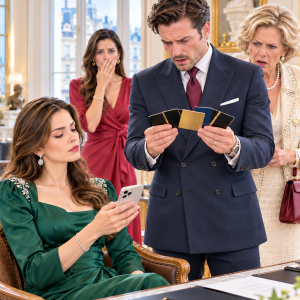
I met her gaze. “The records did that.”
Lily removed the engagement ring from her finger and held it out toward Grant.
“You said the divorce would leave you with everything.”
He reached for her hand. She pulled it back.
“You told me the company was yours.”

Her voice was unsteady, but she did not look away from him. I understood then that Grant had been telling people whatever suited the moment. He had assured me that our finances were nearly gone, told Lily that his future was secure, and let Eleanor believe she could spend freely. The company’s controlling shares had been pledged as part of the debt arrangements. Once the financial disclosures proved false, the loan agreements gave Hemlock Ridge rights that Grant had not expected me to enforce.
His attention settled on the papers again. He looked at his mother, then at Lily, then at me. I could almost see him trying to find a person to blame. Eleanor had encouraged him. Lily had trusted him. I had stopped covering for him. But the choices were his.
Grant looked down at his hand. He was still wearing the wedding ring from our marriage. He had kept it on through the courthouse that morning, perhaps out of habit or perhaps because he had not yet thought about taking it off. Now he pulled it from his finger. It slid through his hand and landed on the marble floor with a small, bright sound.
The ring came to rest a few feet from the documents. I remembered the day he placed it on my hand and promised that we would face life together. I had believed him. I had built a future around those words, endured the strain of treatments and loss, and helped protect his family’s home because I thought we were one family.
I did not reach for the ring. I did not ask him what he had meant when he made those promises. The papers in front of us were the answer to that question.
Eleanor lowered herself into a chair, still clutching the documents. The pearls at her throat caught the light, but they no longer seemed to lend her authority. Lily stood apart from Grant, her face tense with disappointment. Guests left in small groups, some avoiding my eyes and others watching openly. The event planner spoke with the estate manager. The court officers reviewed the next steps with Miles.
There was nothing more I needed to say.
That morning, Eleanor had stood on the marble steps and told me I did not belong in her home. That evening, she was learning that the house she used to define her place in the world was tied to a debt held by the woman she had sent away.
I had not come back to plead for Grant. I had not come to compete with Lily or to demand that Eleanor apologize. I had come because the Caldwells had spent years taking my restraint for ignorance and my generosity for weakness. Now the record was in front of them.
I turned toward the exit. Behind me, Eleanor called my name.
“Nora!”
I stopped but did not turn around. I thought she might say she was sorry. Instead, I heard the rustle of papers and the low murmur of guests leaving.
I walked out through the ballroom and down the front steps. The family crest remained above the entrance, and the white roses still lined the hall. The house itself had not changed. I had.
The House I Chose

Three months later, Grant admitted in court that he had concealed financial information and submitted false documents during the divorce proceedings. He received probation, was ordered to repay funds, and was barred from holding certain executive positions. The corporate career he had built around the Caldwell name came to an end.
For years, he had avoided hard conversations by telling me not to start. If I asked about Eleanor’s behavior, he said I should stay calm. If I asked about money, he said he had everything under control. If I pointed out that something did not add up, he treated my questions as an inconvenience.
The records did not care whether he was charming. The transfers remained where they were. The court had no reason to accept his explanations just because he came from a well-known family.
I did not celebrate his career ending. I had loved him once. We had made plans together and talked about children. I could still remember the nights he held me after we lost a pregnancy, and the way he used to make coffee on Sunday mornings while I read at the kitchen table. Those memories were real, even if the marriage had become something I could no longer trust.
Remembering what had been good did not require me to excuse what he had done. He had hidden assets, misrepresented our finances, and let his mother put my belongings on the sidewalk the day our divorce became final. I could feel sorrow for the life we had lost and still accept that the consequences belonged to him.
Eleanor’s life changed too. For years, she had presented herself as the unquestioned authority of the family. The mansion, the diamonds, the social events, and the summer properties all helped maintain that image. Once the enforcement process began, she could no longer keep that lifestyle untouched. She sold jewelry, artwork, and vacation property to meet the obligations tied to the estate.
The mansion was transferred to Hemlock Ridge Capital under the enforcement process, which meant it came under my control. For seven years, I had lived in those rooms while Eleanor reminded me that I was merely a guest in the Caldwell family. She had pointed to the crest above the entrance as if a name could decide who deserved respect. She had never known how close the house had come to being lost, or how much of my family’s money had helped prevent it.
When the property finally became mine to decide about, I could have kept it. I could have moved back into the rooms where I had spent so long trying to earn Eleanor’s approval. I could have walked down the grand staircase each morning and reminded myself that she no longer controlled the house.
But the mansion held too many memories I did not want to carry. I remembered Eleanor entering my room without knocking. I remembered Grant telling me not to make trouble. I remembered the long, quiet hours after the treatments, when I wondered whether I would ever become a mother. I remembered the morning my suitcases sat on the sidewalk while Eleanor stood above them in silk and pearls.
The house was beautiful, but beauty was not enough reason to stay attached to it. I sold it.
I did not sell it because I needed the money. I sold it because I no longer wanted my life connected to those rooms. Letting it go felt like the last step in leaving the marriage behind.
Lily left Grant before the baby arrived. During the investigation, she cooperated with the authorities and described the financial conversations she had heard. She had known about the affair and had participated in discussions about some of the transfers, so her choices were her own. At the same time, Grant had misled her about what he owned and what the divorce would leave him. I did not feel responsible for the relationship between them. I did not need to follow their story or decide who had been more disappointed.
I had a future to build that did not depend on either of them.
After the sale, I bought a smaller house near the Connecticut coast. It had no grand columns or ballroom, no family crest above the front door and no marble staircase where someone could stand and tell me I did not belong. Instead, it had a quiet porch, wide windows, and a view of the water between the houses across the street.
I chose the furniture. I arranged the books on the shelves and put the kitchen table where the morning light reached it. I could leave a mug beside the sink without anyone commenting on it. I could sit in my bedroom with the door closed and know that no one would walk in without asking.
For the first time in years, I could be quiet without waiting for someone to criticize me.
I continued managing my financial interests. My work had taught me that appearances could hide almost anything. The Caldwells had hosted elegant parties and surrounded themselves with people who admired their success, while the estate beneath them was carrying more debt than it could comfortably bear. My father had taught me that money was something to manage with care, not something to display. That lesson had helped me see what Eleanor and Grant had tried to conceal.
For a long time, I had used my resources to protect my marriage. When I understood that the people I was protecting had been working against me, I stopped shielding them. I did not need to prove I was wealthier than Eleanor, and I did not need to make Grant suffer beyond the consequences of his own decisions. The records had established the financial facts. The court process dealt with the legal questions. My part was to step away.
Nearly a year after the divorce, I sat on the porch of my coastal home with a cup of coffee in my hands. Morning light moved across the water, and a breeze stirred the leaves along the fence. There were no photographers or guests to impress. No orchestra, no champagne fountain, no one waiting to applaud a version of my life that had been written for them.
My phone rang. It was Miles.
“I thought you’d want to know,” he said. “The last restitution payment cleared.”
I looked out at the water. I thought of the courthouse that morning, of the final signatures and the silence between Grant and me as we left. I thought of the drive to the mansion, Eleanor in her cream dress, my suitcases on the sidewalk.
“Let’s not turn this into a scene, Nora.”

“You could at least take one suitcase to the car.”
“Why? So you can pretend you still have a place here?”
I remembered the way Eleanor had told me about the party, the amount she had spent, the more than one hundred guests, and then Lily’s pregnancy. At the time, I had carried seven years of marriage, three treatments, and two losses inside me. Eleanor thought that one more piece of news would finish what the divorce had begun. Instead, I understood that there was nothing left for me to protect.
I remembered Miles’s message saying the papers had been filed. I remembered the white roses and chandeliers, Eleanor lifting her glass to new beginnings, and the silence when I placed the envelope beside it. I remembered telling her I owned Hemlock Ridge Capital, then watching the story she had believed about herself begin to fall apart.
I remembered Grant’s wedding ring slipping from his finger and striking the marble. It had once represented a promise. By then, the promise had already been broken. I did not need to pick it up.
“Thank you for calling,” I said to Miles.
We spoke for another minute, then I set the phone on the table. The final payment mattered, but it was not the part that brought me the most relief. I had never needed Grant’s money. I had never needed Eleanor’s approval. I had spent years hoping that if I were patient and generous enough, they would treat me like family.
Now I understood that respect could not be earned by making myself smaller. It had to be present without being purchased by silence.
My little house by the sea was not grand, but it was mine. I could make an ordinary morning my own. I could decide what came next without measuring every choice against the Caldwell name. I had lost the marriage I once thought would last for the rest of my life, but I had regained the freedom to choose a life for myself.
I watched the sun shimmer across the water and listened to the waves beyond the shore. For years, Eleanor had told me I was lucky to belong to her family. She was wrong.
The luckiest day of my life was the day she sent me away, because that was the day I finally stopped protecting the people who had hurt me and began choosing myself.