The Check on the Library Table

The afternoon my marriage ended, my father-in-law placed a check for ten million dollars on the polished walnut table between us, and although the amount was large enough to change almost anyone’s life, what I remember most clearly is not the number printed across it but the way my husband kept staring at the floor.
His name was Graham Caldwell, and for three years I had loved him with the quiet certainty of a woman who believed she had already found the person beside whom she would grow old. Graham came from one of the wealthiest families in New England, a family whose money stretched through commercial real estate, medical technology, and private investment firms, but when we first met at a charity dinner in Boston, he had seemed almost embarrassed by the Caldwell name, and I had believed him when he told me that he wanted a marriage built far away from the expectations that had shaped his childhood.
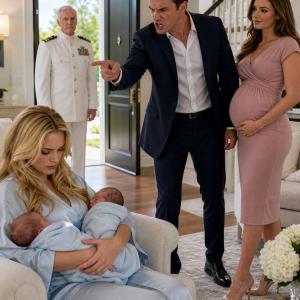
That promise felt very distant as I sat in the library of his parents’ estate outside Greenwich, Connecticut, facing Graham, his parents, and a young woman named Serena Cole.
Serena had worked as Graham’s executive coordinator for almost two years.
She was also twenty-two weeks pregnant.
With three boys.
Graham’s mother, Eleanor, kept returning to that detail as though nothing else mattered.
“Three grandsons,” she said softly, almost reverently. “You understand what this means for the family.”
I did understand.
I understood that Serena was carrying the children everyone in that room believed belonged to my husband.
I understood that Graham had been involved with her during our marriage.
And I understood that after three years of treating me as family, the Caldwells had apparently decided I could now be removed from it like an inconvenient paragraph in a contract.
Graham’s father, Richard, pushed a folder toward me.
“This gives you ten million dollars, the apartment you already own in Boston, and complete financial independence. In return, the separation remains private and uncomplicated.”
Eleanor added, “You would never need to work again.”
I almost smiled.
I had spent eight years building my career as an architectural consultant before marrying Graham, yet somehow she imagined permanent idleness was compensation for being quietly replaced.
But there was something else they did not know.
My period was six days late.
For several mornings, coffee had turned my stomach. The perfume I had worn for years suddenly seemed overwhelming, and I had been falling asleep before nine despite doing nothing unusually tiring. That morning, I had taken a pregnancy test from the bathroom cabinet and placed it beside the sink, intending to use it before breakfast, but Graham’s message had arrived first.
We need to talk. Please come to my parents’ house.
Now, while his father explained the financial terms of my disappearance, I rested one hand unconsciously against my stomach.
Then I looked at Graham.
His eyes were red.
That almost made everything worse.
“Tell me not to sign it.”
Richard stopped speaking.
Eleanor’s expression tightened.
Serena looked down.
Graham finally met my eyes.
I gave him one last chance.
“Tell your father to put the check away. Tell me this marriage still matters enough for you to fight for it. I’m not asking you to explain everything right now. I’m asking whether you want me to stay.”
For one brief moment, I saw the man I had married.
He leaned forward.
His lips parted.
Then Serena began crying.
Not loudly. Just a soft, frightened sound.
Graham turned toward her immediately.
“Serena, hey. You’re okay.”
He reached for her hand.
Something inside me became very quiet.
I picked up the pen.
Graham looked back at me.
“Claire…”
“I already asked you to stop me.”
Then I signed.
Every page.
Four Heartbeats
That evening, I left the Boston townhouse Graham and I had shared with two suitcases, one garment bag, and the pregnancy test I had never used.
My closest friend, Dr. Hannah Pierce, owned a small women’s health practice in Providence, and there was a furnished apartment above the clinic that visiting physicians occasionally used. She handed me the keys without asking how long I intended to stay.
Graham called fourteen times that night.
I answered none of them.
At nearly midnight, sitting alone on the bathroom floor beneath a light that was much too bright, I finally opened the test.
Two lines appeared.
I stared at them until the room seemed to tilt.
The Caldwell family had just paid me ten million dollars to leave because another woman was carrying three sons.
And I was pregnant too.
The next morning, Hannah brought me downstairs before her first appointment.
“It may be too early to see much,” she warned as she prepared the ultrasound. “So if we don’t—”
Then she stopped.
I turned my head.
“What?”
Hannah leaned closer to the monitor.
“Claire…”
There was a pause.
“One.”
My fingers tightened around the edge of the table.
Then she whispered, “Two.”
I stared at her.
“Hannah?”
Her eyes moved across the screen.
“Three.”
I stopped breathing normally.
Then her expression changed again.
“Oh.”
“Oh what?”
She looked at me, almost laughing from disbelief.
“Four.”
I blinked.
“Four what?”
She reached for my hand.
“Four babies.”
For several seconds, neither of us spoke.
Four.
Four tiny beginnings.
Four children belonging to the man who had sat silently while his family paid me to disappear.
I cried then, but not entirely from sadness. Fear was part of it, certainly, because carrying four babies would be complicated, and my life had been rearranged in less than twenty-four hours, but underneath the fear was something surprisingly strong.
They were mine.
Whatever happened next, they were mine.
I did not call Graham.
Perhaps I should have.
For years afterward, I questioned that decision more than any other.
But I remembered Serena crying and Graham reaching for her hand while mine rested alone in my lap, and I could not bear the thought of presenting my pregnancy as another argument in a competition I had never agreed to enter.
Three weeks later, I moved to a quiet town outside Portland, Maine, where Hannah connected me with a maternal-fetal medicine specialist she trusted.
I changed my phone number.
I rented a cottage near the water.
And I disappeared.
Months later, Benjamin, Oliver, Sophie, and June arrived safely—two boys and two girls, each tiny and determined, each somehow carrying a different piece of the man I had tried so hard to forget.
Benjamin had Graham’s serious little frown.
Oliver had his chin.
Sophie loved music almost from infancy.
June had the same gray-blue eyes as Eleanor Caldwell.
For nearly two years, I raised them quietly.
I never spoke badly about their father.
When Benjamin eventually pointed at a photograph tucked inside an old book and asked, “Daddy?” I told him only that his father lived far away.
That was true.
Just not in the way he understood.
The Wedding Invitation

My silence might have lasted much longer if Hannah had not sent me a photograph one Tuesday morning.
It was a wedding announcement.
Graham Caldwell and Serena Cole were finally getting married at the Caldwell family estate.
By then, Serena’s three boys were nearly two, and according to the society pages, Richard Caldwell had begun reorganizing several family trusts around his grandchildren.
His three grandchildren.
I sat at my kitchen table while four toddlers argued over blueberries and stared at Graham’s photograph.
He looked older.
So did I.
For the first time, I realized my silence was no longer protecting my children from chaos.
It was erasing them from a family structure that could affect their future.
So I contacted an attorney.
Then I arranged legally recognized DNA testing.
The result was clear.
Probability of paternity: greater than 99.99 percent.
Graham Caldwell was the biological father of all four children.
I did not call him.
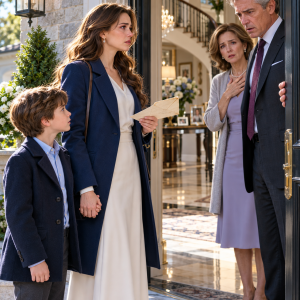
Instead, on the afternoon of his wedding, a black SUV carried the five of us down the long driveway toward the Caldwell estate.
I wore an ivory pantsuit.
Benjamin held my left hand.
Sophie held my right.
Oliver and June followed with our nanny.
By the time we reached the lawn, the ceremony had not yet begun, but hundreds of guests were already seated beneath white flowers and pale linen canopies.
The whispers started first.
Then Eleanor saw us.
The champagne glass slipped from her fingers and broke against the stone terrace.
Graham turned.
I watched recognition move across his face, followed by confusion as he noticed the children around me.
“Claire?”
“Hello, Graham.”
Richard approached quickly.
“What are you doing here?”
I reached into my handbag and removed a white envelope.
“I brought something Graham should have received a long time ago.”
Graham barely looked at the envelope.
He was staring at Benjamin.
Then Oliver.
Then Sophie.
Then June.
“Who are they?”
I told him their names.
His voice became almost inaudible.
“How old?”
I said nothing.
He did the arithmetic himself.
His face lost its color.
“Claire…”
I handed him the envelope.
“Read it.”