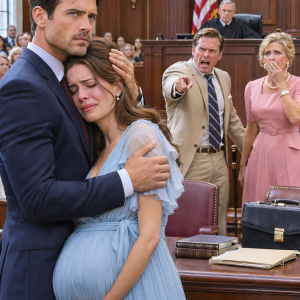
“My wife has never asked me to turn against my family. She asked me to listen to her, and I failed to do that. Everything else we’re discussing today is the result of your own decisions.”
The meeting ended in a dangerous confrontation during which a window was shattered and Nathaniel sustained a minor injury to his forearm before authorities took Russell into custody.
When Nathaniel returned to Maryland that evening, I immediately noticed the white medical dressing beneath his rolled-up shirt sleeve.
“What happened to your arm?”
He explained the confrontation without minimizing what had occurred, and when I reached toward the dressing, he allowed me to examine it.
“Please don’t ever tell me something doesn’t matter simply because the injury looks small,” I said.
He understood what I meant.
Later, as we sat together in the living room, I finally asked the question that had been waiting between us since the afternoon he entered my bedroom.
“Do you still want to end our marriage?”
“No,” he answered. “But I would understand if that’s what you wanted.”
I looked down at my hands.
“I haven’t stopped loving you. I just don’t know whether I can trust you the way I used to.”
He reached for his coffee, then set it down again without drinking.
“Then I won’t ask you to trust me before you’re ready. I’ll give you reasons to believe in me again, even if it takes a long time.”
Learning to Be Married Again
Russell remained in custody while the criminal and financial proceedings continued, and Margaret was required to answer questions about her involvement before a grand jury.
When she contacted Nathaniel requesting permission to visit me, he told her that the decision belonged entirely to me.
I was not ready to see her, and he respected that without attempting to persuade me otherwise.
During the following months, I continued attending physical therapy, gradually regaining movement in my shoulder and learning to manage the discomfort that still interrupted my daily life.
Nathaniel began attending counseling himself, where he examined the pride, insecurity, and unquestioning family loyalty that had made him so willing to believe the worst about me.
There were difficult conversations, evenings when old memories resurfaced, and mornings when I wanted nothing more than to be left alone, but he gradually learned that supporting me did not mean trying to control how quickly I recovered.
One afternoon, I returned from an appointment to discover that he had converted an unused upstairs room into a textile preservation studio.
My embroidery frames, specialized tools, reference books, and carefully labeled containers of antique fabrics had been arranged beside a large worktable overlooking the lake.
“I thought you might enjoy having somewhere to work again,” he said.
I ran my fingers across a wooden embroidery frame I had owned since college.
“I didn’t think you remembered how much all of this meant to me.”
“I remembered. I just haven’t done a very good job of showing you.”
I asked whether he would stay while I worked, and he brought a chair beside the window, where he spent the next two hours reading while I carefully repaired a small piece of nineteenth-century embroidery.
We barely spoke, yet the silence felt comfortable in a way it had not for nearly a year.
When December arrived, we were invited to a holiday benefit dinner, and I chose a beautiful champagne-colored evening gown that left part of my surgical scar visible.
Standing before the mirror, I found myself instinctively reaching for a shawl.
Nathaniel noticed my hesitation.
“Would you rather wear something else?”
“Do you think the scar is too noticeable?”
He considered his answer carefully.
“I think you’re beautiful, but I also understand that seeing it brings back memories you’d rather not have. You don’t have to cover it for me, and you don’t have to uncover it to prove anything to anyone.”
I set the shawl aside and turned toward him.
“Would you hold me for a minute?”
He opened his arms, waiting for me to step into them, and when I lifted my face toward his, we shared our first kiss in almost a year.
It was not the kind of moment that belonged in a fairy tale, because there was still so much work ahead of us, but it was honest, and by then honesty had become far more precious to me than perfection.
The Marriage I Chose for Myself

The following spring, I organized a fundraising reception at a historic museum in Philadelphia to support a foundation I had established for people requiring reconstructive procedures and extended physical rehabilitation after serious accidents.
I wanted others to have access to the kind of treatment that had helped me reclaim my independence, particularly those whose financial circumstances made months of rehabilitation difficult to afford.
That evening, I wore a sapphire-blue gown with a neckline that made no attempt to conceal my scar, and although I still occasionally felt self-conscious, I was no longer willing to organize my entire life around hiding it.
Nathaniel stood near the edge of the ballroom while I greeted donors, spoke with medical professionals, and introduced several families who would benefit from the foundation’s work.
When the musicians began playing a familiar slow melody, I walked toward him and extended my hand.
“Are you planning to spend the whole evening watching me from over here, or would you like to dance with your wife?”
He smiled, and together we walked onto the dance floor.
As we moved beneath the soft ballroom lights, I thought about the woman I had been a year earlier, frightened of losing her husband and equally frightened of letting him see what she had endured.
I wished I could tell her that her worth had never depended on the smoothness of her skin, the opinions of her husband’s relatives, or even the survival of her marriage.
When the music ended, I reached into my evening bag and removed a folded sheet of paper.
Nathaniel recognized it immediately.
It was the first page of the divorce documents he had brought into my bedroom.
“You’ve kept that all this time?”
“For a while, I thought I needed it to remind myself never to forget how you made me feel.”
He nodded, accepting my words without defending himself.
“But eventually I realized that I don’t have to remain married because someone expects me to, and I don’t have to walk away simply to demonstrate that I’m strong enough to leave. This is my life, and I want the decisions I make about it to belong to me.”
I unfolded the document and slowly tore it into two pieces.
Nathaniel looked at me with tears gathering in his eyes.
“Are you certain?”
“I’m certain that I want to keep building something better with you. That doesn’t mean we’ve finished working through everything, but it means I’m willing to continue.”
He took my hand, and instead of offering another elaborate promise, he simply thanked me.
As we left the museum that evening, the spring air was cool, and Nathaniel helped me settle my coat around my shoulders before we walked toward our waiting car.
I understood that forgiveness had not required me to forget what happened, just as rebuilding our marriage had not required me to pretend that love alone could solve every problem.
Nathaniel had learned that providing a beautiful home was not the same as making someone feel safe within it, and that being a husband meant far more than expecting loyalty from the woman beside him.
For my part, I had learned that loving someone did not require surrendering my voice, concealing my pain, or accepting disrespect in the name of keeping a family together.
We could not return to the marriage we had before that spring evening, but perhaps that was not what either of us truly wanted anymore.
What we wanted was a marriage in which difficult truths could be spoken without fear, apologies were followed by meaningful changes, and affection was something freely given rather than something either person felt entitled to receive.
As Nathaniel intertwined his fingers with mine during the quiet drive home, I rested my head against his shoulder, grateful not because everything had become easy, but because we had finally learned how to face the difficult things together.
The scar I had once tried so desperately to conceal remained with me, and it probably always would, but it no longer represented the part of my life I wished to hide.
It reminded me that even after something precious has been damaged, restoration is sometimes possible, provided that the people responsible for its care are willing to approach it with patience, humility, and gentle hands.
And after spending years restoring fragile pieces of history, I finally understood that the same principle could apply to a marriage, too.