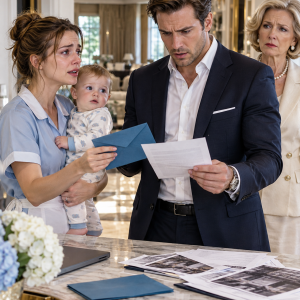
“You have always blamed me for your unhappiness,” he said. “Now you are trying to ruin my company because I found someone who could give me a child.”
“Your company was built with money taken from my trust,” I said. “Your sister approved documents she knew I had not authorized. And the clinic connected to your family altered my records while you encouraged me to continue treatment that was not medically appropriate.”
“You knew,” I said. “Your emails prove it.”
Graham reached for my arm, but a security officer stepped between us before he touched me.
“Do not come closer,” I said. “There is a protective order.”
“Where is the child?” he asked.
I held his gaze. “Safe.”
Three Truths Beneath the Flowers

Rebecca opened the portfolio and removed three sealed packets. The first contained the independent review of my original medical tests, the later alterations, and the correspondence tying Graham and Meredith to the clinic administrator.
“I was never the reason we struggled to conceive,” I told him. “Your first tests showed that you needed specialized help. Instead of facing that truth, you allowed the clinic to put your diagnosis under my name. You watched me accept blame for five years because my shame made your financial scheme easier.”
Rebecca explained that Aaron Bell had voluntarily provided the prenatal report and related messages as part of the financial investigation. She handed copies to counsel representing Graham’s company and to Paige’s attorney, who had arrived moments earlier after receiving notice.
“Aaron?” he asked. “Tell me this is not true.”
Paige’s composure disappeared. “You cannot believe her. She planned all of this because she wants you back.”
“I do not want him back,” I said. “This is not a competition between two women. It is an accounting of choices.”
I removed a photograph taken the previous week. Rose lay asleep in a white knitted blanket, her dark hair visible beneath a small cotton cap. I held the picture where Graham could see it but did not hand it to him.
“Her name is Rose Elaine Hart,” I said. “She was born six weeks ago in Maine. She was conceived naturally after I left the clinic and stopped the treatment your family had arranged.”
“Is she mine?” he asked.
“The certified test says you are her biological father.”
“Then she is my daughter. Audrey, you had no right to hide her from me.”
“You had no right to manipulate my care, misuse my signature, or spend years convincing me that I was less worthy because I could not give you what you wanted,” I said. “The court has granted me sole custody and issued a no-contact order while the investigation continues. You cannot approach her, contact me, or use her existence to reach her trust.”
“Please,” he said quietly. “Just let me see her.”
“A shared bloodline can make you a father on paper,” I said. “It does not automatically make you her dad.”
His face folded in a way that might once have made me rush to comfort him, but I felt no triumph, only sorrow for the child he had wanted as a symbol and never learned to imagine as a person. Rose was not a prize awarded to the most persuasive adult. She was a small human being whose safety mattered more than his sudden regret.
Investigators then asked Graham and Meredith to accompany them. No one announced a grand punishment, and there was no need for spectacle beyond the truth already standing among the flowers. The siblings were served with formal notices concerning financial misconduct, altered records, and unlawful use of trust assets. Their attorneys guided them away as cameras clicked from a respectful distance.
Then I walked inside, took Rose from the nurse, and held her against my heart.
What Remained After the Noise
Graham and Meredith eventually admitted to financial misconduct and falsifying documents. Graham also acknowledged that he had knowingly encouraged an improper course of treatment in order to keep me dependent and distracted. Their agreements required restitution, the surrender of company assets, professional disqualification, and several years in federal custody. The clinic lost its license, and former patients were notified that their files might need independent review.
Prescott Meridian was dissolved. Its remaining properties were sold under court supervision, and the proceeds restored the money taken from my grandmother’s trust. I chose not to enlarge my fortune through Graham’s collapse. After every legitimate debt and worker’s wage was paid, a portion of the recovered funds established a nonprofit legal program for women facing financial control during medical treatment or divorce.
The family court later made my sole custody order long-term. Graham could not contact Rose while the protective restrictions remained in effect, and he had no authority over her property. I did not tell myself that the future was permanently written. Rose would one day be old enough to ask questions, and when she did, I would answer honestly without teaching her to carry my bitterness.
Eight months after the ceremony that never became a marriage, autumn light filled the front room of my grandmother’s townhouse. I had restored the old place slowly, choosing warm colors, strong furniture, and shelves low enough for a curious child. Nothing in it was arranged for display. It was a home meant to be touched, lived in, and occasionally covered with toys.
Rose sat on a quilt near the window, surrounded by wooden blocks. She had learned to pull herself upright by gripping the edge of the sofa, and each success delighted her as though she had personally discovered standing. When she saw me, she released one hand and laughed.
My life was not the flawless victory Graham once pretended life should be. There were difficult nights, legal letters that made my hands tremble, and mornings when an old sentence of his returned without warning. There were also bottles warming in the kitchen, neighbors who brought soup, Rebecca reading picture books in a voice far too serious for the stories, and Rose falling asleep with her hand curled around my thumb.
For a long time, I thought healing would mean returning to the woman I had been before Graham. Eventually I understood that there was no return, only a way forward. The earlier version of me had been loving and hopeful, but she had also been trained to abandon her own judgment whenever someone spoke with enough confidence. I could forgive her for that without becoming her again.
The inheritance was never merely buildings or money. It was the right to stand on solid ground when someone tried to convince me I had none. It was the education to read a document, the courage to ask a second question, and the responsibility to leave Rose something cleaner than what had been handed to me.
One rainy evening, I carried Rose upstairs and paused beside a framed photograph of my grandmother. She had acquired each property through years of careful work, not to create status, but to give the women who followed her room to choose their own lives. Only then did I fully understand what she had left us.
“You were never proof that I won,” I whispered. “You were proof that I was never broken.”
That was what I gave Graham on the coast of Georgia.
What I gave Rose was everything after.