PART 1
She Threw $300 at My Feet and Told Me to Pick It Up—Then Her Father Saw the Necklace Around My Neck
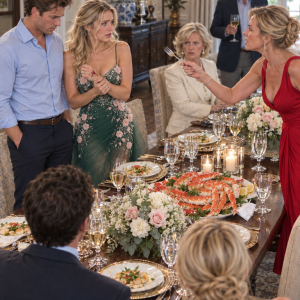
The woman standing across from my counter pulled three hundred-dollar bills from her purse and dropped them at my feet.
One landed beside my shoe. Another slid beneath a clothing rack.
“There. If three hundred dollars matters that much to you, pick it up.”
Four customers were watching us by then, but I didn’t bend down. I kept one hand on the red cocktail dress she’d brought back that morning, its hem streaked with dirt and a dark wine stain spreading across the waist.
“I’m not refusing the refund because I need your money,” I said. “I’m refusing because you wore the dress, removed the tag, stained it, and now I can’t sell it to somebody else as new.”
She rolled her eyes.
“I wore it for one dinner. You’re acting like I dragged it behind my car.”
“I offered you store credit.”
“I don’t want store credit.”
She leaned closer.
“Do you even know who I am?”
I didn’t.
Apparently that offended her more than the return policy.
“Renata Vale.”
The name registered. Vale Department Stores had locations all over Arizona and several neighboring states.
“Okay.”
She stared at me.
“Okay? That’s it?”
“I don’t know what you want me to say. My return policy doesn’t change because your last name is Vale.”
Her mouth tightened. She glanced toward the other customers and gave a short laugh.
“Honestly, I don’t know how little places like this stay open. Half the women shopping here probably have to check their bank accounts before buying a dress.”
A woman near the fitting rooms slowly lowered the blouse she’d been holding.
That bothered me more than anything Renata had said about me.
My mother had built Elena’s Closet from one rack of consignment dresses and a borrowed sewing machine. Four months after her death, I was twenty-six years old, grieving, behind on two supplier invoices, and doing everything possible to keep her store alive.
Those customers had kept us alive too.
I walked around the counter and placed the red dress in Renata’s arms.
“You need to leave.”
Her eyebrows lifted.
“You’re throwing me out?”
“I’m asking you to take your dress and stop insulting my customers.”
“You’re unbelievable.”
The bell above the door rang.
A man in a charcoal suit stepped inside.
Renata turned.
“Dad?”
He looked at her, then at me, then at the money scattered across the floor.
His expression changed.
“What’s going on?”
Renata sighed.
“Nothing. She’s refusing to refund a dress.”
He pointed toward the bills.
“What’s that?”
“Dad, please. Can we just go?”
His voice remained calm.
“Did you throw that money on the floor?”
Renata folded her arms.
“I was giving it to her.”
He looked at the bill beside my shoe.
“By throwing it at her feet?”
Renata didn’t answer.
Her father waited.
“Pick it up.”
Her face flushed.
“Seriously?”
“Yes. All of it.”
“You’re going to embarrass me in front of everyone?”
He glanced around the boutique.
“You seemed comfortable embarrassing her in front of everyone.”
Renata crouched, retrieved the bills, including the one beneath the rack, and shoved them back into her purse.
Her father nodded toward me.
“Now apologize.”
“Dad—”
“Renata.”
She stared at him before finally turning to me.
“I’m sorry. I shouldn’t have thrown the money, and I shouldn’t have said that about your customers.”
“Thank you.”
Renata grabbed the dress.
“Can we go now?”
Her father nodded toward the door.
“Wait outside. I’ll be there in a minute.”
She left without looking at me.
The man remained.
“I’m sorry,” he said. “She had no right to speak to you that way.”
“I appreciate that.”
I bent to straighten a display.
When I stood again, he wasn’t looking at the clothes.
He was staring at my necklace.
The Necklace My Mother Never Took Off
It was a small silver flower with a faded blue stone in the center.
Nothing expensive.
My mother had worn it for as long as I could remember. After she died, I found it in the ceramic dish beside her bed and started wearing it myself.
The man seemed to forget where he was.
“I’m sorry. Where did you get that?”
My fingers went instinctively to the pendant.
“It was my mother’s.”
“What was her name?”
I hesitated.
He noticed immediately.
“Sorry. That’s a strange question. I just… I’ve seen that necklace before.”
“Elena Salgado.”
The color left his face.
“Elena?”
“Yes.”
He reached slowly for his wallet.
“My name is Alexander Vale. I need to show you something.”
From behind his driver’s license, he removed an old photograph with softened corners.
He placed it on the counter.
My mother stood in the picture.
She couldn’t have been older than twenty-one. Her hair was long, her smile wide, and beside her stood a much younger Alexander Vale.
Around Mom’s neck was my silver flower.
I looked from the photograph to him.
“Why do you have a picture of my mother?”
Alexander pulled one of the chairs near the fitting rooms closer but waited before sitting.
“Elena and I were together when we were young.”
“Together how?”
He rubbed his thumb along the edge of the photograph.
“We planned to get married.”
I stared at him.
My mother had never mentioned Alexander Vale.
He explained that he had worked for my grandfather’s distribution company when he was barely out of college. My grandfather disliked him immediately—no money, no influential family, no future he considered suitable for Elena.
Then Alexander was offered a job in California.
“Your mother wanted me to take it,” he said. “We thought I’d work for a year, save money and come back.”
“But you didn’t.”
“I wrote constantly. At first she answered. Then her letters stopped, and mine started coming back unopened.”
Alexander returned to Arizona months later.
My grandfather told him Elena had married someone else and moved away.
“And you believed him?”
Alexander lowered his eyes.
“For longer than I should have.”
“She never married.”
His face tightened.
“I know that now.”
“She raised me alone.”
This time, when he looked at me, neither of us spoke.
Something in my stomach tightened.
Then I remembered the envelope.
The Letter Behind Her Sewing Machine
After Mom died, I had spent weeks sorting through the apartment above the boutique.
Behind her old sewing machine, wedged between the table and the wall, I’d found an envelope with one name written across the front.
Alexander.
No last name.
No address.
I had kept it because it was in Mom’s handwriting.
I went into the back room and returned with the envelope.
Alexander recognized the handwriting before I reached the counter.
“Where did you find that?”
“Behind her sewing machine.”
His hand stopped halfway toward it.
“May I?”
I handed him the letter.
As he read, his expression changed.
Then he went back to the beginning and read it again.
“She was pregnant.”
The boutique suddenly felt too quiet.
“What?”
He turned the page toward me.
Mom had written that her father wanted her to give up the baby. She had refused. She wrote that she didn’t understand why Alexander had stopped answering her and begged him to come back before her father found another way to separate them.
Alexander looked at me.
“When were you born?”
I told him.
His eyes dropped to the date on the letter.
I did the math at the same time he did.
“Sophie…”
“Don’t.”
He stopped immediately.
I folded my arms because I needed something to hold in place.
“We don’t know anything yet.”
“You’re right.”
“My mother told me my father knew she was pregnant and didn’t want me.”
Alexander’s face changed again.
“I swear to you, I never knew.”
I wanted to believe him.
That frightened me more than deciding he was lying.
Before either of us could say more, the bell above the door rang.
Renata walked back inside.
“Dad, are you coming? I’ve been sitting out there for—”
She saw the photograph.
Then the letter.
Then her father’s face.
“What’s going on?”
Alexander folded the letter carefully.
“I don’t know yet.”
99.99 Percent
Two independent DNA tests answered the biological question.
99.99 percent.
Alexander Vale was my father.
When the second result arrived, he called me. For several seconds, neither of us knew how to begin.
Finally he asked:
“Did you see it?”
“Yeah.”
“Are you okay?”
I stared at the silver flower around my neck.
“I have no idea.”
He gave a quiet, nervous laugh.
“Me neither.”
The result didn’t suddenly turn Alexander into Dad.
It did something more complicated.
For twenty-six years, I had believed my father knew I existed and chose not to know me. Now I had to make room for another possibility: two young people had been separated by a man who believed he knew what was best for his daughter, and neither had ever learned the whole truth.
Alexander’s first instinct was to repair twenty-six years with money.
He offered to pay the boutique lease.
I refused.
He offered to renovate the store.
I refused again.