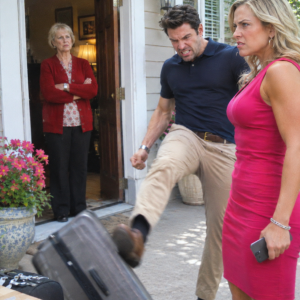
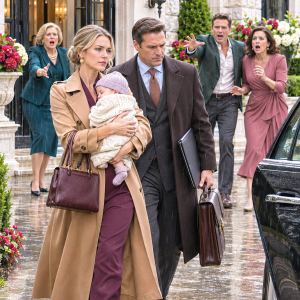
Calvin and Molly.
The timestamp read 8:41 p.m.
Another photograph appeared, taken at 9:14. My children were still outside.
Ross hurried to stop the slideshow.
But Allison had already seen them.
She stood beside the projector, staring at the screen.
“Ross, you told me the children went home with their grandfather. Why are they still sitting on our porch?”
Nobody answered.
Lamar stood near the back of the room.
“Those are the children I brought inside that night,” he said quietly.
Allison turned toward her husband.
“You told me they’d already left.”
Ross disconnected the projector.
“This isn’t the place to discuss it.”
“Then you shouldn’t have lied to me.”
Marcus stepped forward.
“Ross, put the microphone down. This is my birthday.”
My brother looked around the room. For once, nobody rushed to defend him.
I didn’t make a speech. I took Calvin and Molly to the dessert table, where Marcus’s parents were waiting with birthday cake.
But I knew something had changed.
Ross had spent weeks insisting that the children were perfectly safe and that he’d done nothing wrong.
Now his own photographs had shown the family what happened.
And in three weeks, we’d be in court.
PART 2 — THE MONEY HE CALLED HIS OWN

On February 26, I walked into the Sedgwick County courthouse carrying my blue folder.
Ross arrived wearing an expensive dark suit. Allison sat behind him with our parents, looking as though she wished she were anywhere else.
I wasn’t happy about being there either. For years, I’d believed family disputes should be settled privately. But Ross had filed a lawsuit, and I wasn’t going to let him change the facts simply because he disliked being questioned.
The judge began with his claim.
“Mr. Haskins, you’re asking for $1,800 based on twelve deposits of $150?”
“That’s correct, Your Honor.”
“Do you have documentation for those deposits?”
Ross shuffled his papers.
“Not every receipt, but I made them.”
I provided the certified bank statements. They showed four deposits totaling $600.
The judge examined the records.
“I’m seeing four deposits, Mr. Haskins. Do you have evidence of the other eight?”
“The bank must have made a mistake.”
“Do you have anything supporting that?”
Ross looked down.
“No, Your Honor.”
The judge then reviewed the account registration and asked about our family arrangement. I explained why I’d opened the fund, how we contributed, and why Ross had been given a card.
I also provided the November group message reminding everyone that charges over $200 required approval.
Ross had acknowledged that message.
“Did you obtain approval for the purchases listed in your sister’s counterclaim?” the judge asked.
Ross hesitated.
“Not specifically. But they benefited the family.”
“Including the tires?”
“I drive our parents around.”
“And the private New Year’s celebration?”
“Family members were there.”
I explained that the party had been advertised as Ross’s personal expense and that no one had agreed to use the Family Fund for it.
The judge asked several questions about our previous practices. I showed examples of approved expenses and the messages we’d exchanged before paying for other celebrations.
Then we reached the $350 anniversary gift.
“Mr. Haskins, you say you personally contributed this amount toward your sister’s anniversary trip?”
“Yes, Your Honor. That was my own money.”
I opened the blue folder.
“May I show the court the registry confirmation?”
The judge examined the receipt. It identified the Family Fund debit card as the payment method.
Then she compared it with the matching transaction on the bank statement.
“Mr. Haskins, if this was your personal contribution, why was it paid from the Family Fund account?”
Ross stared at the documents.
“I intended to reimburse it.”
“Did you?”
“No.”
“Then the money didn’t come from your personal funds, did it?”
My brother looked toward Allison, then at our parents.
Nobody spoke.
Finally, he lowered his eyes.
“No, Your Honor.”
It wasn’t a dramatic confession. He didn’t shout or storm out. He simply sat there, unable to explain away a charge he’d spent months insisting was his own generosity.
The judge continued reviewing the evidence and took the case under advisement.
We left without an immediate decision.
Outside the courthouse, Ross caught up with me.
“You didn’t have to embarrass me like that.”
I stopped beside my car.
“I answered the questions, Ross. You’re the one who filed the case.”
“You could’ve handled it privately.”
“I tried. You came to my house demanding money and threatened me with a lawyer.”
He looked away.
“Mom’s upset.”
“So am I.”
I got into my car before either of us said something we’d regret.
On March 9, the written judgment arrived.
The court rejected Ross’s claim and awarded me $3,140 on the counterclaim, plus allowable court costs.
I read the order twice while Marcus made coffee.
“Well?” he asked.
“The judge ruled in my favor.”
Marcus put a hand on my shoulder.
“Good. You worked hard for that.”
I looked at the papers.
“I thought I’d feel happier.”
“You’re allowed to be relieved without being happy about suing your brother.”
Calvin came into the kitchen and noticed the envelope.
“Did Uncle Ross lose?”
I folded the judgment.
“The court decided he owed money back to the account.”
“Does that mean he’ll stop being mad?”
I considered my answer.
“I don’t know, sweetheart. But that’s something the grown-ups need to work out.”
He nodded and went to find Molly.
I put the judgment into my blue folder and closed it.
The money was settled. The rest of our family wasn’t.
THE SECRET ALLISON HAD BEEN LIVING WITH
Three days later, Allison called.
She’d read the judgment, and Ross was still insisting the bank had made a mistake. She wanted us to discuss everything together.
When I arrived, Ross was pacing in the driveway. Allison stood on the porch with her arms folded.
“Tell her,” Ross said. “Tell her this whole thing was a misunderstanding.”
“The judge reviewed the evidence,” I replied. “I’m not going to pretend otherwise.”
Allison held up her hand.
“Ross, I have a different question. Where have you been going every morning?”
He frowned.
“Work.”
“What work?”
“I’m between projects.”
“Since when?”
Ross didn’t answer.
Jillian appeared in the doorway behind her mother. She looked uncomfortable.
“Dad, you said you’d tell Mom after Christmas.”
Allison turned toward her.
“Tell me what?”
Jillian swallowed.
“Dad lost his job in October.”
The driveway went quiet.
Ross had been unemployed for months. He’d continued leaving the house every morning, pretending to meet clients while searching for work and trying to keep up with the bills.
Allison sat down on the porch steps.
“You told me your company was covering the New Year’s party.”
“I thought I’d have another job by then.”
“My parents loaned you $4,000 because you said you needed money for the caterer.”
I looked at him.
The Family Fund had paid that bill.
Allison stared at her husband.
“Where did my parents’ money go?”
Ross rubbed his forehead.
“The mortgage. Credit cards. Things were getting behind.”
“So you lied to my parents, used Dana’s account, and let everybody believe you were paying for that party yourself?”
“I was trying to keep everything from falling apart.”
“No, Ross. You were trying to keep anybody from finding out.”
He didn’t argue.
For the first time, he looked less angry than exhausted.
I could understand why losing his job had frightened him. Ross had spent years presenting himself as the successful older brother who could afford anything. Admitting he’d been laid off would have been humiliating.
But that didn’t excuse his decisions.
He’d lied to Allison, misused family money, and left my children outside because their presence didn’t fit the evening he’d planned.
Allison stood.
“I’m taking Jillian to my parents’ house for a few days. I need time to think.”