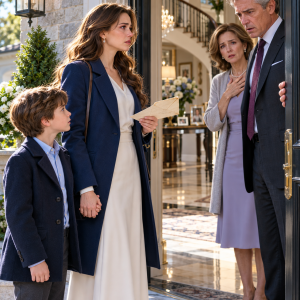
“The children upset him.”
“Today’s exercises were too demanding.”
“He doesn’t want you to see him struggling.”
Meanwhile, her requests for money increased. I canceled Lily’s summer music program, postponed repairs on our house, and worked late to cover each new charge. Nathan stopped asking for baseball equipment because he understood, far too young, that money had become scarce.
Standing in that hotel hallway, I finally understood what my sacrifices had financed.
The Truth Beneath the Wheelchair

We moved into the hotel lounge, where employees and security cameras surrounded us. Colin admitted that he had begun walking independently three months earlier. Holly then revealed that their relationship had started long before the platform collapse.
The reduced travel allowance had never existed. Colin had used household money for dinners, hotel rooms, and the deposit on Holly’s apartment. Some of the money Patricia collected for therapy had paid the rent.
“Does your mother know about Holly?” I asked.
“She knows I recovered,” Colin replied. “That’s all.”
Holly folded her arms.
“That isn’t true. She brought us dinner last month and warned me to leave before the neighbors noticed.”
Colin glared at her, but Holly had clearly decided she would not accept all the blame.
Then she disclosed something even more serious. The day before the platform gave way, the plant’s safety specialist had recommended closing that section until several damaged supports were replaced. Colin, already behind schedule, had changed the final report to indicate that no immediate closure was necessary.
“I thought the maintenance contractor would handle it,” he said.
“But you allowed the work to continue,” I replied.
His eyes dropped.
Holly added that Colin had been speaking with her by phone close to the time the platform failed. He later claimed that he could not remember the events clearly because he feared investigators would discover the altered report.
His condition after the collapse had been real, but when movement returned, he concealed the improvement. He was afraid his benefits would be reviewed, his employer would expect him back, and questions about the safety record would reopen.
While pretending to prove that Patricia knew nothing about Holly, Colin unlocked his phone. I glimpsed a message from his mother and took the device before he could hide it.
“Natalie’s payment arrived. I’ll transfer your portion tonight.”
Another message instructed him to reuse an old therapy invoice with a different date. A third suggested telling me that the medical mattress had been replaced again.
I photographed the conversation and quietly preserved the recording from our table.
“I trusted you when you truly needed help,” I told him. “That was devotion. What you did with it was your choice.”
Then I walked away.
When the Records Began Speaking
Meredith introduced me to Abigail Foster, a family attorney in Raleigh. By the next morning, Abigail had my bank records, videos, photographs, invoices, and Colin’s recorded admissions spread across her conference table.
What appeared to be a marriage falling apart was also a pattern of fabricated expenses, concealed assets, questionable benefit claims, and altered workplace documents.
Abigail advised me not to confront Patricia again. Her office compared every payment with clinic records and discovered that many appointments had been canceled. Several invoices carried identical numbers but different dates, while others listed services that had never occurred. The secret car Colin drove was registered to Patricia.
I filed for divorce, and the relevant evidence was forwarded to the insurer, Colin’s employer, and the proper investigators.
Colin called constantly until I finally answered.
“Please think about the children,” he said.
“I am thinking about them.”
“They need their father.”
“They needed him during all those months when he chose to hide from them.”
“I made mistakes.”
“A mistake is forgetting an appointment. You created a system—false receipts, a secret car, hidden payments, and a wheelchair you no longer needed.”
Two weeks later, Patricia arrived at my parents’ home and accused me of ruining her son’s future. I read several charges aloud and told her that the clinics had no records matching her invoices.
My mother, who had remained silent until then, stepped beside me.
“You criticized my daughter for spending money on her own children while you were charging her for care your son never received.”
Patricia began to cry.
“I was protecting him.”
“You were protecting an arrangement that paid you,” I said.
The workplace inquiry uncovered the original safety recommendation and its altered replacement. Peter Dalton, the technician injured in the collapse, had been unable to return to his former duties. For months, I had believed my children and I were the people most deeply affected by Colin’s choices, but another household had been carrying consequences we could never fully repair.
What the Children Deserved to Know

Telling Nathan and Lily was harder than any legal meeting. I spared them the adult details, but I explained that their father’s injury had been genuine at first and that he later regained more strength than he admitted.
Lily’s eyes filled immediately.
“Is this happening because I went back for my phone?”
I moved beside her and held both her hands.