The Night My Family Finally Learned Who I Was
For most of my adult life, my family believed I was barely getting by.
I never corrected them.
After my husband, Andrew, passed away, I raised our son, Caleb, quietly outside Raleigh, North Carolina. At family gatherings, I arrived in an ordinary SUV, wore simple clothes, and avoided talking about work.
My mother, Marjorie, interpreted my privacy as failure.
My younger sister, Paige, did too.
They believed I was a struggling widow with an unremarkable office job who still needed her family more than she wanted to admit.
I allowed them to believe it because the truth was complicated.
Then one Sunday evening, everything changed.
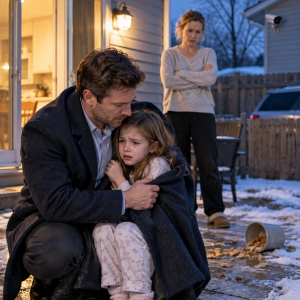
Caleb was six years old. He had brought a small red toy truck to my parents’ house, one of his favorite toys because Andrew had given it to him before he passed away.
Paige’s son, Connor, wanted it.
When Caleb refused to hand it over, an argument started.
I was in the kitchen when I heard Caleb cry out.
I rushed into the dining room and stopped.
My mother stood beside him.
Caleb was holding one side of his face, staring at the floor.
No one moved.
My father, Russell, remained in his chair.
Paige stood beside Connor.
And my mother looked at me as though Caleb had been the one who caused the problem.
“Your son needs to learn how to share,” she said.
I walked straight to Caleb.
There was a small mark near his ear, and his eyes were filled with confusion.
“Mom, what happened?”
Marjorie crossed her arms.
“He was being selfish. I corrected him.”
I looked around the room.
Nobody had stopped her.
Nobody had even checked on him.
Something inside me became completely still.
I picked up Caleb’s coat and took his hand.
“We’re leaving.”
My mother rolled her eyes.
“Don’t turn this into some huge family drama.”
I looked at her once.
“I’m not.”
Then I walked out.
The Question That Changed Everything

During the drive to the hospital, Caleb barely spoke.
He sat behind me holding a tissue near his ear while I checked him repeatedly in the rearview mirror.
Then, at a red light, he asked something I will never forget.
“Mom, was I bad?”
My hands tightened around the steering wheel.
“No, sweetheart.”
“Grandma was really mad.”
“That doesn’t mean you did anything wrong.”
He stared down at the little red truck in his lap.
“Maybe I should’ve just given it to Connor.”
I pulled into the hospital parking lot and climbed into the back seat beside him.
“Caleb, look at me.”
He raised his eyes.
“You are allowed to say no when someone tries to take something that belongs to you. An adult being angry does not make you responsible for that adult’s behavior.”
His lower lip trembled.
Then he whispered:
“Grandma says I always make things harder for you.”
That sentence frightened me more than anything I had seen at dinner.
Because it sounded practiced.
Like something he had heard before.
What My Son Had Never Told Me
The physician who examined Caleb was calm and gentle.
She checked his hearing and the area around his ear. Fortunately, the injury appeared minor.
Then she asked me a simple question.
“Has something like this happened before?”
I hesitated.
For years, my instinct had been to protect my family’s image.
Mom was stressed.
Dad didn’t like conflict.
Paige was emotional.
Connor was younger.
There was always an explanation.
Before I answered, Caleb quietly said:
“Not exactly like tonight.”
I turned toward him.
The doctor lowered herself to his eye level.
“What do you mean?”
Caleb looked at me.
His expression seemed to ask permission.
Can I tell the truth?
That was when I realized how badly I had misunderstood silence.
I nodded.
“You can tell her anything.”
Caleb took a breath.
He explained that Grandma sometimes grabbed his arm when I wasn’t watching.
Sometimes she pinched him.
Once, after Connor broke a decorative bowl, she made Caleb accept responsibility because she didn’t want Paige getting upset.
I remembered that bowl.
I had paid to replace it.
Caleb had insisted he hadn’t broken it.
And I had believed him—but not enough to challenge my mother.
That realization hurt.
“Why didn’t you tell me?” I asked.
Caleb looked down.
“Grandma said you already had enough problems.”
Then came the sentence that finally erased every excuse I had made for my family.
“She said we need them because you don’t have money.”
I stared at him.
My mother had convinced my six-year-old son that if he upset the family, we might lose our home.
I took his hand.
“Caleb, listen carefully. We are not going to lose our home.”
He blinked.
“But Grandma said—”
“Grandma was wrong.”
For the first time, I stopped thinking about keeping peace.
I started thinking only about protecting my child.
The Phone Call After Midnight
After the hospital documented everything and the proper professionals became involved, I drove Caleb home.
Our real home.
The one my family had never seen.
It sat on several private acres outside Raleigh, behind a gated entrance surrounded by trees.
Caleb loved the backyard, especially the tree house Andrew and I had planned before he passed away.
My parents believed we rented a modest place across town.
I had encouraged that assumption.
I never wore expensive jewelry around them. I drove a regular vehicle to family gatherings. I avoided business interviews whenever possible.
But that night, after Caleb finally fell asleep, I entered my office and called my attorney, Everett Shaw.
He answered immediately.
“Sloane? It’s after midnight. What happened?”
“I need three things handled.”
His voice became serious.
“Tell me.”
I explained what had happened with Caleb.
Then I gave him my second instruction.
“End every private financial arrangement connected to my parents and Paige.”
There was silence.