“She’s right there.”
“Are you mad that I got up?”
“No.”
“Dana got mad when we got out of bed.”
I knelt beside him.
“In this house, you may come find me whenever you need something, especially at night.”
Three hours later, he checked again.
I still did not get angry.
Over the following months, we built our lives out of ordinary routines: breakfast at the same time, school, counseling appointments, warm baths, bedtime stories, open doors, and hallway lights that remained on whenever the children wanted them.
Maisie adjusted first. Owen needed longer. I found crackers behind books, bread wrapped in napkins, and once, an apple beneath his pillow. I never scolded him. I removed anything spoiled and quietly kept the pantry full.
Then one week, I realized I had stopped finding hidden food.
I did not announce it or turn it into a celebration. I simply bought his favorite cereal and placed it on the lowest shelf, where he could always see it.
Learning to Be a Child Again

One rainy afternoon, I brought out a box of family photographs. There was Benjamin and me as boys, covered in mud after falling into a creek; Benjamin holding newborn Owen; and Benjamin asleep in a recliner with baby Maisie resting against his chest.
Owen studied each picture.
“Did Dad know you really well?”
I smiled.
“Your father spent thirty-four years bothering me whenever he had the chance.”
A small grin appeared.
“Did he like you?”
“He loved me very much, and I loved him.”
Owen grew quiet before asking the question I had feared.
“Did you stop loving us?”
“Never.”
“Then why didn’t you come?”
I could have blamed Dana completely, but Owen did not need an adult argument. He needed a truth sturdy enough to stand on.
“I believed a grown-up who told me you needed space. I should have kept checking. I am deeply sorry I didn’t.”
He stared at his hands.
“I thought maybe we were bad.”
“You were never bad, Owen. You were children who needed someone to pay closer attention.”
After a moment, he placed his hand over mine.
Several months later, the court granted me permanent guardianship. I cried alone in a courthouse restroom, not because I felt I had won, but because no one could make Owen and Maisie return to the house where they had learned to fear empty cupboards, dark rooms, and locked doors.
A year after the morning they reached me, Owen could walk comfortably again. We stood together on my porch, looking toward the street he had crossed.
“Did I really come all the way from our old house?”
“All seven blocks.”
“I don’t remember everything. I just remember Maisie crying.”
He watched a car pass before continuing.
“I thought if I stopped, she would have to go back.”
I had to look away for a moment. No six-year-old should need such a thought to keep moving.
“You don’t have to carry her anymore,” I told him.
He frowned.
“But I’m her brother.”
“You can always be her brother. You just don’t have to be her parent.”
“Then who takes care of everything?”
“I do.”
“Forever?”
“For as long as you need me.”
From inside the house, Maisie called that she could not find her purple crayon. Owen turned quickly out of habit, then paused when he realized no real danger waited for him.
“It’s under the kitchen table!” he called back.
Those were the emergencies I wanted for them now: missing crayons, disputed toys, mismatched shoes, and arguments over which movie to watch—ordinary childhood problems instead of burdens built for adults.
That evening, I gave Owen one of the recovered birthday boxes. It contained a wooden race car I had bought when he turned four.
He recognized my handwriting on the tag.
“Is this one of the presents you brought?”
“Yes. It arrived nearly three years late, but it has always belonged to you.”
He opened it slowly. Maisie immediately asked to play with the car, and Owen looked at me as though waiting for an instruction.
“Aren’t you going to make me give it to her?”
“No. It’s your gift.”
For a long time, Owen had believed loving his sister meant surrendering everything—his food, his safety, his rest, and nearly all of his childhood. Now he was learning that he could care for her without erasing himself.
He placed the car on the rug.
“She can play with it later.”
“Whenever you decide.”
“Later,” he repeated, and began rolling it beneath his palm.
People sometimes ask how a small boy crossed seven blocks with an untreated fracture. I never know how to answer, because children should not have to discover how much pain they can endure when someone smaller is depending on them.
What matters is not how Owen completed that journey. What matters is why he believed he had to.
I cannot return the birthdays he thought I had forgotten or the nights when he saved his food for Maisie. I cannot give him back the years he spent listening for footsteps above a locked room.
What I can do is make certain that everything ahead is different.
There will be breakfast every morning. The bedroom doors may remain open every night. Every gift will be placed directly into their hands, and whenever either child calls my name, I will answer.
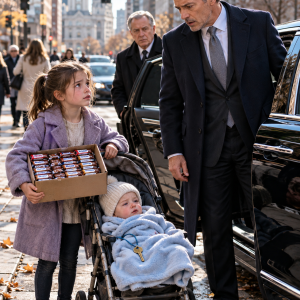
The first time Owen truly needed me, he crossed seven blocks to find an open door.
He will never have to make that journey alone again.