My name sounded wrong in her mouth.
Claire spoke before I could respond.
“She put Mom’s picture in the kitchen drawer.”
I remembered that photograph.
It was a snapshot of Laura holding Claire at a pumpkin patch. For years it had been attached to our refrigerator by a crooked magnet shaped like a strawberry.
Several weeks earlier, I noticed it was gone.
Meredith told me it must have fallen.
Claire looked up.
“She said you needed to get used to seeing Mom less.”
Meredith shook her head.
“That is not how I said it.”
Claire’s voice became smaller.
“She also said my room would probably be for the new baby someday.”
I turned toward Meredith.
“What?”
“We discussed possibilities.”
“We never discussed moving Claire.”
“Her bedroom is larger, Ethan. If we had a baby, it made practical sense.”
Claire began wiping at her eyes.
“She told me I could have the little room downstairs.”
The little downstairs room was barely large enough for a bed and desk.
Meredith looked increasingly frustrated.
“These were future possibilities. Nothing had been decided.”
“You had decided enough to tell my daughter.”
“Somebody has to think about the future.”
That was when I understood what I had failed to see.
Meredith had not imagined joining our family.
She had imagined replacing it.
Claire had been welcome only as long as Meredith believed she would eventually become less central, less visible and less connected to the life we had lived before her.
The Ceremony That Stopped Before It Started

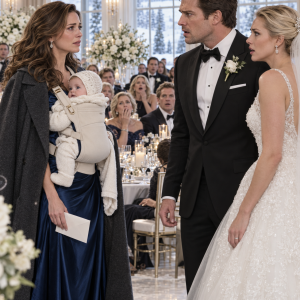
The music changed.
That was the coordinator’s cue for everyone to stand.
Through the open garden doors, guests rose from their chairs and turned toward the aisle.
Meredith glanced toward them, then reached for my arm.
“We are all upset. Let’s get through the ceremony, and we can talk tonight.”
I stepped away.
“There won’t be a ceremony.”
Her expression froze.
“Ethan.”
“I’m not marrying you today.”
For the first time, fear replaced anger on her face.
“You cannot make a decision like this because a child misunderstood a conversation.”
“I’m making this decision because you isolated my daughter on purpose and made her believe she should be ashamed of her place in my life.”
“Then talk to me privately.”
Her voice became urgent.
“Please don’t embarrass me in front of everyone.”
For one brief moment, every instinct I had developed as an adult told me to reduce the scene, move indoors and protect everyone’s dignity.
Then I looked at Claire.
If I hid the reason the wedding was stopping, what would she learn?
That Meredith deserved protection from embarrassment while Claire was expected to carry hers quietly?
I could not do that.
I walked toward the arbor with Claire beside me.
The coordinator stopped the music.
Sixty-four people stared back at us.
I picked up the microphone.
“Thank you for coming. I know many of you traveled a long way, but there will not be a wedding today.”
A murmur moved across the lawn.
Meredith approached behind us.
“Ethan, please don’t turn a private family disagreement into a public accusation.”
I looked at the guests.
“A few minutes ago, I found Claire in a locked utility room. She had been told to stay there until the ceremony was finished because her presence supposedly interfered with the new family Meredith wanted to create.”
Meredith stepped toward the microphone.
“That is not a fair description.”
I turned toward her.
“Did you tell Claire not to walk in the ceremony?”
Meredith hesitated.
“I asked her to give us space.”
“Did you tell her she needed to stop trying to be the most important girl in my life?”
Her cheeks flushed.
“A wife should not always come second, Ethan.”
Several guests looked away.
I reached into my jacket pocket and removed the wedding band I had been carrying all afternoon. Instead of placing it on Meredith’s hand, I set it on the small table beside the guest book.
“My daughter is not your competition.”
Meredith stared at the ring.
“You’re throwing away our future over one conversation.”
I looked down at Claire.
Her fingers were wrapped tightly around mine.
“No. I’m finally paying attention to my future.”
Meredith’s mother came forward and tried to calm the situation, suggesting that stress had made everyone overly emotional and that blended families often required difficult adjustments.
Emily answered before I could.
“Adjustment is deciding where to spend Thanksgiving. It is not telling a child she has to disappear from her father’s wedding.”
Nothing useful could be gained from arguing further.
Guests slowly began leaving the lawn. My coworkers quietly helped the coordinator move people toward the reception room, where the food had already been prepared. Emily stayed with Claire while I collected our things.
Meredith followed me inside.
“If you leave, I will never forgive you.”
I continued folding Claire’s cardigan into a travel bag.
“That is not the problem I’m responsible for solving today.”
Her voice rose.
“Do you have any idea how much I have accepted for you? Your work schedule, Laura’s pictures, Claire’s moods, your sister constantly hovering around us?”
There it was again.
Accepted.
I turned.
“You never accepted Claire. You tolerated her because you thought eventually you would have enough influence to move her aside.”
Meredith stared at me for a long moment, then pulled off her engagement ring and placed it sharply on the table.
“One day Claire will grow up and build a life of her own. Then maybe you’ll understand what you gave up.”
I picked up my daughter’s bag.
“She does not have to remain a child forever to deserve a father who protects her while she is one.”
Then I walked away.
What Claire Had Been Carrying Alone
At home that evening, Claire changed into gray sweatpants and one of my oversized station T-shirts.
The lavender dress ended up draped across the back of a dining chair.
For several hours I handled practical things because practical things were easier.
I called the venue. I emailed the caterer. I spoke with the photographer. I found the contract for the honeymoon rental and canceled it. I made lists because lists gave my hands something to do.
Eventually Claire fell asleep on the sofa with the dog curled against her feet.
Emily sat across from me at the kitchen table.
“How long has this been happening?”
I had no answer.
Over the following week, Claire slowly gave me one.
Meredith had begun moving Laura’s photographs out of common rooms months earlier.
She told Claire that mentioning her mother made me sad and that a good daughter would help me move forward by speaking about her less often.
She told Claire that my long work shifts proved adults sometimes had responsibilities more important than children.
When Claire became anxious about the wedding, Meredith called her selfish.
Worst of all, she convinced Claire that telling me any of this would ruin my chance at happiness.
My daughter had remained quiet because she believed silence was a gift she was giving me.
That was the part I struggled with most.
I had mistaken Claire’s silence for adjustment.
I had seen her becoming quieter around Meredith and thought she was simply growing older.
I had noticed her stomachaches before family outings and assumed she was nervous about change.
I had wanted our new life to work so badly that I kept finding reasonable explanations for things that deserved closer attention.
A week after the wedding, Claire and I began meeting with a family counselor named Dr. Rachel Monroe.
During our second visit, Claire finally described what Meredith had told her in the utility room.
“She said Dad needed a normal family.”
Claire kept her eyes on the carpet.
“She said I made everything harder because I still wanted Mom to be part of things.”
Every protective instinct in me rose at once, but Dr. Monroe gave me a small look that reminded me Claire needed reassurance more than anger.
I moved my chair closer.
“You are not the reason anything became harder.”
Claire looked at me.
“But what if you want to get married someday?”
“Then the person I marry will understand something before we ever get near a wedding.”
She waited.
“Loving me means respecting you. It means respecting where we came from. Nobody gets to build a future with us by asking us to pretend our past never happened.”
Claire studied my face.
“Would you cancel another wedding?”
I smiled.
“I hope I get smarter long before another wedding.”
For the first time in several difficult weeks, she smiled too.
Building a Home That Did Not Need Erasing

Meredith tried contacting me for nearly a month.
At first she insisted Claire had exaggerated everything. Later she claimed the utility-room conversation had lasted only a few minutes and had been misunderstood. Eventually her argument became that a healthy marriage required a husband to make his wife his highest priority.
I responded once, through an attorney.
My message was simple: no adult relationship should require a young child to be pushed aside or taught that loving a parent from her earlier life was disloyal.
After that, communication gradually stopped.
At work, news of the canceled wedding traveled farther than I would have preferred. Fire stations are not particularly good places for secrets.
One afternoon my division chief, Robert Hayes, called me into his office.