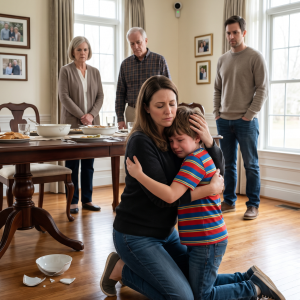
Nora gathered her close. “You never have to fix a grown-up problem. Not ever. Do you understand me?”
Maisie looked over her mother’s shoulder at me. “But Mr. Gideon said—”
“Mr. Gideon was wrong,” I said.
Four faces turned toward me. I crouched several feet away, holding out the rabbit.
“Wrong like when I colored your work paper?” Maisie asked.
Two months earlier, she had drawn an enormous orange moon on the reverse side of a shipping agreement.
“Something like that.”
“Did you get another paper?”
“I did.”
She considered this carefully. “Then it got better.”
I held Juniper closer. Maisie climbed from her mother’s arms, took the rabbit, and gave me a quick embrace around the neck.
“You found her.”
“Yes.”
“Thank you.”
Then she returned to Nora. Her forgiveness was simple, complete, and unearned.
A Home That Could Vanish

By nine o’clock, Maisie was eating eggs in the kitchen while Nora, Ruth, Mrs. Pritchard, and two cooks watched her as if breakfast were a public celebration. I returned to the library and called Wade inside.
The maple chair stood beside my window.
“Cancel the order,” I said.
“Already canceled.”
I looked at him. “You assumed?”
“I hoped.”
“Nora stays. Maisie stays.”
“And Owen?”
I turned toward the wet lawn beyond the glass. “What do we actually know?”
“Twelve thousand dollars disappeared. His code was used. He admitted taking it.”
“What do we not know?”
Wade closed the door. “Why he took it.”
I had never asked. That omission now seemed larger than the missing money.
“Find him,” I said.
“For what purpose?”
Yesterday, my answer would have been consequence. That morning, I chose a different word.
“A conversation.”
Nora came to the library before noon and knocked. For the first time since I had known her, I disliked that sound.
“You do not need permission,” I told her.
She entered but remained standing. “I appreciate that you withdrew the order, but we cannot simply return to the way things were.”
“It should never have included you.”
“It should never have included Maisie.”
“No.”
She seemed surprised that I did not defend myself.
“My daughter needs stability,” she continued.
“You have it here.”
“Do we?”
The question was quiet, but there was no easy answer. Nora glanced toward the little chair.
“Maisie loves this house. She loves the kitchen and the gardens, and she loves you. But one decision from you nearly took everything away. This can never be a stable home if our lives depend entirely on whether you are pleased with us.”
“My decisions are not moods.”
“No. They are rules, and rules can be just as frightening when the people affected by them have no voice.”
I had built a world in which no one questioned me. Nora had done it three times that morning, and I was still listening.
“What are you asking for?”
“A choice.”
“You have one.”
“I have a room because I work here. If you dismiss me tomorrow, my job and our home disappear together.”
Then I understood. Nora did not want rescue or generosity. She wanted the dignity of knowing that her future belonged to her.
“What would independence look like?” I asked.
She hesitated. “I have been saving to open a bakery.”
“A bakery?”
“Who do you think makes the rosemary shortbread you steal every Thursday?”
“I do not steal it.”
“The tin is labeled for the afternoon staff.”
I looked away, and her mouth curved into the first genuine smile I had seen that day.
There was a narrow shop for sale near Cedar Hill, with an apartment upstairs and an owner preparing to retire. She hoped to afford it within a year.
“How much do you need?” I asked.
“No.”
“I have not offered anything.”
“You were about to.”
“A loan, then.”
“No.”
“An investment.”
“Gideon, I am trying to build a life that cannot vanish because a powerful man changes his mind.”
Powerful. Once, I had wanted no better description. In Nora’s voice, it sounded empty.
I offered her an employment agreement guaranteeing six months’ notice and making clear that Maisie’s home could never be used as leverage. I would also introduce her to the shop owner’s accountant without contributing money or taking control.
“Why would you do that?” she asked.
Because I wanted her to stay, and because I was learning that caring for people did not give me ownership of their choices.
Instead, I said, “Because you asked for one.”
Nora finally sat down. It felt like more progress than any promise could have been.
The Reason Behind the Missing Money
Wade found Owen late that afternoon in the cafeteria at Mercy Crossing Medical Center. When he named the place, the cup on Nora’s tray slipped from her hand and broke on the hallway floor.
“Why is he there?” she asked.
“We do not know,” Wade replied.
Nora steadied herself against the wall. “My husband passed away there. Owen has avoided that building ever since.”
We drove into Richmond without a convoy, and I discovered how little authority mattered inside a silent car.
Owen sat near a vending machine, looking as if he had not slept. When he saw Nora, he stood so quickly that his chair scraped the tile.
“What are you doing here?” they asked each other at almost the same moment.
Then Owen looked at me. “If you came for the money, I do not have it.”
“I know.”
Nora stepped closer. “Then tell me why you are here.”
His shoulders lowered, the way a man’s shoulders do when a burden has finally become too heavy to conceal.
“Rebecca is ill,” he said.