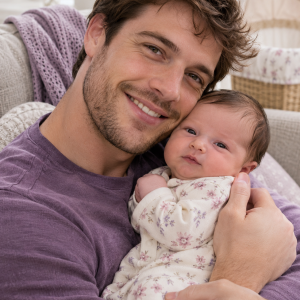
The Morning I Woke Up With Only One Baby

At thirty-eight weeks pregnant with twin boys, I had reached that strange final stretch of pregnancy when every ordinary task felt like something I needed to negotiate with my own body.
I moved slowly through our house outside Portland, Oregon, one hand almost always resting beneath my stomach, while my husband, Nathan Cole, teased me that I had developed the careful walk of someone carrying two bowls filled to the very edge.
For most of the pregnancy, there had been very little to worry about.
Every appointment had ended with reassuring words. Both boys were growing well. Their heartbeats were strong. I had spent months folding tiny sleepers, arranging diapers in two neat rows, and standing in the doorway of the nursery trying to imagine what our quiet house would sound like after two newborns arrived at once.
Nathan had appeared excited too.
He was thirty-six, worked in commercial lending, and had always been the calmer one in our marriage. Whenever I worried about whether we could handle two babies, he would put his hands on my shoulders and remind me that people had raised twins with far less preparation than we had.
“We’ll be tired,” he would say, smiling. “But we’ll figure it out. That’s what families do.”
I believed him.
I believed him so completely that, even now, remembering those words feels like touching something that once looked solid and discovering it had been hollow all along.
The afternoon everything changed began without warning.
I was standing beside the kitchen counter slicing an apple when a fierce pressure tightened across my abdomen. At first I thought labor had started, but within seconds the pain became so intense that the knife slipped from my fingers and struck the cutting board.
I remember gripping the edge of the counter.
I remember calling Nathan.
After that, my memories arrive only in fragments: the sound of paramedics entering the house, a bright ceiling moving above me, someone asking me to keep my eyes open, Nathan’s frightened face appearing briefly beside the ambulance doors.
Then there was nothing.
When I opened my eyes again, the light in the hospital room was gray and soft, as though morning had been waiting patiently for me to return.
My throat felt dry. My body seemed impossibly heavy.
For several seconds, I did not understand where I was.
Then I saw Nathan.
He was sitting beside the bed in the same chair he must have occupied for hours, his hair uncombed, his shirt wrinkled, his face drawn with exhaustion. The instant he realized I was awake, he stood so quickly that the chair scraped across the floor.
“Emily?”
I tried to answer, but my voice barely came out.
“The babies.”
His expression changed.
It was a tiny movement, no more than a tightening around the eyes, but I saw it.
Nathan sat on the mattress beside me and took my hand between both of his.
“One of the boys is doing well,” he said carefully. “He’s in the neonatal unit. He needed some help at first, but the doctors say he’s strong.”
I waited.
There should have been another sentence.
When it did not come, the room seemed to grow smaller.
“And the other baby?”
Nathan lowered his head.
Then he began to cry.
“I’m so sorry, Em.”
For several moments, I simply stared at him.
My mind refused to move beyond those four words.
“What are you saying?”
He squeezed my fingers.
“There were complications during the delivery. The doctors tried everything they could, but our second little boy didn’t make it through.”
Something inside me went completely quiet.
I had spent months imagining two cries, two car seats, two tiny faces sleeping beside each other. I had bought matching blankets in slightly different shades of blue because I had worried we might mix them up during midnight feedings.
Now Nathan was telling me that only one of those blankets would ever be needed.
I turned my face toward the window.
I cried without making much sound, partly because I was too weak and partly because grief seemed too large for anything my body could produce.
Nathan leaned over me and pressed his forehead against my shoulder.
He cried too.
That was the part I remembered later.
How convincing his tears had been.
For the next two days, I depended on him almost completely.
He brought me water. He spoke with doctors when I was too tired to follow what they were saying. He brushed my hair one morning because lifting my arms hurt. He placed fresh white roses on the windowsill and told every visitor that we needed to focus on gratitude for the baby we still had.
The hospital staff praised him constantly.
“Your husband hasn’t left your side,” one woman told me.
Another smiled and said, “Your little boy is lucky to have two parents who love him this much.”
I remember looking at Nathan and thinking that, whatever sorrow waited for us after we went home, at least I would not face it alone.
I had no idea that I was already alone.
The Woman Who Wouldn’t Meet My Eyes
On the third morning after I regained consciousness, the neonatal team finally decided our surviving son was stable enough to spend several hours in my room.
We had named him Evan.
Nathan and I had chosen two names months earlier, but after everything that had happened, neither of us had spoken the second name aloud.
Around ten that morning, the door opened and a woman I had seen several times in the neonatal wing entered, pushing Evan’s bassinet.
Her name was Megan Holloway.
Megan was not one of my regular nurses. She worked as a neonatal family-care specialist, helping parents prepare for feeding schedules, discharge routines, and the transition home. She was somewhere in her early forties, with light brown hair usually pulled into a low ponytail and the calm, practical manner of someone who had spent years around frightened new parents.
That morning, however, something about her seemed different.
She smiled at Nathan.
“Ready to have your little guy in here for a while?”
Nathan immediately stood.
“More than ready.”
Megan moved the bassinet beside my bed and carefully lifted Evan.
The first time I held him while fully awake, the room around me disappeared.
He was smaller than I remembered imagining. His entire head fit against the curve between my wrist and elbow, and when I touched his cheek with one finger, he turned slightly toward me as though he already recognized that I belonged to him.
I began crying again.
But these tears felt different.
They carried love, relief, sorrow, guilt, and a gratitude so intense that it almost hurt.
Nathan stood beside us, taking pictures on his phone.
“Look at him,” he whispered. “He has your mouth.”
Megan adjusted Evan’s blanket.
Then, without looking directly at me, she spoke so quietly that I almost thought I had imagined it.
“Keep smiling.”
My eyes lifted toward her.
Her expression did not change.
She tucked the blanket more securely around Evan’s legs.
“I sent something to your phone,” she murmured.
My heart began beating faster.
I forced myself to look back at the baby.
Nathan was only a few feet away.
Megan continued explaining feeding instructions in a perfectly normal voice, pointing to the chart on Evan’s bassinet. Then she leaned close as though checking the identification band around his ankle.
Her next words were almost inaudible.
“Do not open it while your husband is in this room.”
My fingers tightened beneath the blanket.
For one dangerous second, I nearly turned toward Nathan.
Megan’s hand touched my wrist.
Not firmly.
Just enough to stop me.
“Smile,” she whispered again.
So I did.
I smiled while my entire body went cold.
For the next twenty minutes, I barely heard anything Nathan said.
He talked about ordering lunch. He showed me a picture his mother, Patricia, had sent of flowers waiting for us at home. He asked whether I thought Evan looked more like my father or his.
I answered automatically.
All I could think about was my phone lying on the bedside table.
Eventually Nathan glanced at the clock.
“I’m going downstairs for coffee. You want your usual?”
“Yes.”
My voice sounded surprisingly normal.
He bent to kiss my forehead.
“Back in ten minutes.”
I watched him leave.
I waited until the door clicked shut.
Then I reached for my phone.
There was one new message from a number I did not recognize.
No introduction.
No explanation.
Just a video file.
Twenty-nine seconds.
For reasons I still cannot explain, I hesitated before pressing play.
Perhaps some part of me understood that there are moments when your life divides itself into before and after, and once you cross the line between them, you can never return to the person you were.
Then I touched the screen.
The video began.
Twenty-Nine Seconds

The footage came from a security camera mounted high in the corner of a hospital consultation room near the surgical wing.
The image was slightly grainy, but the people in it were unmistakable.
Nathan stood beside a clear newborn transport bassinet.
Inside was a sleeping baby wrapped in a hospital blanket.
Beside my husband stood his mother, Patricia Cole.
Patricia was a wealthy property investor from West Linn who had spent most of our marriage treating every family decision as though she had purchased the right to approve it. She had never openly disliked me, which somehow made her behavior harder to confront. Instead, she questioned everything gently, politely, relentlessly.
Was our house really large enough?
Was I planning to continue my bookkeeping business after the twins arrived?
Would two babies be too much for someone who had been raised as an only child?
Had Nathan truly considered the long-term cost of raising twins?
Before the delivery, I had dismissed most of it as the behavior of a controlling mother who had difficulty accepting that her grown son had his own family.
In the video, Patricia held a document folder.
She placed it on the table in front of Nathan and handed him a pen.
The camera also captured audio.
Her voice came through my phone speaker.
“The placement coordinator is downstairs. Once you sign, they can leave through the private transport entrance.”
Nathan stared at the papers.
“What if Emily asks questions?”
Patricia’s answer came immediately.
“She was unconscious through most of the emergency. She’ll believe what the doctors tell her.”
My breathing stopped.
On the screen, Nathan looked toward the bassinet.
For one desperate instant, I expected him to push the papers away.
Instead, he signed.
Patricia gathered the documents.
A man wearing a medical-transport jacket entered the room.
Nathan lifted the newborn from the bassinet.
My newborn.
My second son.
He held him for perhaps three seconds.
Then he placed him into the arms of a stranger.