Another voice came up the stairs, calm and clear.
“Ma’am, this is Officer Jamie Lawson. Are you behind this door?”
“Yes,” I called. “Please help me.”
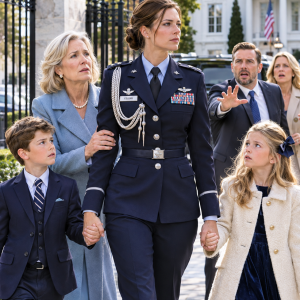
Someone tried the handle, then asked whether I could step back. I shifted carefully toward the wall, holding Lily close as the lock turned from the other side. The door opened, and Officer Lawson was there with another officer behind her. She looked first at the baby, then at me, and the concern on her face was immediate.
“We need an ambulance,” she said over her shoulder. Then, turning to me, “You’re not alone. The paramedics are coming upstairs now.”
The next few minutes passed in a blur of practical kindness. One paramedic wrapped Lily in a warm blanket and checked her while another helped me onto a stretcher. Kevin tried to come with us, but Officer Lawson stepped between him and the doorway.
“Sir, we need to talk with you here.”
Barbara stood near the stairs, her eyes wet and her hands clasped together.
“We were only trying to protect our granddaughter,” she said.
Even then, I could not stop looking at the forms on the bathroom floor.
“Protect her from what?” I asked.
Neither of them answered.
A File I Had Never Seen

At Franklin Regional Medical Center, a physician named Dr. Morgan Hale examined me while a nurse brought Lily to the pediatric team for a checkup. My symptoms had become serious enough that the medical staff moved quickly, and Dr. Hale explained that they needed to treat a postpartum complication without delay. She spoke to me in a measured voice, answering each question plainly, and for the first time that day I felt that someone was listening without deciding in advance what I meant.
“How long have you been feeling this way?” she asked.
“The cramps started three days ago, but they got much worse today,” I said. “I kept telling Kevin I wasn’t feeling right.”
“And he didn’t bring you in?”
I looked down at my hands.
“He said I was making too much of it.”
Dr. Hale watched my face for a moment before writing anything in my chart.
“Has anyone kept you from getting medical care before?”
I thought of the times our car keys had gone missing just before appointments, and of the evenings when Kevin had taken my phone during an argument because he said I was using it to upset myself. I remembered Barbara suggesting that I cancel my follow-up visit because Lily and I both needed rest, then telling me that a good mother should trust her family instead of worrying over every ache.
“Yes,” I said, so quietly that I was not sure the doctor had heard me.
She set down her pen and gave me her full attention.
“You can tell me what happened. I’ll make a note of what you share, and we can discuss what support you need.”
I described the missing keys, the phone, and the way Kevin spoke whenever I asked for help. I did not know whether each detail mattered, but I had reached a point where keeping the whole story to myself felt heavier than telling it.
Officer Lawson returned while I was receiving treatment. She asked whether I felt well enough to answer a few questions, and when I said yes, she explained that the officers had recovered the documents from our home and had also found a folder in Kevin’s locked office.
On its cover, someone had written my name followed by the words Medical History.
Inside were notes, medication lists, and reports describing psychiatric appointments I had never attended. One document claimed that I had been evaluated by a doctor after Lily’s birth. Another suggested that I had become unable to make sound decisions about my daughter. The pages appeared official, with dates and signatures, but I had never met the physician named on them.
“We’re checking whether the records are genuine,” Officer Lawson said. “Your husband had already shown copies to a family-law attorney.”
I tried to sit up, but the nurse gently asked me to remain still.
“Why would he do that?”
“He had asked about temporary custody arrangements,” she said. “We’re still learning what he intended to do.”
The doctor’s name caught my attention when she turned one page toward me. It belonged to Dr. Adrian Wells, a psychiatrist Barbara had introduced at our baby shower as an old family friend. She had said he was thoughtful, discreet, and well regarded, then changed the subject before I had a chance to ask much about him.
“I’ve never been his patient,” I said. “I met him once at the shower.”
Officer Lawson wrote that down, then asked if I knew why his signature might be on those forms.
I shook my head, though I could feel a terrible answer beginning to take shape. Kevin had not only dismissed my symptoms. He had apparently been preparing a story about me, one that could make his demands seem reasonable to people who had never met me.
When I asked why he had done it, Officer Lawson did not pretend to know.
“We’re still investigating,” she said. “But the emergency call gave us a clear record of what was happening in that house.”
A few hours later, Dr. Hale returned with better news. The treatment had helped, my condition was improving, and Lily’s examination showed that she was healthy. I looked at my daughter in the clear bassinet beside me, and the tightness in my chest eased just enough for a full breath.
Then my phone rang. The caller was Meredith Shaw, the attorney I had contacted several months earlier after Kevin and I began disagreeing about our finances. I had thought those disagreements were ordinary, the kind that could be handled with time and better communication. I had never expected to hear from her while recovering in a hospital room with an officer beside my bed.
“I heard what happened,” Meredith said. “Are you and Lily safe?”
“We’re both here, and she’s doing well.”
“Good. I reviewed the documents the officers recovered, with your permission. The power-of-attorney form could have given Kevin substantial control over financial matters if you had signed it. The guardianship form is more complicated, but the medical records could have been used to support a request for temporary custody.”