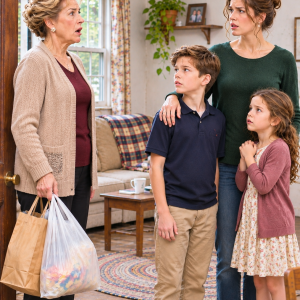
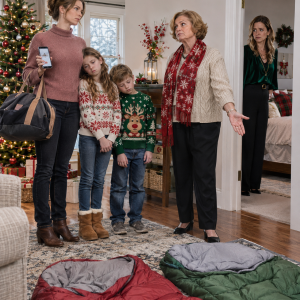
“This is our first trip without him. Hadley is trying to act older because she thinks she needs to help me. Theo obviously doesn’t understand what happened. And I’m still figuring out how to get through a normal day without calling Gavin when something goes wrong.”
Marianne looked down.
“I had no idea.”
“Exactly.”
She looked back at me.
I kept my voice gentle.
“You didn’t have to know my story to treat me with respect.”
Her eyes filled.
“You’re right.”
Then she said the simplest thing she had said all morning.
“I’m sorry.”
I believed her.
But an apology was only the beginning.
The Message She Almost Didn’t Send
Marianne pulled out her phone.
“I should write to Kelsey.”
“Probably.”
She opened a message window and stared at it.
After nearly a minute, she asked, “What would you say?”
I shook my head.
“It has to sound like you, not me.”
“I don’t know how to start.”
Hadley leaned forward from behind us.
“Start with what you did wrong.”
Marianne turned toward her.
Hadley shrugged.
“Dad always said apologies don’t work when you spend the whole time explaining why you did the thing you’re apologizing for.”
For the first time, Marianne laughed.
A real laugh.
“Your father sounds like he was a wise man.”
Hadley’s expression softened.
“He was.”
Marianne began typing.
She told Kelsey that she had spent too much time criticizing choices she had never tried to understand.
She admitted she had been preparing to arrive in Boston with advice instead of support.
She wrote that she wanted to meet her grandson without telling Kelsey how to raise him.
Then she stopped.
“What do I promise?”
I answered, “Don’t promise perfection. Promise a different effort.”
Marianne typed again.
Finally, she pressed send.
The Reply
About fifteen minutes later, Marianne’s phone buzzed.
Her hands trembled as she opened the message.
Kelsey had written:
“You can still come. But I need you to mean what you just wrote. I don’t need another inspection. I need my mother.”
Marianne read the message twice.
Then a third time.
“Do you think that means she forgives me?”
I shook my head.
“I think it means she’s giving you a chance.”
Hadley added from behind us, “A chance is pretty good.”
Marianne smiled faintly.
“Yes. I suppose it is.”
The Arrivals Hall
When we landed in Boston, Hadley carried her backpack while I pushed Theo’s stroller toward baggage claim.
Marianne walked several steps behind us.
The confident woman who had boarded the plane in Seattle looked suddenly nervous.
Then she stopped.
Near a row of baggage carousels stood the woman from the photograph.
Kelsey.
She held a baby against her chest.
Marianne did not rush toward her.
She simply stood several feet away.
Then she asked, “May I hug you?”
Kelsey looked at her mother for a long moment.
Finally, she nodded.
Marianne walked forward.
The hug was brief and cautious.
When they separated, Marianne did not immediately reach for her grandson.
Instead she said something quietly to Kelsey.
Kelsey listened.
Then she took a small step closer.
It was not a dramatic reunion.
There were no cheers.
No perfect ending appeared within thirty seconds.
But as Hadley and I walked toward my mother, I looked back once.
Marianne and Kelsey were walking beside each other.
And that seemed like enough.
The Card That Arrived Later
Almost a month later, a card arrived at my mother’s house.
I recognized Marianne’s handwriting.
Inside was a photograph.
Marianne was sitting on Kelsey’s sofa with her grandson resting against her.
Kelsey sat beside them with one hand gently touching the baby’s back.
Nobody looked perfectly relaxed.
But they were together.
Below the photograph, Marianne had written:
“I’m learning to listen before correcting, ask before advising, and love someone without requiring them to live exactly as I would. Please tell Hadley that one brave question followed me all the way home.”
Hadley pinned the card to my mother’s kitchen board.
I stood beside her and asked, “Why do you want to keep it?”
She smoothed the corner.
Then she looked at me with Gavin’s eyes.
“Because sometimes speaking up doesn’t just stop somebody from being mean.”
She glanced at Marianne’s photograph.
“Sometimes it gives them a chance to become better.”
I pulled her into my arms.
For once, neither of us tried to hide that we were thinking about Gavin.
And somehow, that did not feel quite as unbearable as it had before.
Kindness matters most when we know almost nothing about the person standing in front of us, because the story we cannot see may be carrying far more weight than the few seconds we are using to judge them.
A mother caring for her child in public does not need strangers to grade her choices; sometimes what she needs most is simply enough space, patience, and dignity to do what her family requires.
Children often notice hypocrisy long before adults are willing to admit it, and one sincere question from a child can sometimes expose a truth that years of arguments never managed to reach.
Saying “I’m sorry” is meaningful only when we are also willing to examine the behavior behind the apology and make different choices when the same situation appears again.
Loving our adult children does not mean controlling every decision they make, because real love creates room for another person to build a life that may look different from the one we imagined for them.
We should be careful about deciding what kind of parent, spouse, daughter, son, or human being someone is after observing only a few difficult minutes of their day.
Grief does not always look dramatic; sometimes it looks like checking boarding passes four times, carrying an old sweatshirt in a suitcase, or trying to complete an ordinary task without the person who once shared it with you.
Courage is not always loud or confrontational; sometimes courage is an eight-year-old calmly asking an adult whether she would accept the same treatment for someone she loves.
Families are rarely repaired by one perfect conversation, but a sincere apology, a willingness to listen, and one small change repeated consistently can become the beginning of something much stronger.
Before criticizing a stranger, imagine that the person in front of you is someone you deeply love, because the respect you would hope the world gives your own family is the same respect another family is hoping you will give theirs.