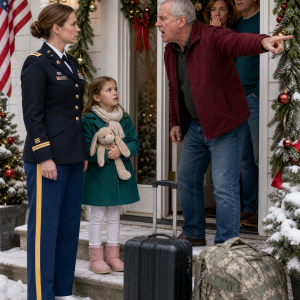
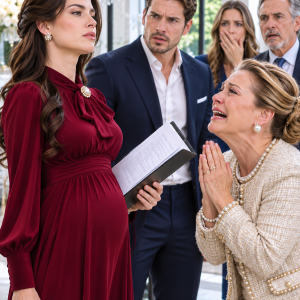
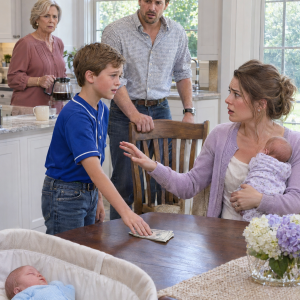
Miriam arrived with the guards and told her that Owen’s visitor list had been restricted. Eleanor’s eyes found me at the far end of the hall.
For years, I had swallowed disagreements because I wanted Owen to keep a connection to his father’s family. Now I could see that protecting him required me to stop treating every boundary as a negotiation.
Eleanor mouthed something I could not hear. I raised my phone and began recording. Once she realized the exchange was being documented, she turned toward the elevators.
The effort of standing there calmly left me shaky, but I returned to Owen’s room with my shoulders squared.
“Was that Grandma?” he asked.
“Yes. The hospital rules are keeping you safe,” I told him. “Those rules apply to everyone.”
He watched me for a moment, taking in the fact that I had not argued with her, apologized, or let her pass. The small certainty in his face mattered more than any words I could have offered.
At the end of the week, Rachel called with an update. The company’s vehicle tracking records and billing files matched in ways that raised serious questions. Equipment listed as working on a county water project had spent those same hours at a private development site.
“We’ve confirmed that the records don’t line up,” she said. “And we have a witness from inside the company who’s willing to talk.”
The witness was Cal Brenner, a mechanic who had worked on the company’s fleet for fifteen years. He told Rachel that the storage rack described in the family’s account could not have fallen in the way they claimed. He also said that, on the afternoon Owen was hurt, Arthur, Lewis, and Samuel had questioned the boy about missing printouts from the billing office.
The strongest account came from Victor, the youngest brother. Facing questions about his own role, he hired an attorney and agreed to give a recorded statement. He said Owen had brought several invoices to the workshop because he did not understand why a machine appeared to be assigned to two jobs at once.
According to Victor, the adults became frightened when they realized Owen had seen something they had tried to conceal. Arthur ordered Samuel to take the papers away and make the boy stop asking questions. In the confusion, Samuel shoved Owen backward. Owen fell near equipment that had not been properly secured, and the machinery moved before anyone could stop it.
Victor also described the minutes that followed. Rather than calling for emergency help at once, the adults argued about how to explain what had happened. They took Owen’s phone, erased the workshop camera files, and agreed to describe the incident as a storage rack accident. Only after that discussion did Victor place the call.
As Rachel read the statement to me, I felt as if I were hearing the outline of a room I had never wanted to enter. I asked her to repeat the part about the delay, then asked for a moment alone.
The Courtroom And The Long Way Home

The state moved quickly once Rachel had the company records, Cal’s account, and Victor’s statement. Formal charges followed against the family members involved in the incident and the billing scheme. Detective Mercer was also investigated after Rachel uncovered evidence that he had accepted improper payments connected to Voss Site Services.
I expected the news to bring relief. Instead, I felt tired in a way sleep could not fix. Court documents could describe the allegations, but they could not explain what it felt like to watch Owen flinch when a door closed or to sit awake listening to the monitors beside his bed.
When I told him that the adults involved were being held accountable, he did not cheer. He was sketching with his non-dominant hand, making slow, uneven lines across the paper.
“If Grandma says she’s sorry, do I have to forgive her?” he asked.
“No,” I said. “You don’t owe anyone forgiveness because they ask for it. You get to decide what feels safe for you.”
He turned toward the window.
“I don’t want to see her again.”
“Then you won’t have to. I’ll make sure of it.”
The defense lawyers argued that Owen could not remember events clearly and that Victor had a reason to blame his brothers. Cal testified about the workshop layout, while Rachel presented tracking records that placed equipment at different sites than the invoices claimed. The evidence did not depend on one person’s memory.
When I testified, one lawyer asked whether my decision to deploy had left Owen vulnerable. The question was designed to make my service sound like a choice I should regret, and for a moment the courtroom seemed to narrow around me.
I leaned toward the microphone.
“I left my son with family members who promised to care for him,” I said. “I did not give anyone permission to frighten him, put him in danger, or delay getting him help.”
The judge allowed the answer to stand. I returned to my seat and looked at Owen, who was watching from beside his advocate. He gave me the smallest nod.
The proceedings took months. In the end, several family members were convicted for their roles in the incident, the false account, and the financial scheme. The company’s assets were used to repay the county. Mercer was removed from his position and faced his own legal consequences.
There was no single moment when everything felt settled. Owen’s rehabilitation was slow, with good mornings followed by afternoons when the pain and frustration left him unwilling to speak. I moved into a reserve administrative role so I could be home more often. We learned to take each day as it came, without pretending that progress always moved in a straight line.
I tried not to let my vigilance become another burden for him. I checked the locks once at night, then made myself leave them alone. We returned to ordinary things in small pieces: breakfast at the kitchen table, a walk to the mailbox, a movie on a rainy evening.
Six months after the hearings ended, Owen opened a storage box in the living room and found the photograph of our unfinished cardboard bridge. Its center span was still missing.
He smoothed the curled corner of the picture.
“We never finished the middle,” he said.
I sat down beside him on the rug, where we had built the first version years ago.
“We didn’t,” I said. “The design needed more support.”
He studied the picture, then looked at his healing hands.
“Could we build a stronger one this time?”
I brought over a fresh sheet of drafting paper. The bridge we had started before my deployment had been made of cardboard and careful measurements. The one we would build now needed something else, too: patience, honesty, and the knowledge that love did not require either of us to stay silent.
“I think we can,” I said. “We know more about what helps it stand.”
Owen picked up a pencil, and together we began again.