The Two Girls Who Made Us a Family

For thirteen years, I believed I understood why my husband had walked away from our family.
I had built an entire explanation around that belief, not because anyone had ever confirmed it, but because human beings are uncomfortable with empty spaces, and when someone leaves without giving you enough truth to make sense of it, you eventually fill the silence yourself.
In my version, Nathan Mercer had simply reached the limit of what he could bear.
We had lost one of our twin daughters when she was five, and three days after the memorial service, while our surviving daughter slept down the hall, Nathan sat across from me at our kitchen table and told me he could not continue living the life we had built together.
Then he packed a suitcase and left.
For years, that was all I knew.
It was also all I thought I needed to know.
Until the night our daughter turned eighteen, when my father walked into my kitchen carrying an old cardboard box and told me that almost everything I believed about Nathan was incomplete.
But before I tell you about that box, I need to tell you about my daughters.
Claire and Sophie Mercer were born eight minutes apart on a bright June morning in Columbus, Ohio, and although everyone insisted they were nearly impossible to tell apart, I never understood how anyone could confuse them.
Claire came first and behaved, from infancy onward, as though those eight minutes had given her seniority over the entire household. She was thoughtful, cautious, and wonderfully serious about things most children never bothered to analyze. Before she learned to walk, she spent weeks watching other people do it, studying feet and furniture and balance as though she were preparing for an examination.
Sophie approached life differently.
She walked early because patience had apparently not been included in her personality, and within days she had converted walking into running, climbing, tumbling, laughing, and beginning all over again. She spoke to strangers in grocery-store lines, complimented people’s hats, invented names for squirrels, and believed nearly every tree existed because someone was supposed to climb it.
My father, Walter Bennett, called the girls “the weather and the map.”
Sophie was the weather—unpredictable, energetic, impossible to ignore.
Claire was the map—the one who knew where they were going and usually how to get home.
One summer afternoon, when they were four, Sophie decided she could reach the lowest branch of an enormous maple tree in my parents’ backyard while Claire stood below offering increasingly detailed instructions.
My father watched them for several minutes before shaking his head.
“Those two are one complete operation,” he said. “Separate them and neither one knows what to do with herself.”
Nathan laughed.
I can still remember that laugh.
Back then, he was everything I thought a husband and father should be—not spectacular in the theatrical sense, but dependable in all the ways that become far more important after you have built a life with someone.
He made pancakes on Saturday mornings. He knew which daughter wanted the hallway light left on and which wanted complete darkness. He packed lunches badly but enthusiastically. He remembered pediatric appointments without being reminded, attended school events even when work was inconvenient, and could tell which girl was calling him from another room simply by the rhythm of her footsteps.
Nathan worked as a civil engineer, and perhaps that suited him because he trusted structures. He believed things should be built carefully, inspected honestly, and repaired before small weaknesses became large ones.
For the first five years of our daughters’ lives, I believed our marriage had been built that way too.
Then, one Tuesday in March, everything changed.
The Tuesday That Divided Our Lives
There was nothing remarkable about that morning.
That fact bothered me for years.
You imagine the day that changes your life should announce itself somehow, perhaps with strange weather or an uneasy feeling you later recognize as a warning, but our morning was painfully ordinary.
Sophie complained that her head hurt while eating cereal.
She had stayed up too late the night before whispering with Claire, so I assumed she was tired. I gave her the ordinary care a mother gives a child who seems slightly under the weather, kissed both girls goodbye, and reminded them not to argue with their teacher about who was technically older.
At 11:20, the school called.
Sophie had suddenly become seriously unwell in class and had been taken for emergency care.
The hours that followed exist in my memory as disconnected images rather than a continuous sequence: my hands gripping the steering wheel, fluorescent lights, a paper cup of water I never drank, Nathan arriving with his shirt half tucked in, a physician lowering himself into the chair across from us.
Sophie had been born with a hidden weakness in a vessel in her brain, something no ordinary childhood examination had revealed. For five years it had caused no visible problem.
Then, without warning, it did.
By the time I reached the hospital, our little girl could no longer come home with us.
For a long time afterward, the detail that haunted me most was the simplicity of our final conversation.
I had told her to fasten her seat belt properly.
She had rolled her eyes with the dramatic expertise of a five-year-old who had recently discovered that adults could be mildly ridiculous.
“I know, Mom.”
Those were among the last words I remembered clearly.
No grand goodbye. No final wisdom. Just a seat belt, a school morning, and a little girl disappearing through a doorway with her sister.
Afterward, our house seemed to have forgotten how to be a house.
There were toys belonging to two children but only one child to play with them. Two toothbrushes stood beside the sink. Two coats hung near the back door. Claire woke during the night asking questions that neither Nathan nor I knew how to answer.
For three days, Nathan and I moved around each other like people trying to cross a frozen lake without knowing where the ice was thin.
Then, on the third evening after the service, he asked me to sit with him at the kitchen table.
He looked exhausted.
I assumed we were finally going to talk about Sophie.
Instead, he stared at his hands and said, “Rebecca, I’m sorry. I can’t keep doing this.”
I remember thinking he meant grief.
“Neither can I,” I whispered. “But we have Claire.”
His face tightened.
“That’s not what I mean.”
Then he told me he was leaving.
I asked him why.
He said he could not explain it in a way that would make things better.
I became angry, then desperate, then strangely calm.
“Our daughter just lost her sister,” I said. “You’re going to let her lose her father too?”
Nathan closed his eyes.
For one second, I thought he would change his mind.
Instead, he said, “Someday I hope you’ll understand that I loved both of you.”
I hated him for saying that.
Love, I believed then, was staying.
Nathan carried a suitcase through the front door that night, and I did not see him again for thirteen years.
The Man Who Stayed

If Nathan became the great absence in our lives, my father became the great presence.
Walter Bennett had spent most of his career restoring old houses, which meant he possessed two qualities that proved invaluable during those years: extraordinary patience and an almost unreasonable belief that damaged things could still be made strong.
He never tried to replace Nathan.
He simply arrived.
When I had to work late, Dad picked Claire up from school. When she had a fever, he brought soup and sat on the couch watching old movies with her. When she needed someone to help construct a model bridge for seventh-grade science class, he arrived carrying enough tools to renovate the entire school.
He taught her to drive.
He attended her concerts.
He listened when she was fifteen and convinced the end of a three-month relationship represented the collapse of civilization.
And he never once criticized Nathan in front of her.
I did enough of that silently for both of us.
As the years passed, my anger changed.
At first it burned.
Later it hardened.
Eventually it became something closer to a fact I carried around: Nathan had left. Nathan had chosen himself. Nathan had not been strong enough to remain.
Claire rarely asked about him directly.
She had been five when he disappeared from her daily life, old enough to remember him but young enough that memory gradually became a collection of photographs and sensations.
She remembered sitting on his shoulders at the county fair.
She remembered him singing badly while washing dishes.
She remembered that he smelled like cedar after working in the garage.
Most painfully, she remembered that Sophie had adored him.
I did my best to build a good life around what remained.
Claire grew into a remarkable young woman—quietly funny, observant, thoughtful, and deliberate in exactly the way she had been as a child. Yet every once in a while she would laugh without restraint, and Sophie would return to the room for half a second.
The sound was nearly identical.
It hurt.
It comforted me.
Eventually I stopped trying to decide which feeling was more legitimate.
Both were true.
The Box
Claire turned eighteen on a Saturday.
We celebrated at my house with grandparents, cousins, school friends, too much food, and a cake she claimed was embarrassingly large while eating two pieces of it.
By eleven that evening, everyone had gone home.
Claire went upstairs, and I remained in the kitchen washing dishes.
My father appeared in the doorway.
Something about his face made me turn off the faucet.
“Dad, what’s wrong?”
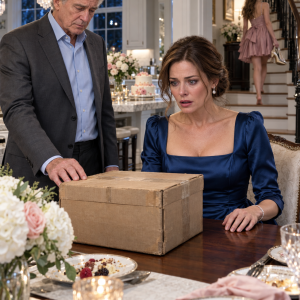
He was holding a cardboard box.
Not an elegant keepsake box or anything that suggested thirteen years of secrets. It was an ordinary storage box, worn at the corners and sealed with aging tape.
My name was written across the top.
I recognized the handwriting immediately.
Nathan’s.
I had not seen it in thirteen years, yet recognition came before thought.
“Where did you get that?”
Dad placed the box on the table.
Then he sat down.
My father had always been a man who looked directly at difficult things, but that night he could barely look at me.
“I made a promise,” he said. “And I’m no longer certain I had the right to make it.”
My stomach tightened.
“What promise?”
He finally met my eyes.
“Nathan asked me not to give you this until Claire turned eighteen.”
For several seconds, I genuinely could not understand the sentence.
“You’ve been talking to Nathan?”
Dad swallowed.
“Yes.”
The room seemed to become very still.
“For how long?”