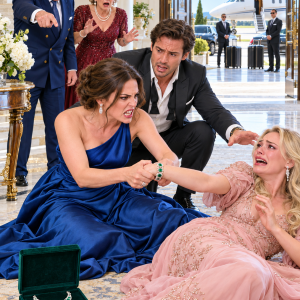
“Then explain why another woman answered your phone while your mother was waiting for you.”
He placed his bag on the floor.
“Her name is Sienna. It’s complicated.”
“Your mother passed away while you were with her.”
He looked away.
“I didn’t know she was that ill.”
“Because you refused to answer.”
Nolan rubbed his forehead.
“Can we discuss this tomorrow? I’ve had a long trip.”
That sentence told me more about our marriage than any confession could have.
I didn’t argue.
I simply walked upstairs, closed the guest bedroom door, and took the silver key from my pocket.
Under the light, I noticed four tiny numbers engraved along its edge.
2147.
Beneath them were three letters.
HNB.
I recognized the initials of Heritage National Bank, where Eleanor had once maintained her personal accounts.
The next morning, I made an appointment.
The Silver Key and the Letter Written Years Earlier
The bank’s private client representative, Mrs. Caroline Foster, studied the key carefully.
“Where did you get this?” she asked.
“My mother-in-law gave it to me before she passed away.”
Caroline looked at her computer, then requested identification.
After confirming the details, she explained that Eleanor had rented a safe-deposit box many years earlier.
My name was listed as an authorized person with access to it.
I stared at her.
“My name?”
“Yes. Mrs. Mercer completed the authorization several years ago.”
I had never known.
A few minutes later, Caroline escorted me into a private room.
Inside the box were three thick envelopes, a small notebook, several photographs, and a folder containing financial records.
The first envelope had my name written across the front.
For Laurel, when you are finally ready to know.
I recognized Eleanor’s handwriting from the years before her second stroke.
My hands trembled as I unfolded the letter.
My dear Laurel,
If you are reading this, I have either found the courage to tell you everything or I am no longer here to explain it myself.
I owe you an apology.
You gave me years of kindness when my own son could barely spare an afternoon.
I tried to protect our family by remaining quiet, but silence only allowed Nolan to take more.
He did not simply neglect my care. He interfered with decisions that should have belonged to me, and he used my condition to gain control of money I never intended him to have.
I stopped reading.
For years, I had believed Eleanor’s financial affairs were managed by professionals appointed after her stroke.
According to the letter, Nolan had quietly replaced those arrangements.
He had persuaded her to sign documents while she was recovering and struggling to understand complicated information.
Later, he had transferred substantial amounts from her investment accounts into companies he secretly controlled.
But the next paragraph was even more disturbing.
After my first stroke, I began improving. My doctor believed I might regain more independence than we originally expected.
Then Nolan insisted on changing my treatment arrangements.
I became weaker, more confused, and increasingly unable to communicate.
I cannot prove everything I suspect, but I kept copies of the records because I knew something was wrong.
I covered my mouth.
For years, I had watched Eleanor struggle.
I had assumed her condition was simply getting worse.
Now I wondered whether there had been warning signs that none of us had recognized.
The Photograph That Changed Everything
The second envelope contained medical summaries, pharmacy records, and notes written by Eleanor before she lost the ability to write.
Several pages showed changes to her medication following appointments arranged by Nolan.
There were also copies of emails requesting independent medical reviews.
One name appeared repeatedly.
Dr. Adrian Whitcomb.
He had treated Eleanor during her first recovery period.
At the bottom of one page, Eleanor had written:
Find Dr. Whitcomb. He questioned the changes and knows what happened afterward.
I turned to the photographs.
Most showed Eleanor at family gatherings, but one immediately caught my attention.
Nolan stood outside a medical office beside a man wearing a white coat.
They appeared to be discussing a folder.
The photograph itself proved nothing.
However, Eleanor had written a date on the back and included a note explaining that Nolan had met privately with the physician who approved her revised treatment plan.
Another document contained a summary of concerns Dr. Whitcomb had raised about those changes.
I sat back in my chair.
The possibility that Eleanor’s care had been influenced by financial motives was frightening.
But I also knew that suspicion was not proof.
I needed someone qualified to examine the records.
I placed everything carefully back into the folder.
Then I opened the third envelope.
Inside were bank statements showing transfers totaling approximately $3.4 million.
The money had moved through several companies with unfamiliar names.
When I examined the ownership documents, I found Nolan’s signature on nearly every page.
He hadn’t simply been careless with his mother’s affairs.
The documents suggested he had been using her assets to support his business while telling me her medical expenses were draining the family savings.
I remembered all the evenings he complained about money.
“We have to be careful, Laurel. Mom’s care is expensive.”
I remembered postponing repairs to our house and taking additional freelance bookkeeping work.
I had trusted him.
And now I was staring at records that suggested he had been deceiving us both.
A Phone Call I Wasn’t Supposed to Receive
I left the bank carrying copies of the documents and Eleanor’s letter.
My first call was to an attorney named Rebecca Hollis, whom a former coworker had recommended.
After hearing a brief explanation, Rebecca agreed to meet me that afternoon.
“Don’t confront your husband with the documents yet,” she advised. “We need to preserve the records, verify the transactions, and have the medical information reviewed independently.”
For the first time since Eleanor’s passing, I felt that someone was helping me think clearly.
I returned to my car and placed the folder on the passenger seat.
Then my phone rang.
Nolan.
I considered ignoring it, but answered.
“Hello?”
His voice was unusually quiet.
“Where are you, Laurel?”
“I’m running errands.”
“Did you go to Heritage National Bank?”
My heart began pounding.