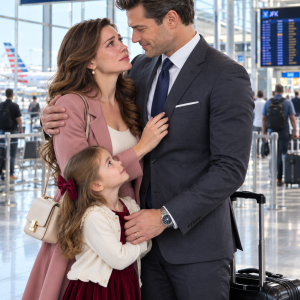
Maisie was quiet.
“Can I talk to her?”
“Maybe. But we’ll do it carefully.”
Later that evening, Brynn found me outside the bridal suite.
Her makeup was smudged and her confidence was gone.
“Can I see her?”
I shook my head.
“Not tonight.”
Her expression changed.
“Tessa, I’m her mother.”
“You are her birth mother. I respect what that means, but I am the person raising her.”
Brynn flinched.
I continued gently but firmly.
“I was there when she was afraid to sleep alone. I took her to her first day of school. I held her when she was sick. I know what food she refuses to eat and which song she wants when she can’t sleep. You gave her life, and that matters. But you cannot suddenly walk into her world because seeing her has awakened feelings you buried.”
Brynn lowered her eyes.
“Do you hate me?”
“No.”
She seemed surprised.
I explained that I could never hate the person whose decision had eventually allowed Maisie to become my daughter.
But if Brynn wanted a relationship with her, it had to happen slowly and responsibly.
“Email me tomorrow. We’ll speak with Maisie’s counselor first. No surprises. No promises you aren’t sure you can keep. And Maisie will never become a way for you to repair your relationship with Calvin.”
Brynn nodded.
“I understand.”
Before leaving the wedding, I encountered Calvin one final time.
He was sitting alone.
The confidence from earlier was gone.
“You really adopted her by yourself?” he asked.
“Yes.”
He stared at the floor.
“You always wanted to be a mother.”
I smiled slightly.
“I wanted to raise and love a child. It took me a long time to understand that giving birth wasn’t the only road to becoming a mother.”
He was silent.
Then he said something I never expected.
“I was cruel to you.”
“Yes, you were.”
He seemed to be waiting for me to tell him it was okay.
I didn’t.
Finally, he asked, “Are you happy?”
Across the room, Maisie was dancing barefoot with Noelle, laughing as her yellow dress spun around her.
I looked at my daughter.
“Very.”
What Happened After That Night
Calvin and Brynn did not immediately separate.
They tried for several weeks to save their relationship, but the problem was bigger than Maisie.
The real problem was trust.
Calvin could not stop thinking about the years Brynn had hidden her connection to Reid.
Brynn could not forget the cruel things Calvin had said about me and the way he had judged people for choices he did not understand.
Three months later, they separated.
But Brynn kept the promise she had made to me.
She contacted me the morning after the wedding.
We arranged meetings with Maisie’s counselor before Brynn saw her again.
Their first real conversation happened almost two months later.
Brynn brought a small wooden box.
Inside were photographs of Reid, copies of old letters, a handwritten recipe he loved and a small silver soccer-ball keychain.
She handed the keychain to Maisie.
“Your dad bought this the day he learned you were going to be a girl.”
Maisie studied it carefully.
“Was he nice?”
Brynn smiled through her tears.
“Sometimes. And sometimes he was incredibly annoying.”
Maisie laughed.
Then she asked the most important question.
“Why did you give me away?”
Brynn took a long breath.
“Because I was young and scared, and I believed someone else could give you a safer and more stable home than I could then. But none of that happened because of you. You did nothing wrong.”
Maisie looked at me.
I nodded.
Then she reached across the table and gently touched Brynn’s hand.
There was no dramatic reunion.
There didn’t need to be.
Over the following year, Brynn slowly became part of Maisie’s life—not as another mother, but as someone who could help her understand where she came from.
She respected my boundaries.
She attended a school performance.
She sent birthday cards.
She told Maisie stories about Reid.
Most importantly, she learned that loving a child sometimes means accepting the place you actually hold in that child’s life instead of demanding the place you wish you had.
More than a year after the wedding, Calvin sent me one short email.
He admitted he had been wrong about me.
Seeing Maisie run into my arms and call me Mommy had forced him to understand something he had failed to understand during our marriage.
Motherhood was never defined by whether I could give birth.
It was defined by everything I had done afterward.
I read his message twice.
Then I closed my laptop.
Years earlier, I would have desperately needed those words from him.
Now I didn’t.
My life no longer required Calvin’s approval.
That night at the wedding had not been my revenge.
I had not exposed Brynn intentionally.
I had not tried to destroy their relationship.
The truth surfaced because a seven-year-old girl recognized the woman in an old photograph and innocently asked the questions the adults around her had spent years avoiding.
And in the end, Maisie taught all of us something simple.
Children should never have to carry the shame, regret or unfinished arguments of the adults who came before them.
They deserve the truth.
But even more than that, they deserve to know that they were never the mistake.
Sometimes the life we imagined for ourselves disappears completely, only for another path to lead us toward a kind of happiness we never would have discovered if everything had gone according to our original plan.
Being a parent is not measured only by biology, because the deepest bonds are often built through thousands of ordinary moments of showing up, staying patient, offering safety and choosing a child again every single day.
A painful truth may be difficult to reveal, but hiding it for years often creates a much heavier burden because every new relationship built around that secret eventually becomes vulnerable to its discovery.
Children should never be forced to carry the guilt of decisions made by adults before they were old enough to understand them, because no child should grow up wondering whether their existence caused someone else’s pain.
Forgiveness does not require forgetting boundaries, and compassion does not mean allowing another person to suddenly take a place in your life that they have not yet earned through consistency, patience and respect.
Sometimes the most powerful response to someone who once underestimated you is not revenge or confrontation, but simply building a peaceful life so complete that their opinion no longer determines how you see yourself.
People can make life-changing decisions while frightened, young or overwhelmed, and understanding the circumstances behind those decisions does not erase their consequences, but it can create room for healing instead of endless resentment.
An apology can matter, but real freedom arrives when you no longer need the person who hurt you to admit they were wrong before you finally allow yourself to believe that you were worthy all along.
Family can begin through birth, adoption, friendship or unexpected circumstances, but what ultimately makes it meaningful is the willingness to remain present when life becomes difficult and when love requires more than words.
The greatest gift adults can give a child surrounded by a complicated past is an honest but gentle truth, together with the unwavering reassurance that whatever happened before them was never their responsibility to fix.