“Before you do, listen to me. Your son needs you to come home and protect him. He does not need you to decide what happened before you’ve even spoken with him.”
For a moment he said nothing. Then his voice softened.
“Is he all right?”
I looked at Owen asleep beneath the hospital blanket, one hand curled around the edge of his stuffed fox, which I had found in the car.
“He’s safe. He’s scared, but he’s safe.”
Reed began to cry quietly. He said he would take the first flight he could get.
He reached Dayton the next afternoon, still wearing the same work jacket he had traveled in. When he entered Owen’s room, he stopped just inside the doorway, as if he were afraid of making the boy more nervous. Owen was coloring at a small table. He looked up and held still.
“Hey, buddy,” Reed said.
Owen watched him for a few seconds.
“Daddy, are you mad at me?”
Reed’s face folded with regret. He came to the bedside and lowered himself until they were eye to eye.
“No, son. I’m not mad. You didn’t do anything wrong.”
Owen turned the crayon between his fingers.
“Tessa said you thought I was bad, too.”
Reed covered his mouth. Then he reached for Owen’s hand, waiting until the boy allowed him to take it.
“I should have listened when you tried to tell me things were hard. I’m sorry I didn’t understand sooner.”
Owen began to cry, and Reed leaned in to hold him. I stood by the window, letting them have that moment, but I knew that one apology could not repair what had happened. Reed would have to show his son, day after day, that he could be trusted to put Owen’s well-being first.
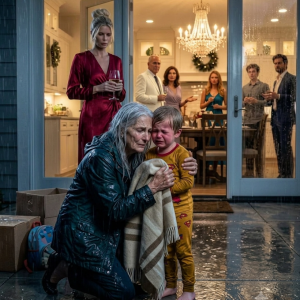
The investigation continued over the next several weeks. Officers spoke with the party guests, collected the available records, and interviewed Tessa. She said she had meant only to frighten Owen into behaving, and that she had expected to bring him back inside shortly. Whatever she had intended, she had left a small child locked outdoors in cold rain without a way to open the door.
Tessa was no longer allowed to stay in my home. Reed packed her belongings with a relative present, ended the relationship, and agreed to attend family counseling. I did not ask him to choose between me and the woman he had loved. I asked him to look honestly at what his son needed. This time, he did.
A few days later, I remembered the small security camera Walter had installed above the garage. Two cameras had stopped working, but the one near the back steps had continued recording. A technician helped retrieve the files, and one showed Tessa guiding Owen toward the yard before returning to the house alone. The recording did not show everything, but it helped establish the sequence of events. I gave the original files to the investigators and kept the copies exactly as they instructed.
Learning to Feel at Home Again

“Can I sleep in your room tonight?”
“Of course, sweetheart. I’ll make you a little bed beside mine.”
I did not tell him he was too old or that he should be over it. The therapist helped us create steady routines: a night-light in the hall, a quiet check of the doors before bedtime, and the same story read in the same chair each evening. Little by little, Owen began to laugh again. He drew pictures and asked to help water the garden. One morning he requested dinosaur-shaped pancakes, and when I brought them to the table, he grinned as if breakfast itself had been invented just for him.
Reed changed his work schedule so he could spend more time at home. He went with Owen to therapy and learned to notice when his son was becoming quiet or withdrawn. One afternoon I found them on the living-room rug building a tower from wooden blocks. Owen looked up at me with a hopeful smile.
“Grandma, Daddy says I never have to sleep outside again.”
Reed met my eyes.
“And I mean it, Mom.”
I nodded. We could not undo the night in the rain, but we could make the days that followed safer and more honest than the ones before it.
Nearly a year has passed. Owen is six now, missing two front teeth and certain that he will be an astronaut, though he also says he might become a firefighter if the astronaut training takes too long. Reed still works hard, but he plans his time off around the ordinary events that matter to a child: school lunches, library afternoons, and Saturday soccer games where Owen spends half his time watching the clouds.
Our house feels like a home again. The music that fills it comes from Owen’s cartoons, or from the old radio I turn on while making supper. The party guests are gone, and the windows are no longer filled with strangers’ shadows. Most of all, no one in the house makes Owen wonder whether he is wanted.
The old kennel is gone. I could not bear to see it from the kitchen window, so we took it apart and turned that corner of the yard into a garden. Owen chose the flowers himself: yellow sunflowers, because they looked, he said, like little suns that knew where to look. We planted them together in the spring, and he made a sign from a scrap of wood, painting his name in bright blue letters.
One afternoon, while we watered the flowers, he asked me why I had come home early from Vermont. I set the watering can down and crouched beside him. I thought of Lorna, who used to tell me that a person should listen when love makes itself heard, even if the message arrives inconveniently.
“I missed you, little astronaut,” I told him. “And something in me said you needed me sooner.”
He leaned against my shoulder, easy and warm in the afternoon sun.
“I’m glad you came home.”
“So am I.”
That night is still part of our family’s story, but it is not the only part. There is also the hospital room where Reed apologized and stayed; the quiet evenings when Owen learned he could sleep without checking the door; the first breakfast when his laughter returned; and the garden he planted where the kennel once stood. When I look at the framed birthday drawing beside my bed, I no longer see only the promise I had failed to understand quickly enough. I see the promise we all had to learn to keep: that home is not simply a place with familiar walls, but the place where a child is believed, protected, and welcomed back into the light.