Part 1: The Warning at the Airport

For nearly eleven years, I worked as a 911 dispatcher in western Pennsylvania, where I learned that fear rarely sounds the way people imagine it will, because the people who are most frightened often speak so quietly that you have to listen beyond their words to understand what they are trying to tell you.
I had heard hundreds of frightened voices through my headset, yet the one that changed my life belonged to my eight-year-old daughter, who was sitting in the backseat of our car on an ordinary Tuesday morning.
It was shortly after seven when I dropped my husband, Nathan Whitmore, outside Pittsburgh International Airport for what he described as a three-day business conference in Atlanta. Nathan worked as a commercial property consultant, and although his schedule had become increasingly unpredictable over the previous year, I had never seriously questioned his frequent trips because he always had an explanation ready, usually accompanied by the easy smile that had once made me feel so fortunate to be his wife.
Our daughter, Sophie, was still wearing her school uniform, with her lunchbox beside her and a library book balanced on her knees. I was thinking about the errands I needed to finish before my afternoon shift when I noticed that she had been unusually quiet since we left home.
As Nathan disappeared through the terminal doors, I reached for the gearshift, but Sophie leaned forward and touched my shoulder.
“Mom, please don’t drive home.”
I glanced at her in the rearview mirror, expecting a complaint about school or perhaps another request to stop for breakfast.
“Honey, what’s wrong?”
Her face was pale, and she was holding the straps of her backpack with both hands.
“I heard Dad talking to somebody Sunday night, when you were working, and he said something was going to happen at our house after you took him to the airport.”
I turned toward her, suddenly aware of the traffic moving impatiently behind us.
“What kind of something?”
She swallowed before answering.
“He said the heating system would look like it broke, and afterward nobody would have to worry about the money anymore. Mom, he was laughing, and I don’t think he knew I was listening.”
For several seconds, I could only look at her.
Our house was an older two-story home outside Sewickley, with hardwood floors, narrow staircases, and a heating system Nathan had been complaining about for weeks. He had repeatedly warned me that the equipment was unreliable, although every inspection I remembered had ended with someone telling us it needed maintenance rather than replacement.
Then I remembered the paperwork he had persuaded me to sign the previous month, supposedly updating our family insurance arrangements.
The amount had been unusually large, and Nathan had insisted that protecting Sophie was the most responsible thing we could do.
At the time, I had believed him.
Now, sitting outside the airport with my daughter’s frightened face reflected in the mirror, I realized how many small details I had accepted without asking another question.
I pulled away from the terminal, but instead of taking the road home, I turned into the parking garage overlooking the passenger pickup area.
“Sophie, I need you to stay low in your seat for a few minutes, sweetheart. We’re going to be careful until I understand what’s happening.”
She obeyed without arguing, which frightened me almost as much as her warning.
Less than ten minutes after Nathan had entered the terminal, I saw him walk back outside.
He was no longer carrying his travel bag, and instead of heading toward the departure gates, he crossed the pavement toward a waiting vehicle, speaking urgently into his phone.
I watched him climb into the backseat.
He was supposed to be boarding an airplane.
Instead, he was leaving the airport.
And I knew I could not take my daughter home.
Part 2: The House That Was Supposed to Be Empty
My father, Benjamin Caldwell, had been a residential electrical contractor for more than forty years, and he believed that a properly maintained house could tell you a great deal about the people living inside it.
He had installed the security lighting around our property himself, including a motion-activated fixture above the back porch that recorded short video clips whenever someone approached the entrance.
Nathan had teased him about spending so much time on a simple porch light, but Dad had only smiled.
“You don’t install security because you expect trouble every morning,” he told me. “You install it because you want a record if something happens when nobody’s watching.”
Dad had been gone for almost three years, yet I still checked that light every spring, partly because he had asked me to and partly because maintaining something he had built made me feel close to him.
As I watched Nathan’s vehicle leave the airport, I thought about that camera.
I followed at a considerable distance, careful not to attract attention, while keeping my phone within reach. When the vehicle turned toward our neighborhood, I stopped near a small shopping plaza where I could see part of our street without approaching the house.
Nathan got out several houses away from our driveway.
He was wearing work gloves and carrying a red utility container in one hand and a long metal tool in the other.
Even from where I sat, I understood that these were not things a man normally carried home after missing a flight.
I immediately called 911.
Although I had spent years helping strangers explain emergencies, I struggled for a moment to describe what I was witnessing without letting my fear take control.
I gave the dispatcher our address, explained what Sophie had overheard, and described Nathan’s movements, emphasizing that my daughter and I were safely away from the property.
The dispatcher instructed us to remain where we were and avoid approaching him.
Through the trees, I could see Nathan moving toward the back porch, occasionally glancing toward the street as though checking whether anyone had noticed him.
Then the security light came on.
Its bright white beam illuminated his face, the container, and the tool in his hand.
For a moment, I remembered my father standing beneath that same fixture, tightening the final screw while Nathan watched impatiently from the porch steps.
Now the light was recording the very person who had once laughed at it.
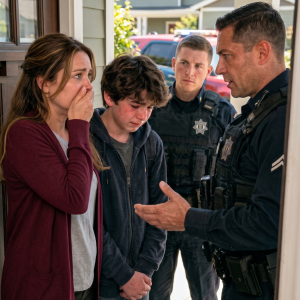
Within minutes, two police vehicles arrived quietly near the property, and the officers approached from different directions.
Nathan had already begun forcing the back entrance when one of them called out.
“Sir, step away from the door and keep your hands where we can see them.”
He turned abruptly, dropped the tool, and raised his hands.
Even at that distance, I recognized the expression he wore whenever a contractor questioned his instructions or a neighbor challenged something he had said.
It was the look of a man offended that anyone would doubt him.
I remained beside Sophie until an officer came to our vehicle, confirmed that the immediate area was secure, and escorted us to a safer location.
When Nathan saw me standing beside the officer, his face changed.
“Emily, thank goodness you’re here,” he said quickly. “There’s been some kind of misunderstanding. I came back because I thought somebody had gotten into the house.”
I looked at the damaged door behind him.
“Nathan, why weren’t you on your flight?”
“I missed it. I was coming home to get myself organized before catching another one.”
“Then why did you bring those things to the back door?”
He opened his mouth, but the officer interrupted before he could answer.
“Mr. Whitmore, we’re going to need you to explain that at the station.”
Nathan looked past me toward our car.
Related Posts

“Who Is Rebecca?” I Asked After Handing My Husband The Card From The Expensive Bouquet Delivered To Our Door. “A Client,” He Answered Too Quickly. Then His Phone Lit Up Between Us. Rebecca Lane Was Calling. He Had Not Confessed Yet, But His Face Already Had—and The Flowers Had Arrived Exactly Where The Truth Needed To Go. Pasted text

My Husband Left Me Home Cleaning Broken Glass While He Took His Mistress to the Biggest Business Gala of His Career. His Mother Said I Was Too Ordinary to Attend. But 90 Minutes Later, I Walked Down the Grand Staircase as the Secret Owner of the Investment Firm Behind His Success. He Turned Pale When He Saw Me—But What I Was About to Reveal on Stage Was Even Worse for Him
“Your Father Is Gone, and I’m Not Wasting Another Day Raising You Two Brats!” A Woman Snapped at Her Late Husband’s 5-Year-Old Twins Before Leaving Them Alone at Chicago O’Hare Airport. She Was Their Stepmother—and She Walked Onto Her Flight Without Even Saying Goodbye. I Was an Army Colonel Who Had Served With Their Army Captain Father. I Called Airport Security, but When the Little Girl Recognized Me, She Clutched Her Teddy Bear and Whispered, “Daddy Told Us to Find You.” Then She Pointed at Her Stepmother’s Suitcase. “She Took the Blue Folder Daddy Left for You.”
Five Minutes After Our Divorce, My Husband Said, “Take Our Two Daughters. I Finally Have a Son Coming.” He Had No Idea I Was a U.S. Army Colonel. Four Hours Later, He Was Begging Me Not to Leave—Because a Shocking Secret About His Unborn “Heir” Had Just Turned His Entire Family Upside Down