Fourteen years collapsed into one word.
Lydia’s eyes filled.
“You knew every day?”
“Yes.”
“Why?”
Elaine looked at Hazel and Theo.
“Because I thought losing one version of your father was better than losing your entire future.”
Lydia shook her head.
“You didn’t have the right to choose that for me.”
Elaine closed her eyes.
“I know.”
That answer hurt because it sounded sincere.
Then movement behind Elaine caught Lydia’s attention.
A man had stopped several yards away.
Gray hair.
Dark jacket.
Small suitcase.
He raised his left hand and rubbed his eyebrow while staring at her.
Once.
Twice.
Lydia felt seventeen again.
Her father had always done that when nervous.
Graham Carver slowly lowered his hand.
“Lydia?”
Hazel whispered beside her.
“Mom… is that him?”
Graham took one step forward.
His eyes moved from Lydia to Hazel and then to the sleeping baby.
His face crumpled.
“I am so sorry.”
Lydia had imagined hearing her father’s voice again thousands of times.
She had never imagined anger would arrive before joy.
“You watched my life from a distance.”
Graham nodded.
“Yes.”
“You knew about my children.”
“Yes.”
“You knew when Mark was gone.”
His voice cracked.
“Yes.”
Lydia wiped her eyes.
“Then whatever happens next, you do not get to decide what I’m ready to know.”
Graham looked at her for a long moment.
Then he nodded.
“You’re right.”
The Photograph From Before
Elaine reached into her purse.
“Then we tell her everything.”
Arthur immediately stiffened.
“Elaine, maybe not here.”
She looked at him sharply.
“That sentence has controlled this family long enough.”
She handed Lydia an old photograph.
In it, young Graham and Elaine stood outside their old Illinois home.
Six-year-old Lydia sat on her father’s shoulders.
Another couple stood beside them with a dark-haired boy around Hazel’s age.
“Who are they?”
“Caleb and Nora Rusk,” Elaine said. “They worked with us.”
“And the boy?”
“Owen.”
Elaine explained that the Rusks had disappeared shortly before Graham’s crash.
For years, everyone assumed the family had vanished because of the financial investigation.
But three years ago, Graham saw Owen again.
At Mark’s memorial.
Now twenty-one, Owen had been watching Lydia.
“Why?”
Elaine looked toward Graham.
He could not meet Lydia’s eyes.
Then another voice came from behind them.
“Because the money was never the biggest secret.”
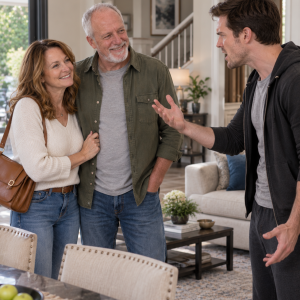
A young man stood near the gate wearing a gray hoodie.
Lydia looked at the childhood photograph.
Same eyes.
Same jaw.
Owen Rusk.
Graham stepped forward.
“You weren’t supposed to come inside.”
Owen gave a tired smile.
“Funny. Everyone keeps telling me where I’m supposed to be.”
Lydia almost laughed despite herself.
The sentence sounded too familiar.
She held up the brass key.
“What is inside box 214?”
Owen looked at Graham.
Then Elaine.
Finally, he looked at Lydia.
“Records.”
“Financial records?”
“Some.”
“Then what else?”
Owen’s expression softened.
“Birth records.”
Lydia stared at him.
“Whose?”
He pointed gently toward her.
“Yours.”
Silence spread through the crowded terminal.
Lydia looked at her mother.
Elaine began to cry.
She looked at Graham.
He seemed unable to speak.
For fourteen years, Lydia had believed the mystery was why her father disappeared.
Now she understood she had been asking the wrong question.
The real mystery was why so many people had been willing to disappear, lie and sacrifice years of their lives to keep Lydia from discovering who she had been before she became Lydia Carver.
She closed her fingers around the brass key.
For once, no one told her where to go.
No one told her what she was ready to hear.
Lydia looked at her mother.
Then her father.
Then Owen.
“We’re opening the box.”
Graham started to speak.
Lydia raised one hand.
“And this time, nobody decides the truth for me.”
Hazel slipped her hand into her mother’s.
Theo slept peacefully against Lydia’s chest.
Elaine wiped her cheeks.
Arthur lowered his head.
And Graham, after fourteen years of believing silence could protect his daughter, finally stepped aside and let her choose the next door for herself.
Sometimes the people who love us make terrible choices while believing they are protecting us, but love cannot erase the consequences of deciding someone else is too fragile to know the truth.
A painful truth may change the way we remember our past, yet discovering it can also give us the freedom to build a future that is based on our own choices instead of someone else’s fear.
Forgiveness does not have to happen the moment an apology is offered, because understanding why someone hurt us and deciding whether we can trust them again are two completely different journeys.
Parents often want to shield their children from every danger, but real protection should eventually include honesty, because children grow into adults who deserve ownership of their own stories.
Fear can begin as a reasonable response to danger, but when we allow it to guide every decision for too long, it can quietly become a prison that separates us from the people we were trying to protect.
Family secrets rarely remain buried forever, and the longer important truths are hidden, the more difficult it becomes to separate genuine love from the hurt created by years of silence.
Lydia’s story reminds us that a person can understand another person’s reasons and still feel angry about what happened, because compassion and disappointment can exist in the same heart.
Sometimes courage is not confronting an enemy or making a dramatic sacrifice, but simply refusing to let other people decide what information we can handle and what choices we are allowed to make.
Children often notice what adults overlook, and Hazel’s quiet attention shows that honesty, curiosity and the courage to speak when something feels wrong can change the direction of an entire family.
In the end, the most important inheritance we can give the next generation is not a perfect family history, but the confidence that when difficult truths appear, they will be trusted enough to hear them, strong enough to face them and free enough to decide what happens next.