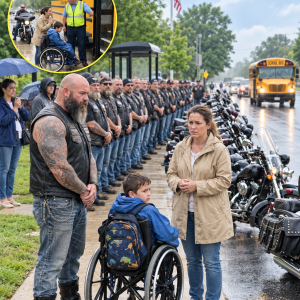
The bikers stayed in touch.
Dennis helped Megan find an affordable used car when hers broke down.
Martin brought Caleb a bicycle for his tenth birthday.
Russ attended one of Caleb’s school baseball games.
Then another.
Eventually, several of the bikers started appearing.
They became the loudest group in the bleachers.
“Those are your uncles?” another boy once asked Caleb.
Caleb looked toward the leather vests in the stands.
“Pretty much.”
Years Passed
Caleb grew taller.
His oversized hoodie was replaced by football jerseys, school uniforms, and eventually a graduation gown.
He became quieter as a teenager but remained unusually observant.
His teachers described him as the student who always noticed when someone else was sitting alone.
If a younger child dropped his lunch tray, Caleb helped clean it up.
If someone was being excluded, Caleb moved over and made room.
Russ never told him to become that kind of person.
Caleb had simply learned something important when he was nine years old.
People remembered who stood beside them on the worst day of their lives.
And sometimes the best way to repay kindness was to pass it forward.
Twelve Years After the Diner
On a warm May afternoon, Russell Danner sat in the front row of a high-school football stadium.
He was seventy now.
His beard had turned almost completely white.
Beside him sat twelve bikers.
Some walked more slowly than they once had.
One carried a cane.
Another had sold his motorcycle years earlier.
But all thirteen had come.
Megan sat among them.
She looked completely different from the frightened woman who had sat in the Maple Street Diner years earlier.
Confident.
Healthy.
Peaceful.
Then the announcer read a name.
“Caleb James Monroe.”
The young man who crossed the stage was tall, broad-shouldered, and smiling.
Pinned discreetly inside his graduation gown was a small embroidered flag patch.
Russ recognized it immediately.
Years earlier, after Megan and Caleb moved into their apartment, Russ had given Caleb the patch from one of his old riding vests.
Caleb had kept it all those years.
The Seven Dollars Came Back
After the ceremony, Caleb found Russ near the parking lot.
They hugged.
“I’m proud of you, kid,” Russ said.
“You don’t get to call me a kid anymore.”
Russ laughed.
“You’ll be a kid until I’m gone.”
Caleb reached into his pocket.
Then he placed something in Russ’s hand.
Seven dollars and twelve cents.
Russ stared at the money.
“You’ve got to be kidding me.”
Caleb smiled.
“I’ve owed you for twelve years.”
Russ shook his head.
“I told you then, and I’m telling you now. You don’t owe me anything.”
Caleb became serious.
“I know.”
He closed Russ’s fingers around the money.
“That’s why I’m not paying you back.”
Russ looked confused.
Caleb continued.
“I’m giving it to you so the next scared kid who walks up to your table knows somebody will listen.”
For several seconds, Russ couldn’t speak.
Then the old biker wrapped both arms around him.
Megan watched from a few feet away, wiping tears from her cheeks.
What Caleb Chose to Do Next
Caleb had already made plans for his future.
He wanted to serve.
Not because he imagined himself as a hero.
Russ had taught him better than that.
Real service, he had learned, rarely looked dramatic.
Sometimes it looked like sitting beside a frightened child in a diner.
Sometimes it looked like making a phone call.
Sometimes it meant driving behind a mother who was afraid to go home alone.
Sometimes it meant showing up at a baseball game simply because a boy needed dependable adults in the stands.
Caleb hoped to build a life around that idea.
Before leaving the graduation parking lot, he looked at all thirteen men.
“You know what I remember most about that day?”
Russ expected him to mention the motorcycles.
He didn’t.
“You listened to me.”
Russ nodded slowly.
Caleb smiled.
“I was nine years old, and everyone kept telling me grown-up problems weren’t my responsibility. You were the first people who understood that even if the problem wasn’t mine to fix, the fear was still real.”
Russ placed a hand on his shoulder.
“You were brave enough to ask for help.”
Caleb shook his head.
“I was scared.”
Russ smiled.
“Exactly.”
Sometimes the person asking for help will not arrive with perfect words or a clear explanation, so we should never underestimate the importance of simply listening long enough for someone to feel safe enough to tell the truth.
Courage is not always loud or dramatic, because sometimes courage is a frightened child walking across a restaurant with a few dollars in his hand and trusting strangers with a problem that feels too large for him to carry.
We often judge people by their clothes, appearance, age, job, or reputation, yet the people who look intimidating from across a room may sometimes become the gentlest protectors when someone vulnerable needs them most.
Helping another person does not always mean confronting someone or becoming a hero, because the strongest form of help can be creating a safe plan, contacting the right people, and staying beside someone while they take the first difficult step forward.
A child may not understand every detail of the problems happening around them, but children understand fear, tension, loneliness, and kindness far more clearly than adults sometimes realize.
When someone has lived in fear for a long time, leaving may not be as simple as outsiders imagine, so compassion should come before judgment whenever we wonder why a person did not walk away sooner.
The greatest gift we can sometimes give another person is not money or advice but the quiet certainty that they no longer have to face their hardest moment completely alone.
One act of kindness can continue traveling through a person’s life for decades, shaping the way they treat classmates, strangers, coworkers, children, and eventually people they may never have met otherwise.
The people who change our lives are not always relatives or lifelong friends, because sometimes family is also made from the strangers who show up on a terrible day, stay afterward, and continue showing up when there is nothing left for them to gain.
If someone once stood beside you when your world felt frightening and uncertain, perhaps the most meaningful way to thank them is not to repay the favor directly, but to become the person who notices the next frightened soul standing alone and chooses to say, “Come sit with me. Tell me what happened.”