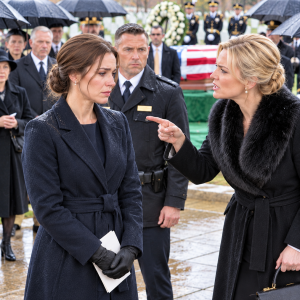
She did not conceal her emotional response.
“I was frightened. I remained composed because I believed struggling would increase the risk of injury.”
For a moment, the room fell silent.
Then the chairperson thanked her for her testimony.
Caroline left knowing the facts were finally being evaluated openly.
The final decision would come later.
But the truth was no longer confined to a deserted roadside.
PART 7 — THE DECISION THAT ENDED ONE CAREER

Three weeks after the hearings began, the department issued its findings.
Sergeant Thomas Rourke was dismissed from police service.
The disciplinary panel concluded that he had engaged in unjustified detention, excessive force, and serious misconduct incompatible with his responsibilities.
His explanations were inconsistent with the video evidence.
The department referred relevant findings to the appropriate authorities for any additional legal review.
Officer Caleb Dawson received substantial disciplinary sanctions.
He was demoted by two ranks.
He was transferred to administrative duties for at least one year.
He was required to complete additional professional training.
A permanent record of the misconduct would remain in his employment history.
The panel specifically cited his failure to intervene and his active participation in restraining a driver without adequate justification.
Caroline received the decision through official channels.
She read the findings twice.
Then she placed the document beside her keyboard.
She felt no desire to celebrate.
Rourke’s dismissal could not erase the experience of being pulled from her car.
It could not remove the memory of handcuffs tightening around her wrists.
And it did not automatically resolve the complaints filed by other citizens over the previous years.
But the findings established that the officers’ behavior carried consequences.
Afterward, some colleagues treated Caroline cautiously.
Others privately thanked her.
Several admitted that concerns about Rourke had circulated within the department for years.
Employees had been reluctant to challenge him because they feared damaging their careers.
Caroline found those admissions deeply troubling.
“No officer should have to choose between professional integrity and fear of retaliation,” she told one colleague.
Meanwhile, the independent review of earlier complaints continued.
Investigators contacted the delivery driver, the elderly woman, and the teenager who had reported mistreatment.
Their allegations were finally receiving the attention previously denied to them.
Caroline understood that reopening a complaint did not guarantee a particular outcome.
Evidence still needed careful examination.
Witnesses deserved opportunities to be heard.
Every decision had to follow appropriate procedures.
But the process mattered.
For the first time, those complainants were no longer being dismissed simply because the accused individuals wore police uniforms.
One afternoon, the elderly woman contacted the department to express her appreciation.
“I thought nobody would ever believe what happened to me,” she said.
Caroline listened as the woman described years of embarrassment and anger.
“Your complaint deserved a serious investigation from the beginning,” Caroline replied.
The conversation stayed with her.
It reminded her why Internal Affairs existed.
Its purpose was not to punish officers because of personal disagreements.
Its responsibility was to ensure that public authority remained accountable to the people it was supposed to protect.
PART 8 — THE ROAD THAT NO LONGER CONTROLLED HER
One month after the incident, Caroline traveled the same rural highway on her way to another departmental meeting.
The surrounding fields looked different.
Crops stood taller, and roadside grass moved gently in the afternoon breeze.
As she approached the familiar gravel shoulder, she unconsciously slowed down.
For a moment, the memories returned.
Rourke approaching her window.
Dawson opening the car door.
The painful pressure of handcuffs against her wrists.
Her breathing became shallow.
But she continued driving.
She allowed herself to acknowledge the memory without pretending it had disappeared.
The roadside looked completely ordinary.
There were no patrol cruisers.
No flashing lights.
Nothing indicating what had happened there weeks earlier.
Yet Caroline knew that stretch of highway had become important for reasons extending far beyond her personal experience.
She had spent years investigating complaints from people who felt powerless during encounters with authority.
She had read statements describing humiliation, confusion, and the helplessness of being unable to persuade an official to listen.
Before the traffic stop, she understood those emotions primarily through other people’s accounts.
Now she had experienced them herself.
The incident also showed how easily accountability could depend on circumstances unrelated to whether someone had been treated fairly.
Caroline possessed official credentials.
She understood investigative procedures.
She had reliable recording equipment and professional colleagues capable of reviewing her complaint.
Most ordinary drivers did not possess those advantages.
A delivery driver working long hours might not know how to challenge an unjustified search.
An elderly woman might fear losing the transportation she depended upon.
A teenager might struggle to explain a frightening encounter to adults who automatically assumed the officer was right.
Caroline thought about all three complainants.
Her case had not magically repaired what happened to them.
But it had created an opportunity for their experiences to be examined honestly.
That possibility mattered more than witnessing Rourke lose his position.
As she continued along the highway, her favorite song began playing on the radio.
She lowered the window.
Fresh air moved through the sedan, carrying the scent of distant fields.
For the first time since the roadside encounter, Caroline allowed herself to enjoy the drive without anticipating another confrontation.
She understood that accountability should never depend on whether the person being mistreated happened to possess an official badge.
Respect should be the starting point of every lawful encounter.
It should not become a privilege granted only after someone demonstrates professional influence.
Rourke and Dawson had believed they were dealing with a powerless woman who would quietly accept humiliation.
They discovered her identity only after crossing boundaries they should never have crossed with anyone.
Their greatest mistake was not failing to recognize an Internal Affairs investigator.
Their greatest mistake was believing that an ordinary citizen deserved less respect.
Caroline drove past the familiar roadside without stopping.
The highway stretched toward the horizon beneath the open sky.
Her hands rested comfortably on the steering wheel.
She followed the speed limit, just as she always had.
The incident would remain part of her history.
She would not forget the fear she experienced or the pain caused by the handcuffs.
Nor would she forget how quickly the officers’ attitudes changed when they realized who she was.
But those memories no longer needed to control her future.
She had helped bring misconduct into the open.
She had supported an independent investigation.
And she had seen an institution begin confronting failures it should have addressed long before her own experience.
There was still work to be done.
The earlier complaints required careful review.
Other citizens deserved answers.
And the department needed to examine why troubling allegations had been dismissed in the first place.
Caroline knew that genuine accountability was not achieved through one dismissal or one disciplinary ruling.
It required consistency.
It required fairness.
And it required institutions willing to listen even when the person making a complaint possessed no wealth, influence, or professional connections.
As the familiar fields disappeared behind her, Caroline felt the tension in her shoulders begin to ease.
She could not change what happened on that road.
But she could carry its lesson into every investigation that followed.
No one should have to prove they are powerful before being treated with dignity.
And no badge should place its wearer beyond accountability.
The road continued toward the horizon.
Caroline kept driving.
What happened there would always be part of her story, but it would no longer determine the journey ahead.
THE END