A further envelope contained written instructions for collecting the rest of his property through an agreed process.
My attorney had already advised me about occupancy rights and the need to avoid an unlawful lockout.
Accordingly, I had initiated the appropriate procedures concerning the residence I owned before marriage.
Grant couldn’t simply be stripped of any legal rights by a dramatic announcement, but he was being given unmistakable notice that I intended to end our shared household.
Then one of the delivery employees offered him the decorative box.
Grant opened it.
Inside lay his old house slippers.
He unfolded my handwritten message and read it silently.
The color drained from his face.
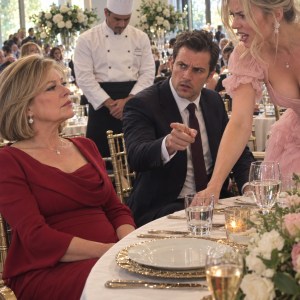
Evelyn Caldwell looked from the legal documents to Dolores.
“I thought Grant was generously hosting this dinner, but apparently his wife paid for everything despite not being invited.”
Henry confirmed the relevant payment information without discussing confidential financial details beyond what I had authorized him to disclose.
The revised dinner had cost $6,200.
I had paid it myself.
Several guests exchanged astonished glances.
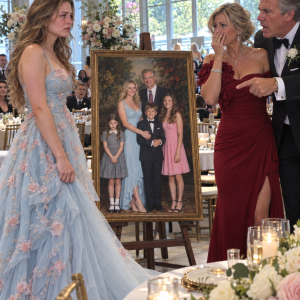
Dolores attempted to explain that the family was experiencing a private misunderstanding.
But the printed program praising Grant’s generosity lay beside her plate.
The contradiction was impossible to ignore.
Evelyn set down her glass.
“I’m afraid I don’t understand why someone would ask a daughter-in-law to finance a celebration and then deliberately exclude her from attending.”
No one answered.
One by one, the guests began leaving.
Some offered brief excuses.
Others departed without addressing Dolores at all.
Grant remained near the table, holding the divorce papers.
His mother’s seventy-year-old social identity had been built around appearances.
That evening, those appearances were collapsing under the weight of an ordinary truth.
Neither Dolores nor Grant could afford the lifestyle they insisted was their rightful place in society.
Dolores sank into her chair, clutching her chest.
When she became faint and unresponsive, the staff immediately requested medical assistance.
The celebration ended while guests gathered their coats and whispered about what they’d witnessed.
The dinner I had paid for became the most discussed event Dolores had ever hosted.
It simply wasn’t the kind of attention she wanted.
Part 6: The Night I Finally Closed the Door
Grant returned toward Myers Park later that evening, furious and desperate to confront me.
My telephone filled with messages.
Some accused me of humiliating his mother.
Others pleaded for an opportunity to explain.
He alternated between insisting that our marriage could be repaired and threatening to demand a substantial share of everything I owned.
I didn’t answer.
Our home’s exterior cameras recorded him arriving in the pickup truck whose payments I’d been making for years.
He approached the front entrance carrying his briefcase.
When his usual access code failed, he began repeatedly ringing the bell.
I had already reviewed the access arrangements with my attorney and arranged appropriate lawful procedures for handling Grant’s belongings and occupancy.
I did not pretend that changing a password automatically resolved every property issue.
Instead, I contacted the authorities when his behavior escalated into persistent shouting and pounding on the door.
Officers arrived to address the disturbance.
After speaking with both parties and explaining the immediate options available, they persuaded Grant to leave rather than continue the confrontation.
His remaining belongings would be collected through a properly arranged process.
I watched the police vehicle depart from my living-room window.
For years, I’d feared that asserting my boundaries would make me selfish.
That night, I realized the greater danger had been allowing other people to decide how much dignity I was permitted to keep.
The following weeks were difficult.
Grant challenged our financial arrangements.
His attorney demanded information about assets acquired during the marriage, while mine assembled purchase records, trust documents, bank statements, and evidence establishing which property I owned independently before the wedding.
The proceedings didn’t conclude through a single dramatic gesture.
There were disclosures, negotiations, and difficult conversations.
But the central truth remained unchanged.
I no longer intended to finance Grant’s failed ventures or Dolores’s social ambitions.
The eventual divorce settlement recognized the relevant ownership records and addressed the financial obligations that could properly be attributed to each party.
My separately acquired house remained mine.
Grant left the marriage without the unlimited access to my salary that he’d treated as permanent.
Meanwhile, the incident at the Rosewood Club spread throughout Dolores’s social circle.
Several acquaintances distanced themselves.
Others continued speaking with her but no longer accepted her stories about her son’s enormous generosity without question.
I didn’t spend time monitoring those reactions.
For the first time in fifteen years, I had other plans.
I reorganized my finances, canceled unnecessary expenditures, and redirected the money previously spent supporting Grant and Dolores toward savings, travel, and causes I personally valued.
My home became peaceful again.
There were no last-minute demands to rescue another failing business.
No expensive presents purchased to satisfy someone who considered me socially inferior.
No conversations in which my husband dismissed my feelings because defending me might inconvenience his mother.
One evening, several months after the divorce, I returned home from work and prepared a simple dinner.
I made grilled cheese sandwiches and tomato soup.
Then I sat beside the window overlooking my garden.
The coincidence made me smile.
Dolores had considered that meal humiliating because it reminded her of ordinary American families.
For me, it represented something far more valuable.
A meal didn’t need caviar, champagne, or expensive silverware to be worthy of sharing.
And a person didn’t need permission from wealthy acquaintances to deserve respect.
I thought about the $16,800 invoice that had arrived in my inbox.
That amount had once seemed like another obligation I would quietly accept.
Instead, it became the moment I recognized fifteen years of imbalance.
The revised celebration had cost $6,200.
The money I saved was significant.
But it wasn’t the most valuable thing I recovered.
I had regained the freedom to decide where my resources went, who entered my home, and how I expected to be treated.
Grant had repeatedly insisted that we were family whenever he wanted access to my earnings.
I finally understood that family should mean something more substantial than a convenient explanation for taking.
That evening, I finished my dinner, cleaned the kitchen, and turned off the lights.
There was no argument waiting upstairs.
No mother-in-law demanding another financial favor.
No husband reminding me that his reputation mattered more than my dignity.
For the first time in years, the silence felt comforting.
I went to bed knowing I had stopped paying for people who believed they were entitled to everything I provided while offering nothing but contempt.
Dolores had been right about one thing.
Money couldn’t purchase class.
But neither could an expensive dinner, an exclusive guest list, or a room filled with influential acquaintances.
Character revealed itself through how people treated those from whom they expected nothing.
And mine had finally revealed itself through one simple decision.
I would never again allow my generosity to become the price of my own humiliation.
THE END