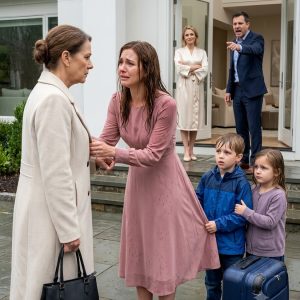
I listened without interrupting.
The possibility that my husband had orchestrated violence frightened me, but I knew accusations required independent investigation.
Several days later, Elise contacted me.
Graham had abandoned her after her suspension and attempted to pressure her into ending the pregnancy.
She was frightened, financially vulnerable, and desperate.
She offered recordings and messages suggesting that Graham had discussed threatening Adrian with an outside contractor before the collision.
I directed her to an attorney and connected her with the investigators handling Adrian’s case rather than privately negotiating over the evidence.
The information ultimately became part of a much broader investigation into Whitaker Development Group.
Federal agents obtained warrants, examined financial records, and investigated the suspected corruption of building inspections.
The authorities also pursued evidence linking Graham to the deliberate highway collision.
When an arrest warrant was issued, Graham attempted to leave the country aboard a private aircraft departing Philadelphia International Airport.
Federal agents arrested him before the flight departed.
Vivian publicly insisted that her son was the victim of a conspiracy.
But the accumulated records, witness statements, communications, and financial evidence ultimately supported the prosecution.
Graham received a twenty-five-year federal prison sentence for the crimes established at trial.
Elise cooperated with investigators and received probation in connection with the offenses for which she was charged.
Her medical career ended following disciplinary proceedings.
I did not attend Graham’s sentencing.
By then, I no longer needed to witness his downfall to believe that my life could continue without him.
Part 6: The Life I Had Almost Forgotten
My divorce was finalized after extensive financial negotiations, and I received the share of marital assets to which I was legally entitled.
Adrian continued rehabilitation until he could walk independently again.
We didn’t immediately resume our relationship.
Sixteen years had changed both of us, and the extraordinary circumstances of our reunion made patience essential.
Instead, we began meeting as friends.
We walked along the Schuylkill River, shared lunches at Reading Terminal Market, and spoke honestly about the years we had lost.
Adrian told me about his work, his father’s final years, and the loneliness he had carried after leaving Philadelphia.
I told him about my medical career, the IVF treatments, and the gradual erosion of my confidence during my marriage.
Neither of us pretended that the past could simply disappear.
But spending time together reminded me that affection did not have to involve deception or conditions.
One autumn afternoon, Adrian showed me the worn four-leaf-clover keychain I had given him years earlier.
“I kept this because it reminded me of the person I wanted to become before fear started making all my decisions.”
I reached for his hand.
For the first time in many years, the future felt like something I could choose rather than something another person had arranged for me.
A year after our reunion, we married in a small ceremony beside the ocean at Cape May, New Jersey.
Miranda attended with a handful of close friends.
There were no society photographers, elaborate speeches, or expensive displays intended to impress strangers.
We exchanged vows beneath a pale sky while the sound of the Atlantic carried across the sand.
A few months later, we began exploring adoption through Pennsylvania’s child welfare system.
We completed preliminary training and learned about the responsibilities involved in providing a permanent home for a child who had experienced uncertainty.
During a visit arranged through the appropriate agency process, we met an eight-year-old boy named Miles.
He was sitting at a table, carefully repairing a toy airplane with a broken wing.
Adrian crouched beside him.
“Do you think that airplane will still fly after you’ve finished fixing it?”
Miles examined his work before answering.
“Maybe it won’t fly perfectly, but I think it deserves another chance.”
I felt tears gathering as I watched them together.
The words seemed unexpectedly close to everything Adrian and I had survived.
But we also understood that Miles was not a symbol of our recovery; he was a child who deserved security, patience, and unconditional care.
We continued through the required evaluations, home studies, interviews, and placement process with that responsibility firmly in mind.
Part 7: A Home Where Nobody Had to Earn Their Place

Nearly a year after we began the adoption process, the family court finalized Miles’s adoption.
I cried when the judge confirmed that Adrian and I were legally his parents.
The moment felt different from anything I had imagined during my years of infertility treatment.
I hadn’t suddenly become complete because I was somebody’s mother.
I had already begun recovering my sense of worth long before Miles entered our lives.
But loving him opened a new chapter that neither Adrian nor I had expected.
On his first evening in our home, Miles stood hesitantly beside the dining table.
Three plates had been arranged beneath a warm hanging light.
“Is this really where I’m going to live, or will I have to move somewhere else again?”
Adrian pulled out a chair.
“This is your home, Miles, and there’s a place for you at our table every single day.”
Miles looked toward me.
“Will I still be here tomorrow, even if I make mistakes or accidentally break something?”
I knelt beside him.
“You don’t have to be perfect to belong here, sweetheart, because being part of this family isn’t something you can lose by making a mistake.”
He wrapped his arms around my neck.
For a long moment, I held him while Adrian quietly stood beside us.
We eventually moved into a welcoming Victorian-style house in a peaceful Philadelphia suburb.
Our home contained none of the cold grandeur that had once filled Graham’s mansion.
Instead, Miles’s toy airplanes occupied the living room, his drawings covered the refrigerator, and Adrian regularly burned toast while insisting he was improving his breakfast technique.
The four-leaf-clover keychain rested beside our first family photograph.
Sometimes I thought about the morning I borrowed Elise’s white coat.
That accidental discovery had uncovered an affair, a sixteen-year-old conspiracy, and a dangerous network of financial misconduct.
It had also led me back to a man whose disappearance I had misunderstood for most of my adult life.
But my greatest discovery wasn’t the truth about Graham.
It was the realization that neither infertility nor betrayal had ever made me less deserving of happiness.
I remained a surgeon, a wife, a mother, and a woman capable of shaping her own future.
My family wasn’t defined by bloodlines, inherited wealth, or the approval of people who believed everything could be purchased.
It was defined by trust, kindness, and the certainty that nobody had to surrender their freedom to be loved.
One evening, Miles placed his repaired airplane beside our family photograph.
He looked at Adrian and me with a proud smile.
“I told you it could fly again, even after its wing was broken.”
Adrian laughed and helped him launch it gently across the living room.
I watched the airplane glide toward the couch and smiled.
For years, I had believed that my life was permanently damaged by choices I could never change.
Now I understood that beginning again did not require erasing the past.
It required the courage to reclaim my future, and the freedom to build a home where love was never something anyone had to earn.
THE END