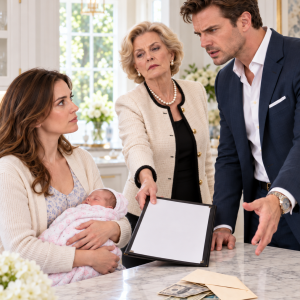
At 5:17 in the morning, our daughter entered the world weighing 3.2 kilograms.
When the nurse placed her against my chest, every other thought disappeared.
I named her Nora, after my late mother.
Grant had always objected because he thought the name sounded insufficiently sophisticated for a Prescott.
I no longer cared.
Ruth cried openly beside the bed.
She looked happier to meet Nora than the father who had spent months claiming he wanted a daughter.
After Nora fell asleep, Ruth opened an old brown leather handbag.
From inside, she removed a thick envelope bearing my full legal name.
The handwriting belonged to Grant.
My pulse quickened.
Ruth explained that he had ordered a private office cleanup several days earlier.
She was supposed to destroy several folders.
Instead, she noticed my name scattered across ownership documents and quietly saved them.
Inside were original business-formation records, founder agreements, hotel-development contracts, and documents from the creation of Prescott House Hotels.
Then Ruth asked:
“Do you remember what you signed when the first hotel opened?”
I did.
Grant had hugged me that day and promised that whatever success came later would always belong to both of us.
The original agreements confirmed that I held a substantial founder ownership interest protected by provisions preventing unilateral dilution or transfer.
Years later, Grant told me major investors required restructuring.
He claimed expensive lawyers had handled everything legally.
I trusted him.
Now, later documents contained signatures I did not recognize.
One approval transferred valuable management rights and branding interests into a newly created entity.
I stared at the signature.
“I never signed this.”
Ruth looked frightened.
“That is what I was afraid of.”
Part 5 — The Lawyer Who Remembered Who I Was

I called Allison Grant, an attorney who had advised me during my early business years.
She listened while I explained Grant’s affair, Nora’s birth, Ruth’s warning, and the documents.
Then she gave me strict instructions.
“Do not sign anything else. Do not accuse him of forgery yet. Preserve every message, every financial notice, and every copy Ruth saved.”
I asked:
“You think the signatures are fake?”
Allison answered:
“I think we need independent examination before making that accusation.”
That answer reassured me more than certainty would have.
Allison wanted evidence.
Not revenge.
I securely transmitted copies of the documents.
Before ending the call, she said:
“Caroline, if these papers mean what I think they mean, Grant did not gamble only with your marriage.”
Several hours later, Grant finally called from Saint Barthélemy.
He did not ask about Nora.
Instead, he complained about the ambulance bill.
“Ruth could have driven you. Why create an unnecessary spectacle?”
I stared at my sleeping daughter.
“Nora was born at 5:17 this morning.”
He paused.
“Oh. Well, if you’re both healthy, that’s good.”
That was all.
No request for a photograph.
No question about labor.
No concern for my recovery.
When I mentioned Paige and the private-jet message, he exploded.
“You had no right to invade my privacy.”
Then he made a mistake.
He mentioned paperwork his attorneys would send concerning an expansion deal.
“Sign it immediately when it arrives. We do not have time for delays.”
I answered:
“Send everything to my attorney.”
Silence.
“Your what?”
“My attorney.”
His voice changed.
“Since when do you have a lawyer?”
I ended the call.
My hands shook afterward.
But I did not call back.
Part 6 — The Settlement Offer
Allison’s first review showed that my founder ownership was significantly larger than Grant had led me to believe.
She also discovered that management contracts, intellectual-property rights, and branding interests had been routed into another company.
Grant personally controlled most of that entity.
Paige’s name also appeared in the structure, although Allison warned that her exact role still required investigation.
The affair was not the only betrayal.
Grant had been shifting economic value away from the company we built together.
Two days later, a courier arrived at my hospital room.
Grant’s attorneys had sent a draft separation agreement.
It offered me substantial money if I waived all claims involving business ownership, acknowledged the validity of prior transactions, and signed a strict confidentiality clause.
Grant included a handwritten note.
This is more than fair. Do not make this ugly.
I looked at Nora sleeping beside me.
He had sent legal surrender papers before sending his daughter flowers.
I photographed everything and forwarded it to Allison.
When I left the hospital, I did not return to the mansion.
Following legal advice, I rented a modest furnished apartment near the medical center.
Ruth came with me.
For the first time in years, I slept without worrying that Grant might walk into the room and tell me I had disappointed him.
He quickly discovered that I had not returned home.
Messages came continuously.
Where are you?
You are behaving irrationally.
Bring my daughter home.
Then came the one Allison told me to preserve carefully:
You think you can steal my daughter and my money?
My daughter.
My money.
Possessions.
That was how Grant understood relationships.
Allison requested an independent corporate investigation.
The board agreed to preserve records and review the disputed ownership approvals.
For the first time, Grant had to explain himself to people who were not emotionally conditioned to believe him.
Part 7 — The Signatures

Four days after abandoning me during labor, Grant cut his Caribbean trip short and returned to Rhode Island.
He did not come home because he missed Nora.
He came because his authority was under threat.
After seventeen unanswered calls, he turned his anger toward Ruth.
He demanded to know what she had told me.
She refused.
Grant fired her by text message.
After nearly eight years of service, the woman who had helped bring his daughter safely into the world was dismissed without even a conversation.
I watched Ruth place her phone on the table.
Her eyes filled with tears.
“You will not suffer because you protected me.”
The next morning, Grant appeared in the lobby of my apartment building wearing an expensive suit and sunglasses.
He called.
“Come downstairs so we can speak like adults.”
I answered:
“Speak to Allison.”
“Did Ruth steal confidential files from my office?”
That question told me how frightened he was.
I stayed silent.
Grant continued.
“You have no idea what you’re interfering with. Those documents belong to me, and you are not qualified to understand them.”