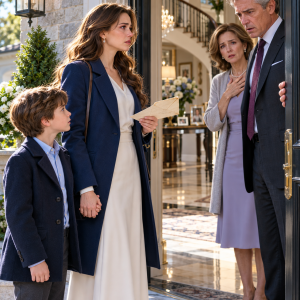
PART 1: THE DINNER THAT CHANGED EVERYTHING
At sixty-three years old, Margaret Lawson had learned how to absorb thoughtless comments without turning every careless sentence into an argument, but the remark her daughter-in-law made during an anniversary dinner stayed lodged somewhere deeper than irritation.
The family had gathered at Michael and Jenna Lawson’s suburban home outside Raleigh, North Carolina, to celebrate their eighth wedding anniversary. Eight adults sat around the dining table, while Margaret balanced her sleeping grandson Owen, two and a half years old, against her shoulder.
Margaret had been at the house since eight that morning.
She roasted chicken, prepared side dishes, set the table, cleaned the kitchen twice, entertained the children, and kept Owen occupied while Michael and Jenna hurried through last-minute preparations.
Nobody mentioned any of that.
When dinner began, one guest complimented the meal before politely turning toward Margaret.
“What do you usually do with yourself now that you are retired?”
Margaret smiled, intending to mention the garden she had recently started behind her townhouse and perhaps the three grandchildren she helped care for almost every weekday.
Jenna answered first.
“Honestly, Margaret does not really have much going on anymore. She is retired and mostly stays home, which is why she has plenty of time to help us with the kids.”
The conversation continued almost immediately.
Nobody gasped.
Nobody seemed uncomfortable enough to challenge the statement.
Margaret remained seated with Owen breathing softly against her neck.
Her eyes drifted toward the mud-stained sneakers belonging to nine-year-old Caleb, which she had scrubbed clean two days earlier. Beside them sat five-year-old Emma’s preschool backpack, which Margaret checked every afternoon because Emma frequently forgot permission slips inside.
For the first time, Margaret saw her own life through the version the family had apparently created.
She was not somebody who had spent three years organizing three children’s schedules, cooking meals, doing laundry, providing transportation, remembering appointments, and rearranging her own life around theirs.
She was simply an older woman with nothing important to do.
Margaret stood carefully and placed Owen into Jenna’s arms.
The little boy stirred and began complaining immediately.
“Margaret, what is wrong with him?” Jenna asked, sounding more inconvenienced than concerned.
“Nothing is wrong with him.”
Margaret retrieved her coat from the entry closet.
Michael came out of the kitchen.
“Mom, why are you leaving already?”
“I am going home.”
“Are you feeling sick?”
Margaret looked at her only son for several seconds.
“I have a headache, and I think I need a quiet evening.”
Nobody followed her into the garage.
That detail hurt more than Jenna’s comment.
Two days later, Margaret arrived at 7:45 in the morning exactly as usual.
She prepared breakfast, took Caleb to elementary school, drove Emma to preschool, cared for Owen, folded laundry, cooked dinner, and collected the older children after class.
When Jenna came home, she dropped her expensive handbag onto a chair.
“Margaret, could you stay until nine Thursday night? Michael and I both have work commitments.”
Margaret folded a kitchen towel.
“All right.”
She drove home that evening and sat in her quiet kitchen for nearly an hour.
The next morning, her alarm rang at 6:50.
For the first time in three years, Margaret turned it off and stayed in bed.
PART 2: THE MORNING NOBODY KNEW HOW TO RUN
At 8:05, Margaret’s phone began ringing.
Jenna called once.
Then twice.
Then several more times.
Margaret made coffee, fried eggs, toasted bread, and sat beside her window while sunlight slowly reached the neighboring rooftops.
At 9:40, she placed the phone inside a drawer.
Across town, Jenna had discovered how many invisible systems Margaret had been operating.
Caleb was still wearing pajamas.
Emma had not eaten breakfast.
Owen was crying because his grandmother had not arrived.
Jenna finally called Michael while he was driving toward a construction site.
“Your mother did not come.”
“Is she sick?”
“I do not know because she will not answer.”
Jenna delivered Caleb to school late and missed Emma’s normal preschool drop-off window. Owen became increasingly upset, forcing her to take both younger children home.
At nine, she called her manager.
“One of the kids suddenly got sick, so I need to work from home today.”
The truth sounded almost ridiculous even inside her own head.
My mother-in-law did not arrive, and I do not know how to operate my own household without her.
By ten, Owen had pulled paperwork from her lap.
At eleven, Emma spilled juice across the sofa.
By noon, both children wanted lunch, and Jenna stood in front of the refrigerator realizing she did not know what Margaret normally prepared for them.
She made pasta.
Emma tasted two bites.
“Grandma makes it different.”
At five that afternoon, Emma’s speech-therapy clinic called because she had missed her 4:30 appointment.
Jenna closed her eyes.
They had prepaid a substantial amount for the therapy program.
She told herself Margaret was simply offended and would return after cooling down.
Wednesday was worse.
Caleb missed soccer practice.
Jenna forgot to buy milk, fruit, and bread.
Owen refused his afternoon nap because Margaret normally used a particular blanket Jenna could not find.
Michael arrived home exhausted and asked what was for dinner.
Jenna stared at him.
“Whatever you are cooking.”
On Thursday, Jenna borrowed a coworker’s phone because Margaret had stopped answering hers.
This time Margaret picked up.
“Hello?”
“Margaret, what exactly is going on?”
“Nothing is going on.”
Jenna swallowed her frustration.
“Are you sick?”
“No.”
“Then why are you not coming over?”
A long silence followed.
Margaret answered calmly.
“Because I am at my house.”
“But we need to know why.”
Margaret inhaled slowly.
“At dinner, you explained to everyone that I am retired, stay home, and have nothing much to do.”
Jenna said nothing.
“So I decided to spend several days doing exactly what you described.”
Margaret ended the call.
That afternoon, Michael drove to his mother’s house convinced he could repair the situation quickly.
Margaret served coffee.
“Mom, Jenna is under enormous pressure at work. We have the mortgage, car payments, childcare expenses, and everything else. She did not mean to insult you.”
“I know she probably did not.”
“Then why are you doing this?”
Margaret looked at him steadily.
“On Mondays I arrive at 7:45. I take Caleb to school, Emma to preschool, and care for Owen all day. I collect Caleb at 2:30 and Emma at 3:30. On Tuesdays, Emma has speech therapy. On Wednesdays, Caleb has soccer. On Fridays, I usually remain until after dinner because you both work late.”
Michael remained silent.
“I am not complaining,” Margaret continued. “I am telling you what my week looks like.”
Michael leaned forward.
“But they are your grandchildren, Mom. You cannot really call that work.”
Margaret’s expression barely changed.
“How many hours do I need to work before you are willing to call it work?”
Michael opened his mouth.
No answer came.
PART 3: THE PRESCHOOL PARKING LOT

By Friday, Jenna was running on caffeine and four nights of broken sleep.
She hired a babysitter through a reputable service.
The woman arrived on time, had excellent references, and lasted less than half a day.
Owen refused to play with her and wandered from room to room calling for Grandma.
When Emma returned from preschool, she repeatedly asked when Margaret was coming back.