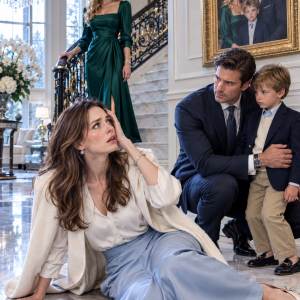
Rebecca called her thirty-year-old married daughter, Hannah, later that afternoon, mostly because she needed to hear her voice.
Hannah immediately detected something wrong.
When Rebecca refused to involve her yet, Hannah said something unexpected.
“If this concerns Dad, please do not automatically make whatever he did easier for him.”
Rebecca stiffened.
Hannah reminded her of years when Rebecca had explained Thomas’s absences, softened his uncomfortable decisions, and delivered difficult messages he did not want to deliver himself.
Rebecca had always thought of that as loyalty.
Her daughter saw it as protection from accountability.
That did not excuse Thomas.
It did force Rebecca to recognize that silence inside a marriage could have more than one architect.
Part 4 – The Letter He Never Gave Her
At four that afternoon, Rebecca opened the desk where they stored insurance documents, property records, and tax files.
She found an unsealed envelope with her name written in Thomas’s handwriting.
The letter was dated seven months earlier.
It had nothing to do with Lauren at first.
Thomas wrote that for nearly a year he had experienced episodes in which familiar names disappeared from memory, rooms became momentarily unfamiliar, and ordinary routines briefly failed him.
Once, while driving to work, he missed an exit he had taken for seventeen years and failed to recognize the neighborhood for almost a minute.
Another time, he forgot the name of a colleague he had known for twelve years.
He had secretly consulted a doctor.
Stress and poor sleep might explain everything, but additional neurological testing had been recommended because Thomas’s father had developed early cognitive decline around sixty.
Thomas had scheduled the tests.
Canceled them.
Rescheduled.
Canceled again.
Then Rebecca reached the paragraph mentioning Lauren.
Thomas had accidentally forgotten the name of Lauren’s former husband during a conversation. She noticed his panic and asked what was wrong.
He answered because, as he wrote, telling somebody who was not Rebecca felt easier.
The final paragraph hurt most:
With Lauren, I have less to lose. With you, I have everything to lose, and somehow that has made me a coward.
Rebecca called Olivia.
“This changes the context.”
Olivia agreed.
“Context is not absolution.”
“I know.”
“You can understand why someone crossed a boundary and still decide the boundary matters.”
At seven, Thomas returned after Rebecca agreed to speak with him.
For the first time in twenty-one years, he knocked on his own front door.
The letter waited on the dining table.
Thomas looked at it and stopped.
“You found it.”
“Why did you never give it to me?”
He admitted fear.
Not fear only of illness, but of becoming another problem Rebecca needed to solve while caring for her mother and supporting Hannah through changes in her own life.
Rebecca refused the logic.
“You were not protecting me. You were protecting yourself from seeing how I might respond.”
Thomas closed his eyes.
Instead of producing another explanation, he said, “You are right.”
That did not repair anything.
It mattered anyway.
Rebecca asked whether he loved Lauren.
He said no.
She asked whether he enjoyed being important to her.
After a long pause, Thomas admitted that he did.
Whether he liked the version of himself Lauren saw—a man without twenty-one years of failures attached to him—Thomas also answered honestly.
“Yes.”
Finally, they were speaking the same language.
Truth rather than technical innocence.
Part 5 – The House He Bought Without Her

Thomas placed a medical folder on the table.
Inside was confirmation of a neurology appointment he had rescheduled for Monday morning.
Then Rebecca found another envelope beneath the forms.
A real-estate contract.
Four months earlier, Thomas had purchased a small two-bedroom house beside Lake Briar, three hours north of their home.
The price was $142,000.
The money came from the $187,000 investment inheritance his late father had left him.
The buyer was Thomas alone.
The real-estate agent handling the transaction was Lauren Hayes.
Rebecca stared at him.
“Was this house for you and Lauren?”
“No.”
She believed him immediately, which somehow made the alternative more painful.
“Were you planning to leave me?”
“No.”
“Then why does my husband own a secret lake house?”
Thomas explained that watching his father decline had filled him with terror about postponement.
His father had talked for years about traveling after retirement, then lost the ability to make those trips before retirement ever became meaningful.
After Thomas began noticing memory lapses, he became obsessed with all the things he and Rebecca had postponed.
Living near water.
Long weekends.
A screened porch where she could read.
Ordinary mornings without schedules.
During a drive home the previous Christmas, Thomas had asked whether she ever imagined another kind of life.
Rebecca, answering work email, had joked that he would survive retirement for three days before looking for another project.
He heard dismissal where she intended humor.
Months later, Lauren mentioned a property near Lake Briar.
Thomas visited it.
Inside the empty kitchen, he imagined Rebecca’s books near the lake-facing window, Hannah visiting with her husband, Rebecca’s mother complaining about mosquitoes, and Christmas mornings around their old dining table.
Then, while standing there, Thomas forgot their home address for approximately twenty seconds.
Lauren witnessed his panic.
That was when he first told her everything.
Fear created the opening.
Emotional intimacy followed.
“You should have come home and told me.”
“I intended to do it the next day.”
Rebecca almost laughed bitterly.
Their marriage, she realized, had been endangered by thousands of tomorrows.
Tomorrow they would discuss retirement.
Tomorrow he would admit he was frightened.
Tomorrow she would ask whether he was happy.
Tomorrow they would remember how to speak before silence became normal.
Thomas had attempted to sell the property privately after regretting the secrecy, but when an offer arrived, he rejected it because losing the house felt like losing a future that should have belonged to both of them.
Rebecca shook her head.
“You secretly purchased our imaginary future and then became sentimental about owning it alone.”
“When you say it that way, there really is no defense.”
“There should not be.”
Part 6 – The Diagnosis That Was Not a Diagnosis
Rebecca did not decide whether to divorce him that night.
She did something smaller.
She told Thomas to stay elsewhere until his neurological appointment.
Monday morning, she picked him up anyway.
The neurologist performed memory testing and reviewed his sleep, stress, family history, medications, and work habits. Thomas remembered most words, completed simple cognitive tasks, and showed no clear evidence of major impairment during the initial screening.
The neurologist explained that chronic stress, anxiety, persistent sleep deprivation, and possible sleep apnea could produce precisely the symptoms Thomas described.
Additional imaging and formal testing were still appropriate because of his family history.
On the drive afterward, Thomas said, “I should have told you.”
Rebecca answered, “Yes.”
Then she kept driving north.
“Where are we going?”
“Lake Briar. I want to see the house you decided I wanted without asking me.”
The house was smaller than the photographs suggested, with blue-gray siding, white trim, a screened porch, tall pines, and silver water visible through the trees.
Rebecca walked through every room.
The bedroom facing the lake was the one Thomas imagined as her reading room.
Annoyingly, she loved it.
Outside on the porch, Thomas admitted he had pictured them drinking coffee there.
Rebecca looked at him.
“You should have asked whether I wanted to drink coffee here.”
“Yes.”
“I might have said yes.”
“I know.”
“I might also have said no.”
Thomas nodded.