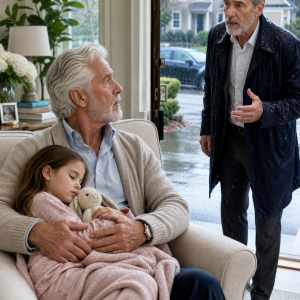
She never used the children’s affection for her to argue that I should return to Lucas.
One afternoon, we sat together on my porch.
Evelyn admitted that she felt ashamed because Lucas was her son.
I squeezed her hand.
“You are not responsible for the choices of a thirty-six-year-old man simply because you gave birth to him.”
Tears appeared in her eyes.
Then she remembered the motel.
“Even while experiencing the worst betrayal of your life, you still protected my health.”
I looked at her.
“You took me away from that room before I could recognize Paige.”
Those words finally opened something inside me.
For months, I had remained functional.
Lawyers.
Statements.
Bank records.
Parenting.
School schedules.
I had delayed the grief because there was always something practical to handle.
On that porch, I finally cried.
For the marriage.
For the family relationships we had lost.
For the future I once believed was secure.
Evelyn held me.
And for the first time, I allowed myself to mourn without also having to solve something.
Part 5: Accountability Without Revenge

Eight months after I found the motel receipt, the divorce became final.
I refinanced our Raleigh home under my name.
That allowed the children to remain close to the same school, friends, and neighborhood.
The court deducted the approximately thirty-five thousand dollars Lucas had removed from family savings from his share of the marital property.
Lucas kept his car.
He also assumed responsibility for his personal debts.
A detailed parenting schedule allowed him weekend time with the children under clear expectations.
I did not demand everything he owned.
I did not attempt to erase him from our children’s lives.
I wanted accountability.
Financial fairness.
And a stable home no longer governed by lies.
Several weeks after the divorce, I was outside my daughter’s swimming lesson when Paige approached me.
She looked exhausted.
Older somehow.
Nothing remained of the confident young woman I had seen inside room 307.
I was placing a sports bag in my trunk when she spoke.
“Will you listen to me for a minute?”
I waited.
Paige swallowed.
“I am sorry for betraying you after everything you did for me.”
Her eyes dropped.
“I know saying that cannot repair what happened.”
I acknowledged hearing her.
Apparently, she expected a larger emotional response.
When I did not provide one, she explained that Lucas had ended their relationship.
He blamed her for losing his children.
His career.
His family.
Even after everything, Lucas was still searching for another person to carry the weight of his decisions.
I answered carefully.
“You did not destroy his life by yourself.”
Paige looked at me.
“And Lucas did not lose everything solely because of you.”
I closed the trunk.
“Two adults repeatedly made choices. Both of you experienced consequences.”
Paige hesitated.
Then she asked,
“Do you hate me?”
I thought about the question.
There had been a time when hatred seemed like the only emotion large enough to contain the betrayal.
Now it simply felt exhausting.
“I no longer have enough energy to waste it hating you.”
Paige said nothing.
“Treat what happened as the most expensive lesson of your life.”
Then I drove away.
That conversation taught me something unexpected.
Indifference could provide more freedom than revenge.
Paige would live with her choices.
Lucas would live with his.
Neither needed to continue living inside my thoughts.
One year after I discovered the receipt, Lucas attended our daughter’s school performance alone.
He looked thinner.
Less polished.
Nothing like the manager who once measured himself through job titles and bonuses.
After the performance, he approached me while the children gathered their things backstage.
He asked how they were doing.
I told him they were thriving.
Lucas complimented the stability I had maintained.
Then he said his relationship with Paige had ended.
After a long pause, he spoke again.
“I betrayed you.”
I waited.
“Then I blamed you.”
His voice was quieter than usual.
“I blamed Paige. I blamed my job. Every time the truth became uncomfortable, I found someone else to blame.”
He looked directly at me.
“I do not expect forgiveness.”
Then came the first apology he had ever offered without immediately asking for something in return.
“But I finally understand that every important thing I lost began with my own decisions.”
For the first time, I heard no excuse.
No request for reconciliation.
No attempt to earn a reward for admitting the obvious.
And for the first time, I felt neither renewed love nor the tight anger that once filled my chest.
Only distance.
A peaceful distance that showed me how far I had already traveled.
“I hope you become a better father than the husband you chose to be.”
Lucas lowered his eyes.
I continued.
“Our children still deserve the most honest version of you.”
He nodded.
He promised to keep trying.
Then the children ran toward us.
We both smiled for them.
A few minutes later, Lucas and I left through different doors.
Part 6: What Eighty-Five Dollars Actually Exposed
After the divorce, I gradually returned to parts of myself that had disappeared beneath marriage, childcare, and work schedules.
I enrolled in a painting class.
I began traveling with friends again.
When my company offered me a promotion, I accepted it.
On weekends when the children stayed with Lucas, the silence inside the house initially felt unsettling.
Eventually, it stopped feeling like abandonment.
It became space.
Room to rest.
Room to think.
Room to remember who I was when nobody needed something from me.
For years, I believed preserving a marriage at almost any cost demonstrated maturity and devotion.
Experience taught me something else.
A family cannot be protected by hiding betrayal.
And endurance becomes destructive when only one person is expected to practice it.
My children did not need two parents pretending to be happy beneath the same roof.
They needed stability.
Honesty.
And a mother who could live without constantly swallowing pain.
I kept the Pine Hollow Motor Lodge receipt.
It remained inside my divorce file.
Not because I wanted a souvenir from the most humiliating period of my life.
I kept it because the paper represented the exact moment when confusion turned into evidence.
That eighty-five-dollar receipt exposed an affair that had lasted more than a year.
It led me toward unauthorized withdrawals.
Secret apartments.
Corporate misconduct.
False business reports.
And an entire network of assumptions that had allowed Lucas to remain unquestioned for too long.
The receipt did not destroy my family.
No matter how often Lucas initially tried to claim otherwise.
The receipt simply turned on a light.
The deception had already been sitting inside the room.
Comfortable.
Protected.
Hidden behind a locked door everyone trusted.
Once I saw what was inside, closing that door again would have required abandoning myself.
The amount printed at the bottom remained eighty-five dollars.
The receipt covered two ordinary afternoon hours on a Thursday that should have been forgettable.
Lucas had treated room 307 as though consequences could not enter it.
For me, that room became an unexpected doorway leading away from a marriage built on hidden choices.
The truth cost me the future I had planned.
It ended the version of our family I once believed would last forever.
But truth returned something more valuable than appearances.
More valuable than promises.
More valuable than shared property.
It returned my authority to decide what kind of life my children and I would live.
And that freedom was worth far more than everything deception had taken away.
THE END