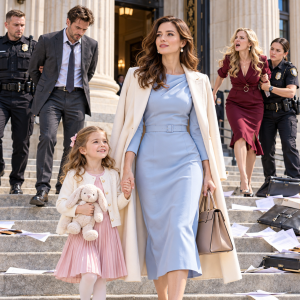
“You are correct that the jewelry is not important. What matters is that nothing between us became important enough for you to defend.”
The elevator opened, and I entered without waiting for another response. As the doors closed, Michael remained motionless beneath the courthouse lights, looking more confused than remorseful.
Part 5: Returning the Last Reminder

Cold March air struck my face when I exited the courthouse, but the chill felt cleansing after the overheated corridor. Instead of returning immediately to work, I walked several blocks toward Rittenhouse Square and sat near a fountain that had not yet reopened for spring.
Only then did I allow myself to cry.
I grieved for the marriage, the home I never possessed, and the attentive man Michael appeared to be during our first year together. More profoundly, I cried from relief because the courthouse conversation had removed every remaining fantasy that leaving might have been a mistake.
I called my closest friend, Natalie Brooks, who answered with her familiar warmth.
“How did the final hearing go this morning?”
“The divorce is official, but you will never believe what Michael requested afterward.”
I described his urgent touch, the brief hope it awakened, and Deborah’s demand for the jewelry. Natalie’s outrage arrived before I finished.
“He asked for an anniversary gift outside the courtroom immediately after your divorce?”
“He said returning it was practical because the set cost almost three thousand dollars.”
“Please tell me that you refused to reward such astonishing behavior.”
I watched pedestrians cross the square while considering the question.
“I am returning everything, but not because Michael or Deborah deserves it. I no longer want an object that ties a painful memory around my neck.”
Natalie remained quiet before responding more gently.
“Then return it as an act of release rather than obedience.”
That evening, I removed the necklace and earrings from their red box. The metal still reflected the bedroom light beautifully, but I no longer saw romance inside its polished surface.
I remembered Michael refusing to move from Deborah’s house, remaining silent during Thanksgiving, and turning away while his mother blocked me from seeking medical care for Lily. The jewelry could not preserve an earlier version of him because that version had never survived beyond easy circumstances.
I packaged the set carefully and mailed it to Deborah the following morning with signature confirmation. I enclosed no angry letter, farewell message, or explanation because the return required no further conversation.
Three days later, Michael sent a brief message.
“The jewelry arrived safely. Thank you for returning it.”
There was no apology, no recognition of the courthouse exchange, and no acknowledgment of the emotional meaning behind my decision. His limited response might once have devastated me, but now it confirmed that I had correctly understood him.
I did not reply. Instead, I deleted his personal number from my favorites and transferred every conversation concerning Lily to a court-approved co-parenting application. The change created a documented boundary without interfering with his parental relationship.
Part 6: A Life Built Without Permission
Recovery did not happen immediately after I mailed the package. Freedom provided space for healing, but it also exposed wounds I had ignored while concentrating on survival.
I began working with Dr. Elena Ramirez, a therapist who helped me understand how repeatedly defending my reality had damaged my confidence. I also continued attending a divorce support group, where other women described the difference between ordinary family conflict and relationships structured around chronic invalidation.
Lily adapted well to our apartment. She slept more peacefully, laughed during breakfast, and stopped becoming tense whenever footsteps approached our bedroom. Those small changes demonstrated how thoroughly children absorb emotional conditions adults believe they have concealed.
Michael followed the parenting schedule, although Deborah remained involved during many visits. I documented concerns calmly and communicated only about Lily’s medical care, routines, and safety. I no longer argued about whether Deborah liked me because her approval had become irrelevant.
Several months later, my employer offered me leadership responsibility for a regional campaign. Previously, I might have declined because additional work would have invited Deborah’s criticism. This time, I accepted and delivered the strongest presentation of my career.
The campaign’s success led to a marketing manager position with a significantly higher salary. More important than the money was the renewed understanding that professional ambition did not make me selfish, negligent, or unworthy of respect.
I repainted Lily’s bedroom pale green, replaced the damaged kitchen cabinets, and invited Natalie to help arrange photographs along the hallway. Our apartment gradually stopped feeling like temporary shelter and became the first home where Lily and I could exist without constant judgment.
On the first anniversary of the divorce, I awoke before Lily and listened to rain touching the bedroom window. Nothing dramatic occurred, yet I realized that happiness had returned quietly through ordinary mornings.
I could prepare breakfast without criticism, choose Lily’s clothing without interference, and make medical decisions without another adult blocking the door. These freedoms seemed modest until I remembered how completely they had once been denied.
The courthouse conversation remained painful, but I eventually recognized it as an unexpected gift. Michael’s request destroyed the final illusion that our marriage might have survived if I had sacrificed more of myself.
He had taken my hand, and for one suspended moment, I believed he finally understood what he had lost. Instead, he asked me to return a gift because Deborah believed its monetary value still belonged to him.
That request summarized our marriage more clearly than the divorce decree. Michael could remember the jewelry’s price but not the emotional cost of his silence. He could calculate what an object was worth while remaining unable to recognize what his wife and daughter required.
I once interpreted endurance as loyalty and believed leaving represented failure. Therapy taught me that staying inside a destructive pattern would have trained Lily to confuse submission with love.
By leaving, I showed her that peace does not require disappearing, and family should never demand the surrender of one person’s voice.
I never regretted returning the jewelry because its departure created space for something more valuable. I purchased no replacement necklace, although Natalie suggested celebrating my promotion with one.
Instead, I opened a savings account for Lily and placed the first portion of my increased salary inside it. That account represented a future built through independence rather than a romantic promise that could later be reclaimed.
Michael remained Lily’s father, and I encouraged a safe relationship between them without pretending our marriage had been healthy. Co-parenting required restraint, documentation, and boundaries, but it no longer required me to absorb Deborah’s criticism.
Occasionally, Michael sent messages unrelated to Lily, usually nostalgic references to restaurants or vacations from our early relationship. I never responded because nostalgia was not accountability, and remembering happier moments did not repair the choices that followed.
If Michael eventually understood how his dependence upon Deborah shaped his life, that growth would belong to him. I no longer waited for it, measured it, or treated it as a condition for my happiness.
One Saturday morning, Lily climbed beside me while I drank coffee near the apartment window. She placed a plastic necklace around my neck and announced that I looked like a princess.
The necklace probably cost less than one dollar, yet I treasured it more than the expensive set Michael reclaimed. It had been given freely by a child who expected nothing except a smile and another minute of attention.
I hugged Lily and understood that love was never proven through luxury. It appeared through protection, presence, respect, and the willingness to listen when another person’s needs became inconvenient.
One year earlier, I left the courthouse believing my life had been reduced by divorce. In reality, I had recovered everything the marriage gradually required me to surrender: my health, judgment, ambition, voice, and right to establish a safe home.
The jewelry returned to Deborah, while the final uncertainty surrounding my decision disappeared with it. Michael believed he had recovered something worth three thousand dollars, but I walked away with something no price could measure.
I finally possessed a life in which nobody could demand that I become smaller so they could remain comfortable.
THE END