8. The Brother Who Could Never Forgive Success
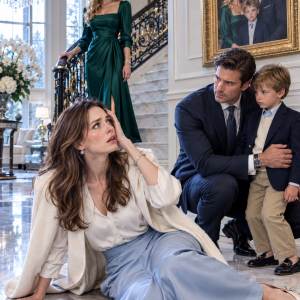
Brandon stopped pretending.
“You want the truth?”
He looked directly at Caleb.
“You were supposed to be the failure.”
Nobody moved.
“Dad paid for my education. He introduced me to investors. Mom told everyone I would run the family businesses someday. Then you came out of a technical program, worked in greasy garages, and somehow built something worth more than everything we had combined.”
Caleb’s expression remained controlled.
Brandon’s voice rose.
“Every time somebody praised your company, it made me look incompetent.”
“I never competed with you.”
“You did not have to. Existing was enough.”
Caleb took a breath.
“I offered to help restructure the retail company last year.”
Brandon laughed bitterly.
“You offered advice.”
“Because you refused to show me the books.”
“We needed cash, not lectures from a mechanic.”
Caleb looked at him for a long time.
“Then you should have accepted bankruptcy instead of deciding murder was a financing strategy.”
Brandon tried to rush toward him.
Officers restrained him immediately.
Margaret moved toward Caleb.
“Please understand, sweetheart. Your brothers were desperate.”
He stepped away.
“So was I when I worked nights and slept in a garage. Nobody forged anybody’s death certificate for me.”
She reached for him again.
“You were always stronger than they were.”
The words sounded almost affectionate.
Caleb’s face changed.
“That sentence has excused everything you ever did to me.”
Margaret began crying harder.
“I knew you could survive hardship.”
“You decided my strength meant I was the most disposable person in this family.”
Howard finally spoke.
“We never wanted it to go this far.”
Caleb turned toward him.
“You signed a death certificate with my name on it.”
Howard stared at the floor.
“Brandon said the document was necessary for insurance negotiations.”
“And the fraudulent loans?”
“I thought we could repay them.”
“With my company.”
Howard said nothing.
9. What Happened After the Arrests

The investigation lasted months.
The forged power of attorney was invalidated, and Warren Industrial Robotics was separated from the fraudulent loan obligations because Caleb had never authorized the transactions.
Brandon faced serious charges connected to attempted homicide, financial fraud, forgery, and conspiracy.
Marcus Doyle cooperated with investigators and admitted helping with surveillance and property access.
The medical administrator involved in the false death documentation lost his position and faced prosecution.
Howard and Margaret were charged for their roles in the conspiracy and financial scheme.
Scott negotiated a reduced sentence after providing extensive cooperation and records that helped prosecutors reconstruct the entire plan.
The retail businesses failed.
Their assets were liquidated.
The enormous house where the Warrens had spent years staging family success was eventually sold during the financial collapse.
Caleb and I left it on a cool afternoon carrying two suitcases each.
He still walked carefully because his ankle had been genuinely bruised in the ladder fall even though the fracture had been invented for the family’s benefit.
Near the pecan tree, he stopped.
“Do you know what hurts most?”
I waited.
“Part of me kept hoping Mom would stop before the last moment.”
I took his hand.
“Wanting your mother to choose you does not make you weak.”
He looked at the empty house.
“It feels ridiculous after everything.”
“It feels human.”
Caleb did not answer.
That night, we checked into a downtown apartment and slept with every light on.
10. Learning That Survival Was Not the Ending
The criminal case ended eventually, but survival did not automatically restore our sense of safety.
Caleb began trauma therapy.
I did too.
For months, he checked protein containers before drinking anything.
I startled whenever unfamiliar vehicles slowed outside our building.
We both struggled with the realization that people who had sat beside us at Thanksgiving dinner had discussed our deaths as financial complications.
One year later, Warren Industrial Robotics opened a new research and engineering center.
Caleb stood before hundreds of employees during the opening ceremony.
He spoke about the company’s early years in a rented garage and thanked the mechanics, engineers, machinists, and programmers who had stayed through difficult expansions.
Then he looked toward me.
“Emily believed in this company when it consisted of secondhand equipment, overdue invoices, and an exhausted mechanic who was too stubborn to quit.”
The audience laughed softly.
Caleb continued.
“She also taught me something more important than business. Protecting people you love does not mean protecting the lies surrounding them.”
That evening, a letter arrived from Margaret.
She wrote that everything had been done because she feared losing the family’s reputation and believed Brandon and Scott would be destroyed without help.
She apologized repeatedly.
Then she wrote that she hoped Caleb could someday remember that she had loved him.
He read the letter once.
He placed it in a drawer.
“Are you going to answer?” I asked.
He thought about the question.
“Maybe someday, but not because she wants relief from guilt.”
He closed the drawer.
“If I write back, I want it to be because I am free enough to choose the words, not because the youngest son is still trying to earn permission to belong.”
11. The Bench in the New Yard
Several months later, we bought a smaller house outside San Antonio with an open yard and no memories attached to it.
Caleb built a wooden bench beneath a young live oak tree.
One board contained a long natural split.
I suggested replacing it.
He refused.
“The crack does not weaken the structure.”
He ran one hand across the grain.
“It only proves the wood went through pressure before becoming part of something useful.”
We sat there often during the first year.
Sometimes we talked about the trial.
Sometimes we discussed the company.
Most evenings we talked about ordinary things because ordinary life had become valuable in a way neither of us understood before.
One afternoon, Caleb laughed and called the bench the most expensive piece of furniture in Texas.
“Why?”
He leaned back.
“Because apparently it cost me an entire family.”
I squeezed his hand.
“No. The family cost itself.”
He looked at me.
I continued.
“You only stopped paying for belonging with silence, money, and obedience.”
The smile disappeared from his face.
Then he nodded.
For most of his life, Caleb had believed his parents’ approval was something he might finally earn if he became successful enough.
Success only changed their method.
When he had nothing, they dismissed him.
When he built something valuable, they tried to use him.
When he resisted being used, they decided he had become the problem.
The fraud, forged documents, and criminal conspiracy were extreme expressions of a much older pattern.
His worth had always been measured according to what the family could extract.
The new house taught us another definition.
A home was not where relatives shared a surname.
A home was where nobody needed to inspect the glass before taking a drink.
Nobody prepared paperwork anticipating your death.
Nobody called your independence selfish because it made exploitation inconvenient.
Caleb once told me he still did not consider the arrests a victory.
I understood.
Victory implies something worth winning existed on the other side.
We had not won his family.
We had lost the illusion that they loved him without conditions.
What remained was harder, quieter, and ultimately better.
Truth.
Safety.
Choice.
And the freedom to build relationships in which strength was not interpreted as permission to endure unlimited harm.
The crack remained visible in Caleb’s bench for years.
He never filled it.
Neither of us needed it hidden.
Some damage deserves repair.
Other damage deserves recognition because pretending it never existed only creates another lie.
We had spent enough of our lives inside those already.
THE END