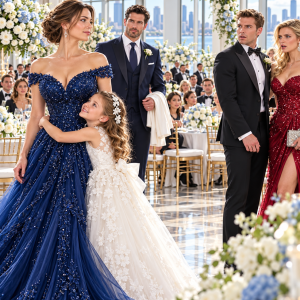
Part 1: The Invitation
“I invited her because people deserve to see what becomes of a woman who walks away from a family like ours.”
Jonathan Vale said the words beneath the glass conservatory of his family’s estate outside Newport, Rhode Island, where more than two hundred guests had gathered for the annual Vale Maritime Foundation gala. His voice carried easily through the ballroom because the string quartet had paused and several nearby donors were listening.
Beside him, his mother, Lenora Vale, adjusted the diamond clasp at her throat and looked toward the circular drive with a smile sharpened by expectation. Six years earlier, she had watched Jonathan’s first wife leave with one suitcase after being blamed for the couple’s inability to have children. Tonight, Lenora believed that woman would return diminished, alone, and grateful merely to be admitted through the gates.
Then the sound of an approaching motorcade rolled across the lawn.
A black sedan stopped beneath the porte cochère, followed by two additional vehicles carrying museum trustees and foundation representatives. The rear door opened, and Amelia Rowan stepped onto the stone drive wearing a deep sapphire gown with a restrained neckline and a fitted ivory evening coat. Her dark hair was gathered in a polished low twist, and she carried no expression of nervousness or apology.
A man joined her, offering his hand as she descended. Jonathan recognized him immediately as Marcus Whitmore, founder of Whitmore Heritage Group, a national preservation firm that managed historic hotels, theaters, libraries, and private collections across the United States.
Two children emerged behind them, a boy of seven and a girl of five, followed by a third child, a quiet little boy holding Marcus’s hand.
The girl looked up at Amelia.
“Mom, is this the place with the ship models?”
“It is, Lily, and you may see them after the speeches.”
Jonathan stopped breathing for several seconds.
However, Amelia’s return to the Vale estate had not begun with the invitation. It had begun seven years earlier, during a dinner in a Boston townhouse where everyone at the table had already decided that her body was the only possible source of the family’s disappointment.
Part 2: The Marriage That Put Her on Trial
Amelia had been married to Jonathan for almost six years when he asked for a divorce. At the time, she was thirty-four and had spent most of her adult life studying architectural conservation. Before the marriage, she worked with her aunt in a small workshop restoring stained-glass windows from nineteenth-century churches and civic buildings throughout New England.
Jonathan came from a family whose wealth originated in shipbuilding and later expanded into biotechnology, commercial real estate, and private equity. He admired Amelia’s intelligence while they were dating, yet after the wedding, he gradually treated her profession as an eccentric hobby that should never interfere with Vale dinners, charity boards, or corporate travel.
Amelia reduced her client work until she was handling only occasional conservation reports. She attended fundraisers, hosted investors, and accompanied Jonathan to conferences where people remembered her dress but rarely asked about her expertise.
The pressure to produce an heir began during their second year of marriage. Lenora never shouted or used crude language. Her cruelty arrived through carefully arranged comments delivered in rooms full of witnesses.
At Thanksgiving, she mentioned that another prominent family had welcomed twins after only one year of marriage. During a garden luncheon, she asked whether Amelia had considered that delaying motherhood might be selfish. At Christmas, she gave Amelia a silver baby rattle and said it was important to remain optimistic even when a woman’s body was “uncooperative.”
Amelia repeatedly asked Jonathan to attend a fertility clinic with her.
“Testing should involve both partners,” she told him after their fifth unsuccessful year.
Jonathan refused.
“The men in my family have never had this problem.”
“Medical history is not a diagnosis.”
“I am not submitting myself to humiliating tests because you cannot accept what is obvious.”
His certainty became a weapon, and his silence allowed Lenora to use it repeatedly.
The final dinner took place in their Beacon Hill townhouse. Lenora sat at the end of the table even though Amelia had not invited her. Jonathan barely touched his food, and a leather folder rested beside his wineglass.
After the plates were removed, he pushed the folder across the table.
“I have filed for divorce.”
Amelia stared at the papers without opening them.
“We have not completed even the most basic medical evaluation.”
“I have waited long enough for a family.”
Lenora folded her hands.
“Jonathan deserves a wife capable of continuing the Vale line.”
Amelia looked directly at her husband.
“Have you ever once considered that the problem might not be mine?”
Jonathan’s face hardened.
“Do not make this uglier than it needs to be.”
“It became ugly when you decided certainty was more convenient than truth.”
She did not beg. She went upstairs, packed one suitcase, and collected the only object from her former career that remained in the house: a small stained-glass panel designed by her late aunt, Miriam. The panel depicted a lighthouse beneath a storm-dark sky, with one clear beam crossing the water.
As Amelia wrapped it in wool, a cracked edge caught her palm. A thin line of blood appeared, and she remembered Miriam’s favorite instruction.
“Do not hide the fracture before you understand what caused it.”
Amelia left through the front door during a freezing February rain. Before sunrise, Lenora ordered the locks changed.
By noon, Jonathan had informed several relatives that Amelia chose ambition over family and had never truly wanted children.
Part 3: The Truth in a Medical Office

Amelia spent her first week after leaving on the sofa of her college friend, Paige Sullivan, a pediatric anesthesiologist who had watched the marriage diminish her confidence.
Paige made an appointment with a reproductive endocrinologist at Massachusetts General Hospital. Amelia arrived expecting confirmation of every accusation she had absorbed.
Instead, after several consultations and tests, Dr. Hannah Mercer placed the results on her desk.
“Your ovarian reserve is within the expected range, your imaging is normal, and we have found no condition that would explain six years of infertility.”
Amelia struggled to understand.
“Are you saying I can become pregnant?”
“I am saying there is no evidence that you cannot. Infertility must be evaluated as a shared medical issue. Without testing your former husband, nobody can responsibly assign the cause to you.”
Amelia cried in the parking garage, not because the news promised an easy future, but because years of shame had been built on an assumption Jonathan refused to examine.
Two days later, Paige drove Amelia to a boarded nineteenth-century theater in Lowell, Massachusetts, where a preservation nonprofit needed someone to assess a damaged stained-glass ceiling.
The glass had been blackened by smoke, fractured by water intrusion, and declared beyond repair by two commercial contractors.
Amelia climbed the scaffolding, studied the lead lines, and spent three hours documenting the pattern.
The nonprofit director, Marcus Whitmore, waited below. He was forty-one, widowed, and known for rescuing historic buildings that developers considered expendable.
“Can it be saved?” he asked when she came down.
Amelia removed her gloves.