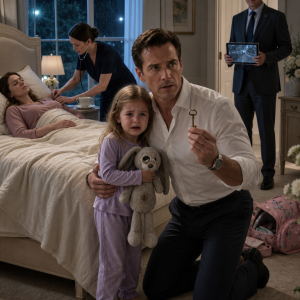
“He will say I imagined everything.”
“Then we preserve what happened before he can rewrite it.”
Julia told him about the affair, the diverted trust money, the proposed medical directive, and Harrison’s threats to portray her as incapable.
Evan photographed visible injuries only after receiving her permission. He recorded the location of the equipment stand, the unlocked wheel, the damaged wall panel, and the blood on the floor before housekeeping arrived.
Hannah returned and quietly closed the door.
“Two executives are asking the technical department to restrict access to the hallway footage,” she said.
“Has it been copied?”
Hannah removed a hospital-issued evidence drive.
“The camera system automatically saves clinical emergencies to a patient-safety archive. I exported the relevant section according to incident-report procedure before access changed.”
“Will you testify?”
“Yes.”
Julia looked at her.
“They may threaten your job.”
Hannah’s expression remained steady.
“A hospital should not require a nurse to choose between employment and describing what happened to a patient.”
At three twelve in the morning, Julia’s eldest brother arrived from Washington.
Daniel Langford was a federal civil-litigation attorney specializing in institutional fraud, whistleblower retaliation, and public-contract misconduct. He entered the room carrying a laptop, an overnight bag, and the controlled expression Evan recognized from difficult trials.
The expression disappeared when he saw Julia.
Daniel kissed her forehead.
“Tell me everything from the beginning, including anything you previously thought was too small to matter.”
She spoke for almost an hour.
Daniel did not interrupt except to clarify dates, names, and documents. When she finished, he reviewed the footage Hannah had preserved.
The video showed Harrison gripping the rail and forcefully moving the bed. The fall occurred partly outside the camera’s angle, but the audio captured Julia’s refusal, the metallic impact, the monitor alarm, and Harrison saying:
“You forced me to stop you.”
Daniel replayed that sentence.
“He converted his decision into your responsibility before you reached the floor.”
Julia closed her eyes.
“What happens now?”
“We preserve the medical records, secure the trust accounts, notify law enforcement, and prevent anyone from changing your consent documents.”
Evan glanced toward the hallway.
“The hospital administration is already protecting him.”
Daniel opened a new legal memorandum.
“Then the hospital becomes part of the investigation if it chooses his donations over accurate records.”
Part 3 – The Signature Waiting on the Discharge Form

By eight the following morning, Harrison’s crisis team had occupied an executive conference room upstairs.
His attorneys, public-relations advisers, two hospital trustees, and the director of donor relations gathered beneath a framed photograph of Harrison opening the maternal-care wing.
He described Julia’s fall as a pregnancy-related episode.
“She attempted to leave while confused,” he said. “I reached for the bed because I feared she would injure herself.”
The hospital’s chief legal officer reviewed his notes.
“Nurse Park documented that you moved the bed during an argument.”
“Then amend the note to reflect uncertainty.”
Nobody answered.
Harrison placed both hands on the table.
“Whitaker Civic Renewal has donated more than twenty million dollars to this institution. Surely someone understands the difference between an observation and a frightened employee’s interpretation.”
A junior compliance manager spoke.
“Changing a clinical record after a donor objects would create serious legal exposure.”
Harrison looked at him.
“Then call it a documentation clarification.”
Downstairs, two administrators entered Julia’s room carrying voluntary-discharge paperwork.
Daniel stood between them and the bed.
“My client is not leaving against medical advice.”
One administrator forced a professional smile.
“Mrs. Whitaker previously expressed a desire to recover at home.”
Julia stared at him.
“I never said that.”
The administrator opened the document.
A signature already appeared above Julia’s printed name.
Daniel took the form without touching the signature area.
“Who witnessed this?”
Neither administrator answered.
Julia examined the handwriting.
“That is not mine.”
The document authorized Harrison to transport her, communicate with physicians, and make temporary medical decisions if she became distressed.
Daniel sealed it inside an evidence sleeve.
“You entered a room containing a hospitalized assault complainant and presented a forged discharge form granting authority to the accused spouse. Leave before I request officers to interview you here.”
The administrators withdrew.
Within an hour, Daniel obtained an emergency protection order preventing Harrison from approaching Julia, contacting her medical team, or altering trust and marital assets.
Harrison responded by filing a petition seeking temporary medical guardianship. The filing claimed Julia suffered prenatal delusions, financial paranoia, and dangerous resistance to treatment.
The supporting opinion came from Dr. Malcolm Reed, a psychiatrist Harrison had selected for marital counseling.
Julia remembered every appointment.
Harrison remained inside the room, answered questions for her, and paid Dr. Reed through Whitaker Civic Renewal’s executive-wellness program.
Daniel’s financial researcher found more than one hundred fifty thousand dollars in consulting payments from Harrison’s companies to the psychiatrist during the previous two years.
The emergency hearing occurred that afternoon by secure video.
Harrison’s attorney described him as a worried husband trying to protect his wife and unborn child.
Daniel played the hospital footage.
Then he displayed the forged discharge form, the consulting payments, Hannah’s sworn statement, and messages in which Harrison told Paige:
Once Julia is declared unstable, the trust board will accept that I need temporary control.
Judge Melissa Grant looked toward Harrison.
“Did you direct anyone to prepare a discharge form bearing your wife’s signature?”
“No, Your Honor.”
Daniel submitted audio from the hospital’s executive-floor conference system. An employee had preserved the recording after hearing Harrison demand that staff create a voluntary discharge.
His voice was unmistakable.
“Make the decision appear to be hers. I do not care which document accomplishes it.”
The judge denied the guardianship petition, expanded the protective order, froze disputed assets, and referred the forged medical document to prosecutors.
Julia began crying after the ruling.
She had spent years being told that disagreement proved instability. Hearing a judge distinguish fear from incapacity felt almost physically relieving.
Outside the courthouse, reporters surrounded Harrison.
“Did you pay a psychiatrist to support your petition?”
“Why was your wife’s signature placed on a discharge form?”
“Are investigators reviewing the Langford Community Trust?”
Harrison pushed through the microphones.
“My wife and her brothers are destroying everything I built.”
The clip spread quickly.
Inside the hospital, Julia watched it once.
“He still believes consequences are something we are doing to him.”
Evan sat beside her.
“Control teaches people that resistance is aggression.”
Part 4 – The Mother Who Brought Fifteen Years of Records
That evening, Harrison’s estranged mother arrived at the hospital.
Margaret Whitaker was sixty-nine, with silver hair gathered neatly at her neck and a worn leather case held against her coat. Harrison had prevented Julia from seeing her for nearly five years, claiming Margaret suffered from jealousy, confusion, and an irrational obsession with family money.
Margaret stopped beside the bed.
“I should have warned you more clearly.”
Julia shook her head.
“He would have said you were unstable too.”
“He did.”
Margaret opened the case.
Harrison’s father had established the Whitaker Housing Renewal Fund to rehabilitate neglected apartment buildings for elderly residents and low-income families. After his death, Harrison became executive director and gradually removed Margaret from financial oversight.
She had preserved copies before losing access.
Bank records showed millions transferred from housing projects into private development partnerships controlled by Harrison and Gordon Price, the company’s chief financial officer. Fictitious management fees, land-option payments, and consulting contracts financed Harrison’s commercial expansion.
Paige’s company had received substantial payments.
The Beverly Hills-style image Harrison cultivated in Charlotte had been built partly from money intended to repair leaking roofs, broken elevators, and unsafe heating systems.
“Why did you wait?” Julia asked.
Margaret accepted the question.
“Because admitting the truth meant admitting that my son used kindness as camouflage. I confronted him privately when that was no longer enough.”
She played an old recording.
A younger Harrison spoke during a meeting shortly before his wedding.
“Julia avoids conflict. Once the trust interests merge with our household, she will sign whatever protects the marriage.”
Julia stared at the laptop.
“He planned to use me before we married.”