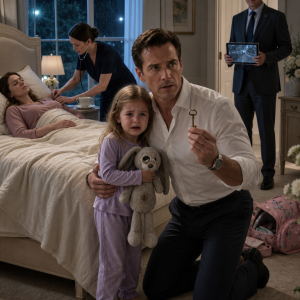
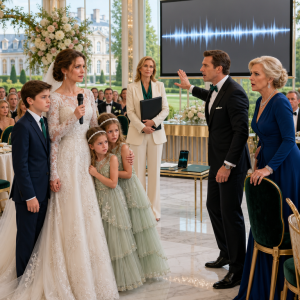
Marcus looked at him.
“The transcript describes transferring voting interests into Silver Ridge until the divorce is finalized.”
Lillian shifted backward.
“Everett told me it was temporary custodial administration.”
Catherine studied her.
“You signed the invoices, accepted company jewelry, and occupied an apartment paid for through a subsidiary.”
Everett stepped between them.
“This board should not allow a marital dispute to interfere with a legitimate corporate restructuring.”
Helen removed her glasses.
“The restructuring appears to transfer control to your affair partner through undisclosed related-party payments.”
Everett’s face tightened.
“Terms such as affair partner are inflammatory.”
Catherine lifted the altered place card.
“So are labels.”
Part 3 – The Locker Her Father Prepared

Helen requested an emergency board meeting for the following morning. Marcus ordered corporate servers secured, while Samuel collected the hotel-owned tablet and documents.
Lillian attempted to leave carrying a company laptop.
Samuel stopped her near the door.
“You may leave after returning corporate property.”
“You cannot detain me.”
“Nobody is detaining you. The computer does not belong to you.”
After most guests departed, Everett placed a thick divorce agreement before Catherine.
“You will receive a generous settlement if you stop interfering with the company.”
“Our marriage is not a transaction you alone may price.”
He leaned closer.
“You inherited wealth. I built something with it.”
Catherine almost laughed. Everett had inherited an executive title, a powerful surname, and a father who removed obstacles before he encountered them. Catherine inherited fiduciary obligations and businesses containing thousands of employees.
“Sign the settlement,” he said.
“What happens if I refuse?”
“Every private difficulty you ever experienced becomes public. The year after your father died. The panic following your miscarriage. The time you considered leaving but stayed because Sophie begged you not to disappear.”
His voice remained quiet.
“You could lose the community trust, your nonprofit boards, and Sophie’s confidence.”
Judith stood in the doorway and heard the final threat.
“Go home, Everett,” she whispered.
He turned.
“Mother—”
“Leave.”
Everett departed with the promise that everything could still end peacefully.
“Not for you,” Catherine answered.
Malcolm approached after his wife left. He smelled of bourbon and exhaustion.
He pressed a brass key into Catherine’s hand. A worn paper tag displayed the number 502.
“Your father gave me this twenty-two years ago,” he said.
“Why?”
Malcolm looked toward the corridor.
“Because he knew someone in my family might eventually attempt to take Northstar through you.”
He left before she could ask another question.
The key opened a secured archive box inside a regional bank owned by Northstar Heritage Group. Rachel accompanied Catherine the following morning.
Inside waited three document files, an encrypted drive, an old photograph, and a letter addressed to Catherine Elizabeth North.
Her father’s handwriting leaned slightly to the right.
My dearest Catherine,
If you are opening this box, affection has probably been used to make caution look like disloyalty.
The letter explained that Monroe Advanced Materials nearly collapsed during a manufacturing recession twenty-two years earlier. Northstar provided a confidential rescue facility worth two hundred million dollars because thousands of employees and retirement accounts were at risk.
The debt was secured by fifty-eight percent of Monroe’s voting shares.
The shares would transfer to Northstar if Monroe executives committed fraud, concealed related-party payments, misused Northstar assets, or attempted to control a Northstar beneficiary through divorce proceedings, coercion, or false incapacity claims.
Rachel read the section twice.
“Everett activated every condition.”
The second file contained the original rescue agreement signed by Catherine’s father, Malcolm Monroe, trustees, and banking officials.
A handwritten note was attached.
Catherine must never be forced to choose between the North name and the Monroe family. If they force that choice, they have broken the agreement.
The third file carried the name of Catherine’s late mother, Dr. Evelyn North.
Before marriage, Evelyn had been a materials scientist who developed a heat-resistant ceramic membrane used inside Monroe’s aerospace battery systems. Public histories credited Malcolm’s father with the breakthrough.
The archive showed otherwise.
Evelyn demanded patent recognition and was threatened with professional destruction. Catherine’s grandfather intervened, placing the patents into an independent trust controlled by Evelyn. Monroe received a long-term license that would terminate automatically if the company defrauded Evelyn’s heirs.
The product line generated most of Monroe’s operating profit.
Everett had not merely activated a share transfer.
He had endangered the license supporting the entire company.
The final photograph showed Catherine’s father, Malcolm, and a woman named Teresa Cross standing outside a Northstar warehouse in 2001.
Teresa was Lillian’s mother.
A letter beneath the photograph claimed that Catherine’s father had promised Lillian would never be abandoned and suggested that she might be his daughter.
Before Catherine could understand the implication, Helen called.
Lillian had filed an emergency paternity and beneficiary claim against Catherine’s father’s estate. A judge temporarily restricted extraordinary transfers connected to the Monroe rescue shares until the claim could be reviewed.
Everett had created enough delay to destroy records, influence directors, or shift additional funds.
When Catherine left the bank, reporters waited outside.
Headlines accused a wealthy heiress of concealing a half sister.
By afternoon, staged photographs from the dinner appeared online. One showed Catherine occupying the head chair while Lillian looked downward. Without context, the image supported the narrative Everett wanted.
Catherine returned home through a service entrance.
Sophie waited in the library.
“Why did you tell me not to attend?” she asked.
“I did not.”
Sophie’s face changed.
“Dad said you requested distance because I made you anxious.”
“He told me you were traveling.”
Sophie showed her messages. Everett had claimed Catherine suffered confusion and required supervision. He also sent Sophie a declaration describing episodes of aggression and paranoia.
“Did you sign it?” Catherine asked.
“No. I told him I would speak with you first.”
Relief arrived painfully.
“He told Lillian that you had already confirmed my incapacity.”
Sophie looked sick.
Before they could continue, Rachel received the filed petition.
A notarized declaration bearing Sophie’s signature had been submitted.
Sophie stared at it.
“That is not my signature.”
Security footage showed a woman wearing Sophie’s coat entering the notary office with her handbag.
A pearl dragonfly brooch was pinned to the woman’s collar.
Judith wore that brooch at every holiday dinner.
Part 4 – The Company Built on a Woman’s Patent
Judith confessed before Catherine finished asking the second question.
She sat inside the library twisting a handkerchief while Sophie stood near the windows.
“I believed I was protecting the family,” Judith said.
“You impersonated me,” Sophie answered.
“Everett promised the declaration would only pressure Catherine to accept medical support.”
“She was never ill.”
Judith lowered her head.
“I knew.”
The admission changed the room.
Corporate counsel Marcus attended with Rachel and advised Judith that she faced criminal exposure. She agreed to explain everything.
Malcolm and Everett had hidden losses for years. The profitable aerospace battery division supported several failing subsidiaries. When material costs increased, Malcolm pledged factories as collateral. Everett later refinanced the loans through private funds and secretly used employee pension assets to secure additional borrowing.
The rescue shares would expose everything.
“They said Catherine would liquidate the company,” Judith explained.
“Did they ask me?”
“No.”
“Because the story required me to be dangerous.”
Judith admitted knowing about the divorce announcement and seeing the altered place card before Catherine arrived.
“I was afraid of losing my family.”
Sophie’s eyes filled.
“Catherine was afraid too. She still walked into that room.”
Fear had become the Monroe family’s preferred excuse. Everett feared losing control. Malcolm feared losing the corporation. Judith feared losing the appearance of family. Each person offered someone else as payment.
An independent laboratory then exposed another layer of fraud.
The stored biological sample submitted as belonging to Catherine’s father did not match her paternal line. Investigators determined that the hair belonged to Malcolm Monroe.
Lillian did not match that sample either.
She was related to neither Malcolm nor Catherine’s father.