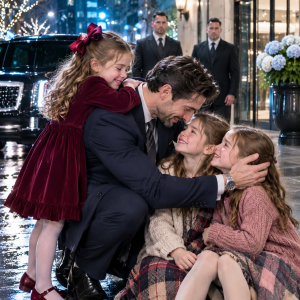
The Penny in His Coat

When the little girl placed two dollars and seventeen cents on the diner counter, Andrew Callahan was trying to remember the last time he had eaten a meal without looking at his phone.
He had come into the roadside diner outside Erie, Pennsylvania, to escape a meeting that had run late and a house that had been too quiet for too many years. The snow had started just before dusk, soft flakes drifting past the windows, and the waitress had already begun stacking the chairs in the far corner. Then the girl, bundled in a red coat and a blue scarf, stepped up to the counter and asked for two containers of chicken soup.
She looked about seven, with brown curls escaping from beneath a knitted hat and the steady, serious expression of someone who had prepared carefully for an important errand. When the waitress told her the total, the girl opened her mittened hand and counted out a small collection of coins and folded bills.
Andrew glanced at the money, then at her. “Are you here with someone?”
“I came by myself,” she said, “but I know where I live.”
That was not the reassuring answer she seemed to think it was. Andrew crouched beside her, careful not to crowd her. “Does your mom know you’re here?”
“She knows I went to get soup. She has the flu, and Mrs. Donnelly says soup and sleep are what she needs.”
“Who’s Mrs. Donnelly?”
“Our neighbor downstairs. She checks on us.” The girl glanced at his face. “Are you sad?”
Andrew was caught off guard. He had not realized how clearly his mood showed. “I guess I am.”
She nodded with the grave understanding of a person who had heard that answer before. “Then you should have soup too.”
Six years earlier, Andrew’s wife, Lydia, had been gone from his life in a way he still struggled to put into ordinary words. He had built a successful furniture company, learned how to make decisions that affected hundreds of employees, and become very good at filling his calendar. What he had not learned was how to make an empty house feel less empty. The girl’s offer, made with all the practicality of a tiny nurse writing a prescription, left him with no quick reply.
“That’s kind of you,” he managed. “But I’m not sure I can accept your whole supply.”
“It’s two quarts. We can’t finish both.”
“What’s your name?”
“Ruby. I’m seven and three quarters, which matters.”
Andrew smiled. “I’ll remember.”
She gave him her address without hesitation, including the apartment number. When he asked how she had gotten to the diner, she explained that she had taken the bus, four stops with a driver she knew. Her mother knew about the soup, she assured him, though when Andrew asked whether her mother knew about the bus, Ruby paused.
“She knows buses exist.”
Andrew felt his concern return. He asked the waitress to call Ruby’s mother, who confirmed that Ruby had left for the diner and asked that she wait there until the neighbor arrived. Andrew paid for the soup, but Ruby insisted on contributing some of her money.
“I have to give you something,” she told him.
“You can pay me back by helping someone someday.”
“That’s later.”
In the end, he let her give him one penny. Ruby looked pleased with the bargain, and Andrew slipped the coin into his coat pocket.
Mrs. Donnelly hurried through the door a few minutes later, wrapped Ruby in a relieved embrace, and gave her a gentle but unmistakable lecture about how “gone for soup” was not enough information for anyone responsible for her.
Ruby listened, then pointed to Andrew. “He bought the soup because he’s sad.”
“There was a little more conversation than that,” Andrew said.
Ruby went on, untroubled. “He also has a picture of Mommy’s secret lady.”
Mrs. Donnelly’s face changed for the briefest moment. Andrew saw it.
“You know something,” he said.
She looked at Ruby first, then back at him. “That’s for her mother to explain.”
Andrew gave her his business card and asked her to tell Ruby’s mother he would be glad to speak whenever she felt ready. He did not want to intrude, he said; he only wanted to understand why a woman he had never met kept photographs of his wife.
Mrs. Donnelly glanced at the band on his finger. Her expression softened. “I’ll tell her.”
Ruby offered him one of the containers of soup before she left. “You look like you forget to eat.”
Andrew accepted it, and Ruby reminded him not to forget their deal. He touched the penny in his pocket and promised he would not.
The Letter Lydia Left
That evening, Andrew called his sister, June, from the diner parking lot. He had not expected the name Ruby gave him—Natalie Brooks—to mean anything, but June’s silence on the phone told him otherwise.
“Where did you hear that name?” she asked.
“A little girl told me her mother has pictures of Lydia. And a ring that looks like mine.”
June asked him to come to her house. When he arrived, she led him to the kitchen and set an old envelope on the table. Andrew recognized Lydia’s handwriting before he saw the words on the front: June — if Natalie ever comes looking, please help her find Andrew.
He stared at his sister. “How long have you had this?”
“Six years. Lydia gave it to me a few weeks before she was gone. She asked me not to open it unless Natalie contacted me.”
“And you never thought I should know?”
June’s eyes filled. “Lydia said Natalie deserved to choose when the story became yours. She thought you would try to solve it before Natalie was ready.”
Andrew felt anger rise, then falter beneath the familiar ache of missing his wife. He had spent years believing he knew all the important chapters of their life together. Now a child’s remark and an envelope suggested that Lydia had kept a whole part of herself carefully folded away.
He opened the letter. Lydia wrote that Natalie’s story belonged partly to Natalie, and that there was no betrayal, no secret romance, no hidden life that altered the marriage they had shared. She had simply tried to give someone hope when that person needed it, and later, the other woman had tried to return that kindness.
At the end, Lydia had added: And Andrew, if a little girl is involved, look at her carefully before you make assumptions. Ruby has eyes exactly like yours.
Andrew read the sentence twice. He remembered Lydia once telling him that the man who raised her, Thomas, was not her biological father. She had never treated that fact as a wound or a mystery. He was her dad, she had said, because he taught her to ride a bike and stayed beside her when she was afraid.
Now Andrew wondered what else Lydia had known about the family she had grown up in.
His phone rang. An unfamiliar number appeared.
“Mr. Callahan? This is Natalie Brooks. I’m sorry Ruby showed up at the diner.”
“You don’t need to apologize. She was safe, and Mrs. Donnelly came for her.”
Natalie explained that she had been sick and that Ruby had taken her promise to get soup very seriously. Then Andrew asked the question he could no longer hold back.
“Who are you?”
A pause followed. “I think it would be better to explain in person.”
“All right. Whenever you’re feeling well enough.”
“You won’t come over without asking?”
“Not unless you invite me.”