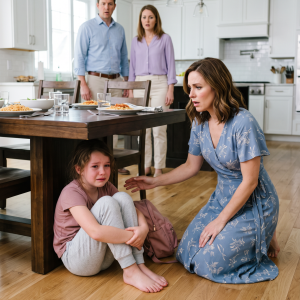
The Birthday Party That Changed Everything

Part One: The Little Girl Behind the Banquet Hall
The evening my mother celebrated her seventieth birthday, I arrived at her sprawling Connecticut estate believing that the greatest inconvenience awaiting me would be another long dinner filled with wealthy acquaintances, predictable speeches, and conversations about business investments that nobody truly cared about, but before the first course had even been served, I found my eight-year-old daughter crouched beside a garbage container behind the catering entrance, searching through discarded food with the quiet desperation of someone who had learned that asking for something as simple as dinner could bring consequences.
“Daddy, please don’t be mad,” she whispered when she recognized me. “I wasn’t taking anybody’s food. They already threw it away.”
For a moment, I could only stare at her.
My name is Daniel Whitaker, and for nearly fifteen years I had owned a successful commercial construction company based in Hartford, where I spent most of my days overseeing developments, negotiating contracts, and convincing myself that the long hours were justified because they allowed me to provide a comfortable life for the people I loved.
My daughter, Lily, was supposed to be one of those people.
Every month, without exception, I transferred twelve thousand dollars into an account designated for her care, a considerable amount that I believed covered everything from private schooling and clothing to medical appointments and the ordinary pleasures of childhood, and because my mother, Margaret, had repeatedly assured me that Lily was thriving under her supervision, I had rarely questioned where the money went.
Yet the little girl standing before me wore a faded pink jacket that I remembered buying nearly two Christmases earlier, her sneakers were splitting along the sides, and her narrow shoulders seemed far too small beneath the fabric.
I knelt beside her, trying to keep my voice steady.
“Sweetheart, why are you looking for food out here?”
She glanced toward the banquet hall before answering.
“Grandma said I already had enough at lunch, and the people inside are important, so I shouldn’t bother them.”
I reached for her hand, noticing how cold her fingers felt despite the mild September evening.
“Where’s your mom, Lily? Does she know about this?”
Her expression changed, and for the first time, she looked at me as though I were the one who had misunderstood something obvious.
“Mommy doesn’t live here anymore, Daddy. Grandma made her leave a long time ago.”
I felt the world around me grow strangely quiet.
For three years, my mother had insisted that my former wife, Caroline, was receiving Lily’s support payments and managing her daily care, although she frequently explained that Caroline preferred to avoid speaking with me because our separation had been difficult.
Whenever I asked to visit, there was always a school activity, a minor illness, or some other reason that made postponing the trip seem reasonable.
And because my work kept me traveling between construction sites across the Northeast, I accepted those explanations far more readily than I should have.
“What do you mean Grandma made her leave?” I asked.
Lily twisted the sleeve of her jacket.
“She said Mommy took something that didn’t belong to her. Mommy cried and promised she’d come back, but Grandma told me she didn’t want me anymore.”
I swallowed hard.
“And where do you sleep, honey?”
She pointed toward a small building beyond the garden.
“In the old storage room. It’s okay when it doesn’t rain, but sometimes the window leaks, so I move my blanket to the other side.”
I had spent years approving construction projects worth millions of dollars, inspecting expensive homes for clients who demanded perfection, and arguing over the smallest details of luxury properties, yet I had somehow failed to notice that my own child was sleeping in a room unsuitable for anyone.
When I lifted Lily into my arms, she held tightly to my neck, and I could feel how little she weighed.
Inside the banquet hall, crystal chandeliers illuminated beautifully arranged tables, a string quartet played near the windows, and nearly a hundred guests gathered around my mother, who wore a burgundy evening gown and a diamond necklace that had belonged to my grandmother.
She stopped smiling the moment she saw us.
“Daniel, what on earth are you doing? The guests are waiting for dinner.”
I walked toward her table, still holding Lily.
“Mom, I’ve been sending twelve thousand dollars every month for my daughter’s care. I want you to tell me where that money has been going.”
Several conversations faded around us.
My mother straightened in her chair.
“Caroline receives everything she’s entitled to, and you know perfectly well that I handle the household arrangements.”
Before I could respond, Lily leaned closer to my ear.
“Daddy, Grandma keeps Mommy’s bank card in the locked drawer in her office.”
My mother’s face tightened.
“Lily, that’s enough. You have no business repeating things you don’t understand.”
She approached us and reached for my daughter, but Lily immediately pulled away, burying her face against my shoulder.
“Please don’t let her take me, Daddy. Last time I told somebody about my room, she wouldn’t let me come inside for dinner.”
I looked at my mother, waiting for some explanation that might make the scene less painful than it appeared, but she seemed more concerned with the guests watching us than with the frightened child in my arms.
I turned and carried Lily out of the house.
For the first time in years, I left one of my mother’s gatherings without asking permission or offering an apology.
Part Two: Thirty-Six Payments and a Locked Drawer
We stopped at a small family restaurant along the highway, where Lily studied the children’s menu so carefully that I wondered whether she was struggling to choose between the meals or searching for the least expensive option.
“Can I just have some soup, Daddy?” she asked. “I don’t want you spending too much.”
I ordered chicken noodle soup, a grilled cheese sandwich, fresh fruit, and a glass of milk, and although she ate slowly, she kept looking toward the kitchen door as though someone might appear and tell her that she had taken more than she deserved.
That night, I prepared the guest bedroom in my house, found an oversized sweatshirt for her to sleep in, and sat beside her until she grew comfortable enough to close her eyes.
Just before I turned off the lamp, she reached for my hand.
“Do I have to go back tomorrow?”
“No, sweetheart. You’re staying somewhere safe.”
“Even if Grandma gets upset?”
“Even then.”
The relief on her face was so unmistakable that I had to look away.
The following morning, I took her to a pediatric clinic, where the physician explained that Lily was significantly underweight, showed signs of anemia, and needed consistent nutrition, careful follow-up, and emotional support.
I listened to every recommendation, knowing that none of them could erase the years during which I had mistaken financial responsibility for actual parenting.
While Lily rested at home with a trusted caregiver, I called my attorney, Andrew Mercer, and asked him to examine every payment I had made toward her support.
By late afternoon, Andrew had identified a pattern.
The monthly transfers had arrived in an account bearing Caroline’s name, but shortly afterward, nearly every dollar had moved into a property management company controlled by my mother.
Thirty-six payments.
Four hundred thirty-two thousand dollars.
And the available records showed no meaningful spending on Lily’s everyday needs.
“Daniel, we need to establish who had access to this account,” Andrew explained. “There’s also a larger financial problem developing, and I don’t think these transfers are isolated.”
I asked him to investigate further while I contacted Harold Benson, a longtime estate manager who had worked for our family since I was a teenager.
Harold initially refused to discuss my mother’s private affairs, but when I showed him photographs of Lily’s sleeping quarters, his hands began to tremble.
“I should have spoken up years ago,” he admitted.
He explained that my mother had accused Caroline of taking an expensive sapphire bracelet shortly after our separation, and although Caroline had denied the accusation, Margaret had ordered her removed from the estate.
When Caroline tried to take Lily with her, my mother threatened legal action and insisted that she possessed documents authorizing temporary guardianship.
Harold opened an old leather folder and handed me several copies of those documents.
One appeared to contain Caroline’s signature.
Another contained mine.
Neither looked genuine.
“Your mother told the staff that everything had been settled legally,” Harold said. “I wanted to believe her because the alternative meant admitting what was happening under this roof.”
Related Posts
My Brother And I Grew Up Believing Our Birth Mother Had Abandoned Us—Then, 20 Years Later, I Overheard My Adoptive Mom Admit She’d Been Hiding Her Letters, And One Recording Forced Me To Question The One Thing I’d Never Doubled: Who My “Twin” Brother Really Was.

When I Turned 18, My Dad Told Me I Had to Pay $275 Every Month to Keep Living at Home. I Resented Him for Five Years—Then, Eleven Days After His Funeral, His Oldest Friend Put a Cardboard Box on My Kitchen Table and Said, “Your Father Made Me Promise You Wouldn’t See This Until He Was Gone.”
My Husband Humiliated Our 8-Year-Old Daughter Over a $3 Plate of Food, Then Smiled as He Spent $149 on His “Nephew,” Declaring, “He’s the Family Heir. He Deserves Everything.” I Watched Our Little Girl Lower Her Head and Said Nothing. That Night, I Quietly Cut Off the Funding Keeping His Company Alive and Called My Attorney. By Morning, She’d Uncovered the One Secret That Could Ruin His Plans: The Shares He Was Preparing to Hand His Precious “Heir” Had Never Been His to Give—and the Real Owner Was the Little Girl He’d Just Humiliated

Three Days After Losing My Soldier Husband, I Gave Birth To His Daughter Alone. While I Was Still Weak From Surgery, My Parents Tried To Make Me Hand Over The Money He Had Left For Us—Then Dad Dumped My Bags Outside And Said, “Give Me Control Of His $400,000 Insurance Or Don’t Come Home.” I Said Nothing And Made One Call… Twenty Minutes Later, He Wasn’t Smirking Anymore.